
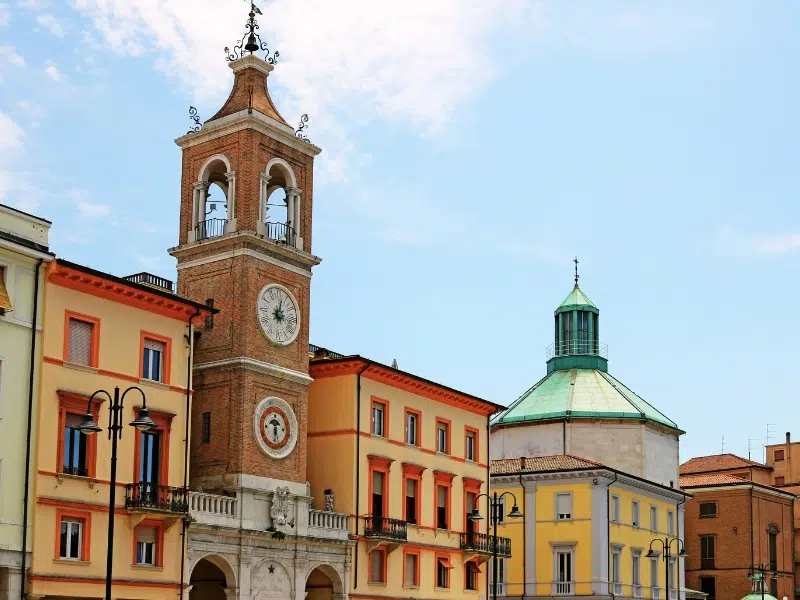
Piazza Tre Martiri is the long square in the middle of Rimini's old town, laid out over the forum of the Roman city of Ariminum. Tradition says that Julius Caesar spoke to his legions here in 49 BC, after crossing the Rubicon. Its name, the Square of the Three Martyrs, remembers three young partisans hanged here by the German occupiers on 16 August 1944.
Piazza Tre Martiri at a glance
- Where: on Corso d'Augusto, the old Roman main street, between the Arch of Augustus and the Tiberius Bridge, in the centre of Rimini's old town.
- Created: as the forum of the Roman colony of Ariminum, founded in 268 BC; renamed Piazza Tre Martiri in 1944, after the war reached Rimini. Before that it was Piazza Giulio Cesare.
- What it is today: a pedestrian square lined with cafés, with the octagonal Tempietto di Sant'Antonio, a clock tower and a memorial to the three partisans.
- Time needed: 15–20 minutes, more if you stop for a coffee.
From Caesar's forum to the square of the three martyrs
The Romans founded Ariminum in 268 BC, and the forum was its centre of public life, on the main street that still crosses the square as Corso d'Augusto. In January 49 BC Julius Caesar crossed the Rubicon, a small river north of Rimini that marked the border of Italy, and started the civil war. According to tradition, he then addressed his legionaries in the forum here and urged them to follow him to Rome. For a long time the square carried his name, Piazza Giulio Cesare.
In August 1944 the front of the Second World War ran close to Rimini, and the city was under German occupation. On 14 August three young partisans, Mario Capelli, Luigi Nicolò and Adelio Pagliarani, were arrested at the old barracks in Via Ducale near the Tiberius Bridge. After a mock trial they were hanged in the square at dawn on 16 August, and their bodies were left on display for three days as a warning. After the liberation the square was renamed in their honour, and it is still the place where Rimini remembers the Resistance.
What to look for
- The Tempietto di Sant'Antonio: the small octagonal chapel with columns and marble on the square. It was first built in 1518 and rebuilt after the earthquake of 1672.
- The church behind the Tempietto, the sanctuary dedicated to St Francis of Paola, known locally as the Paolotti.
- The clock tower: a 16th-century tower rebuilt in the 1750s by the architect Giovan Francesco Buonamici, who added a calendar dial. Its top was damaged by an earthquake in 1875 and restored in 1933.
- The memorial to the three partisans, which marks the spot where they were hanged, near the Tempietto.
- Corso d'Augusto running straight through the square: the Roman main street, with the Arch of Augustus at one end and the Tiberius Bridge at the other.
The miracle of the mule
The Tempietto stands where, according to legend, St Anthony of Padua performed one of his best-known miracles, traditionally dated to 1223. A Rimini farmer called Bonvillo refused to believe that the consecrated host was the body of Christ and proposed a test: he would starve his mule for three days and then offer it hay, while Anthony held up the host. When the day came, the hungry mule ignored the hay and knelt before the host, and the farmer was converted on the spot. The little chapel was built in the early 16th century to commemorate the story.
Tips for your visit
- Come in the early evening, when Rimini's passeggiata fills Corso d'Augusto and the café tables on the square.
- Walk the whole Roman axis: start at the Arch of Augustus, cross the square and continue along Corso d'Augusto to the Tiberius Bridge.
- The memorial is a place of remembrance. In mid-August the city holds a ceremony for the three partisans, so expect wreaths and an official gathering then.
Nearby
- Arch of Augustus: the Roman arch of 27 BC that marked the end of the Via Flaminia, a few minutes' walk along Corso d'Augusto.
- Tempio Malatestiano: Rimini's cathedral, with a Renaissance facade by Leon Battista Alberti, a few minutes' walk away.
- Piazza Cavour: the medieval civic square with the Palazzo dell'Arengo and the Pigna fountain, a short walk north along the Corso.
- Tiberius Bridge: the Roman stone bridge over the Marecchia, completed in AD 21 and still in use, at the far end of Corso d'Augusto.
See Rimini with World City Trail
Our Rimini scavenger hunt turns the old town into a game you play on your phone. The route links 10 stops and takes around 2 hours, with about 34 minutes of walking. Piazza Tre Martiri is one of the stops, along with the Arch of Augustus and the Tempio Malatestiano.
If you prefer a different format, there is also a self-guided walking tour and an outdoor escape game in Rimini.
Play the Rimini scavenger hunt →
Take the self-guided walking tour of Rimini →
Play the outdoor escape game in Rimini →
Facts checked in October 2026.