
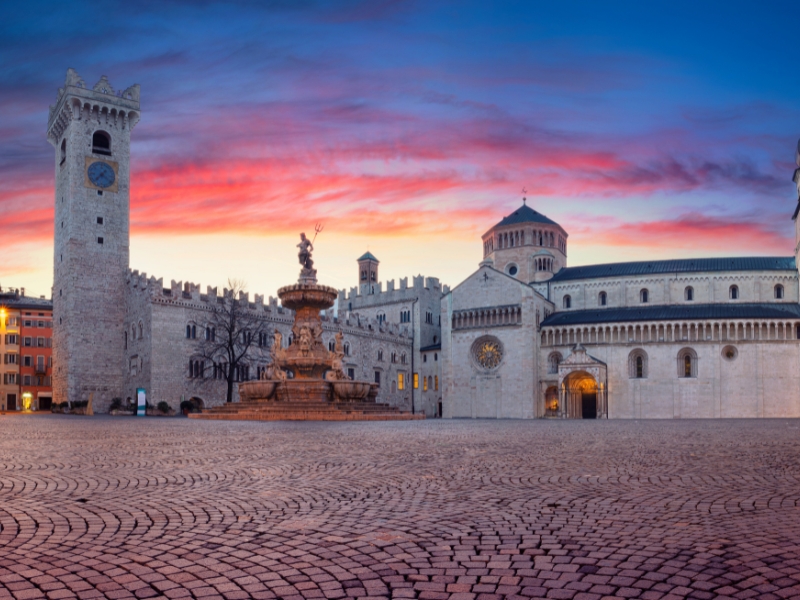
Trento Cathedral, the Cathedral of San Vigilio, is the Romanesque-Gothic church whose long north flank lines the south side of Piazza Duomo. Begun in 1212 on top of a much older basilica, it is where the Council of Trent opened on 13 December 1545, the church assembly that shaped Catholicism for the next four centuries. Inside, staircases climb along the walls, and under the floor you can walk through the remains of the first church of Trento.
Trento Cathedral at a glance
- Where: Piazza Duomo in the centre of Trento; the side facing the square is the north flank, while the main facade looks onto Via Verdi.
- Built: from 1212, when Prince-Bishop Federico Vanga had the cornerstone laid; work went on for centuries, and the bell tower's onion dome dates from the 18th century.
- By: the Comacine master Adamo d'Arogno and his workshop; the facade rose window is by Egidio da Campione.
- What it is today: the cathedral of the Archdiocese of Trento, with an archaeological area underneath.
- Time needed: 30–45 minutes, plus 20–30 minutes for the archaeological area.
From a martyr's basilica to the Council of Trent
Vigilius, bishop of Trento, was killed in 405 while preaching in the valleys, and a large basilica was raised in his honour outside the Roman town walls towards the end of the 4th or in the 5th century. In 1212 Prince-Bishop Federico Vanga decided to replace it with a new cathedral and called in Adamo d'Arogno, a master builder from the lakes of Ticino. Vanga died on crusade in 1218, which slowed the work, and the building grew slowly over the following centuries, mixing Romanesque walls with Gothic vaults.
Trento was chosen for the Council because it lay inside the Holy Roman Empire yet on the Italian side of the Alps. The Council opened in the cathedral on 13 December 1545 and, with long breaks, lasted until 1563. Its solemn sessions were held in the presbytery on a temporary structure, while other meetings also took place in the church of Santa Maria Maggiore nearby. The decrees that came out of it, on the sacraments, the Mass, the training of priests and much else, defined the Catholic Counter-Reformation.
What to look for
- The Wheel of Fortune rose window on the north flank facing the square: twelve spokes and twelve figures rising and falling around the wheel.
- The Porta del Vescovo (Bishop's Door) below it, a 16th-century porch whose columns rest on two lions, with Christ Pantocrator and the symbols of the four Evangelists in the lunette.
- Behind the church, the window of the main apse framed by knotted columns resting on griffins.
- Inside, the ramped staircases with small loggias that climb along the walls of the side aisles towards the bell towers, a rare feature in an Italian cathedral.
- The Chapel of the Crucifix on the south side, built in 1682–1687, with the wooden crucifix by Sixtus Frey of Nuremberg (around 1505) that stood in the church during the Council.
- The 18th-century baldachin over the high altar, modelled on Bernini's canopy in St Peter's in Rome, with the relics of St Vigilius in the altar.
Under the cathedral
Excavations between 1964 and 1977 uncovered the early Christian basilica of San Vigilio beneath the present floor. It was a large building, and you can walk among its walls, floors and tombs in the archaeological area, reached from inside the cathedral. It is the clearest place in Trento to see how far back the city's Christian history goes, long before the Romanesque church above was started.
Tips for your visit
- Look at the north flank from the middle of Piazza Duomo first: the rose window and the Bishop's Door are meant to be seen from the square, not from the main facade.
- Dress respectfully and avoid visiting during Mass; the archaeological area may have its own ticket and times.
- Pair the cathedral with the Diocesan Museum next door, which holds paintings of the Council's sessions and the cathedral treasury.
Nearby
- Fountain of Neptune: the Baroque fountain of 1767–1769 in the middle of the square; the Neptune on top is a bronze copy made in 1942.
- Diocesan Museum Tridentino: in the Palazzo Pretorio next to the cathedral, with images of the Council and the great processional urn of St Vigilius.
- Case Cazuffi-Rella: two houses on the square with painted Renaissance facades, across the square from the cathedral.
- Santa Maria Maggiore: the Renaissance church where many of the Council's meetings were held, a few minutes' walk west.
See Trento with World City Trail
Our Trento scavenger hunt turns the old town into a game you play on your phone. The route takes around 2 hours, with about 46 minutes of walking, and leads you through the streets and squares of the historic centre.
If you prefer a different format, there is also a self-guided walking tour and an outdoor escape game in Trento.
Play the Trento scavenger hunt →
Take the self-guided walking tour of Trento →
Play the outdoor escape game in Trento →
Facts checked in October 2026.