
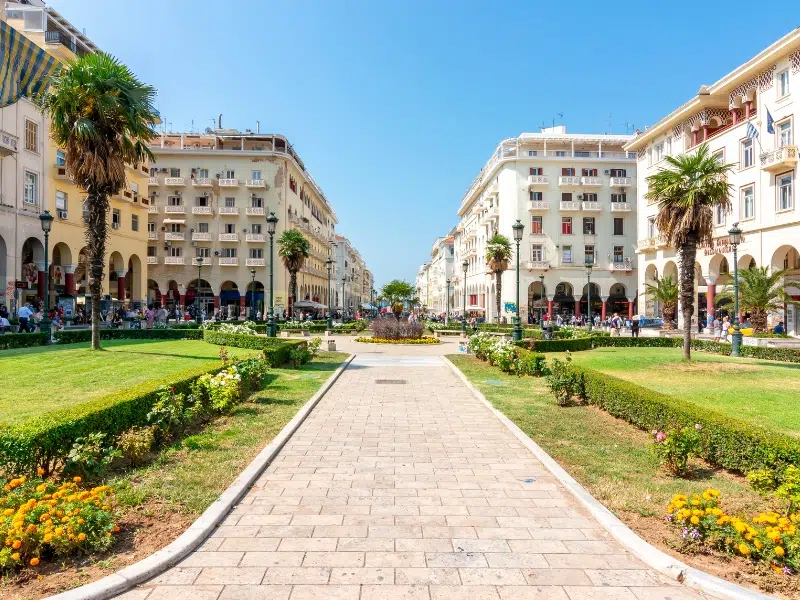
Aristotelous Square is Thessaloniki's main square, a wide space opening onto the waterfront on Nikis Avenue. It looks as if it has always been there, but it was planned only in 1918, by the French architect Ernest Hébrard, after the Great Fire of 1917 had destroyed two-thirds of the city. Most of it was built in the 1950s, and its long axis still points uphill towards the Roman Forum and the Upper Town.
Aristotelous Square at a glance
- Where: on Nikis Avenue on the seafront, at the bottom of Aristotelous Street, which runs up to Egnatia Street.
- Created: designed in 1918, built mainly in the 1950s; the northern parts were largely restored in the 2000s.
- By: Ernest Hébrard, the French architect, archaeologist and urban planner who redesigned the centre of Thessaloniki after the fire.
- What it is today: the city's main square, framed by twelve buildings listed as monuments since 1950, including the Electra Palace Hotel and the Olympion, home of the Thessaloniki International Film Festival. A redesign of the square and the Aristotelous axis went to tender in 2026, so parts may be fenced off for works in the coming years.
- Time needed: 20–30 minutes to walk the square and the arcades; longer with a coffee.
Rebuilt from the ashes of 1917
In August 1917 a fire swept through Thessaloniki and destroyed two-thirds of the city, including much of its old Ottoman and Jewish centre. The government of Eleftherios Venizelos asked Ernest Hébrard to plan a new centre. Hébrard deliberately drew on Byzantine and Western European architecture rather than Ottoman forms, to stress the city's Byzantine past. He planned the square as Alexander the Great Square, with a statue of Alexander in the middle, and a monumental axis running from the sea up to the Roman Forum, where a civic centre was meant to stand. That civic centre was never built for lack of money, but excavations on the site later uncovered the ancient Roman agora.
The square itself took decades. The façades built in the 1950s are simpler than Hébrard had drawn them, partly because money was short and the buildings were funded privately. Even so, the twelve buildings around the square were listed as monuments in 1950. Trams stopped running through the square in 1957. Since then it has been the stage for the city's big moments, from New Year celebrations and the lighting of the Christmas tree to mass rallies, such as the large demonstration on the Macedonia naming issue in 1992.
What to look for
- The arcades: Hébrard planned arched colonnades along the sides, giving shade at street level, an idea often compared to Bologna and Milan.
- The façades: matching buildings that mix Byzantine-style details with Western European proportions.
- The view uphill: from the seafront, the axis frames the Upper Town and the Byzantine walls on the hill.
- The view out to sea: across the Thermaic Gulf you can see Mount Olympus on clear days.
- The Electra Palace Hotel on one side and the Olympion cinema, centre of the film festival, on the other.
Aristotle and his foot
A bronze statue of Aristotle, after whom the square is named, stands at the side of the square; it was moved there from the centre years ago. Aristotle was born in Stagira in Chalkidiki, not far from Thessaloniki. Local students have a tradition of rubbing the philosopher's foot for wisdom and luck in their exams. Treat it as a student custom, not an ancient ritual.
Tips for your visit
- Come at sunset and walk down to the water: the square opens onto the bay and the evening light is the best of the day.
- For a photo of the whole square without crowds, come early in the morning, before the café tables fill up.
- Walk the full axis uphill from the sea to Egnatia and on to the Roman Forum to see Hébrard's plan as he intended it.
Nearby
- Roman Forum: the excavated Roman agora at the top of Hébrard's axis, a few minutes' walk uphill, with a small theatre-like odeon and underground arcades.
- Modiano Market: an early 20th-century covered market hall, just off Aristotelous Street, with food stalls and tavernas.
- Ladadika: the former warehouse district to the west, now full of restaurants and ouzeris in restored old buildings.
- White Tower: the city's symbol, a round Ottoman-era tower further east along the waterfront promenade, with a museum and a view from the top.
See Thessaloniki with World City Trail
Our Thessaloniki scavenger hunt turns the city centre into a game you play on your phone. The route links 10 stops and takes around 2 hours, with about 53 minutes of walking. It includes the Rotunda and the Church of Agios Dimitrios. You can play in English, German, French, Italian and Greek.
If you prefer a different format, there is also a self-guided walking tour and an outdoor escape game in Thessaloniki.
Play the Thessaloniki scavenger hunt →
Take the self-guided walking tour of Thessaloniki →
Play the outdoor escape game in Thessaloniki →
Facts checked in October 2026.