
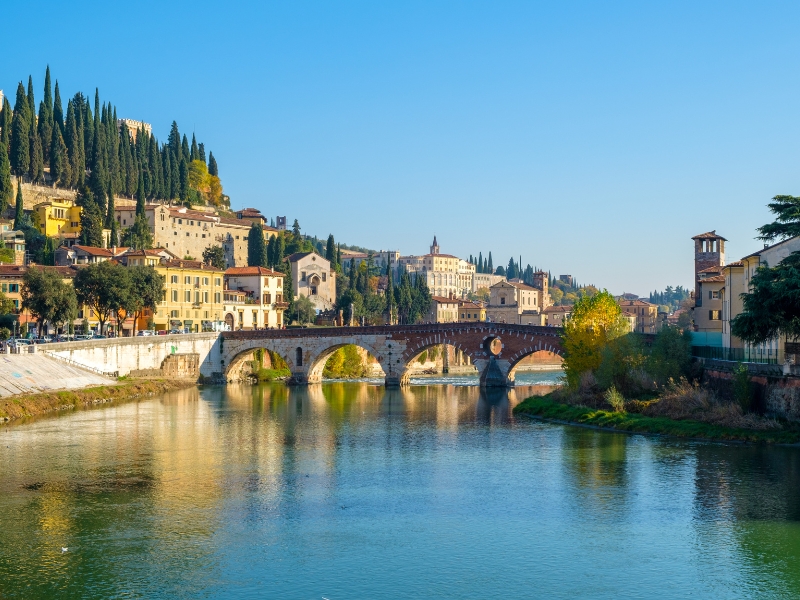
Ponte Pietra, the Stone Bridge, is the oldest bridge in Verona and the only one in the city that goes back to Roman times. It crosses the Adige at the northern tip of the old town, linking the centre with the Roman theatre and the hill of San Pietro. Blown up by retreating German troops in 1945, it was rebuilt in the 1950s using the original stones fished out of the river.
Ponte Pietra at a glance
- Where: at the northern end of the old town, between the Duomo district and the Roman theatre on the left bank of the Adige.
- Built: Roman, from the 1st century BC, on the line of the Via Postumia; rebuilt in parts in 1298, around 1520 and in 1957–1959.
- What it is today: a bridge of five arches used mainly by people on foot, about 93 metres long, mixing Roman stone, medieval brick and Renaissance work.
- By: the post-war reconstruction was led by Piero Gazzola, Verona's superintendent of monuments, with the architect Libero Cecchini.
- Time needed: 15 minutes to cross and look at both sides, longer if you climb to Castel San Pietro for the view.
Two thousand years of floods, wars and repairs
The bridge stands where the Adige could once be forded, the crossing that gave birth to Verona. A wooden bridge came first, when the Via Postumia was laid out in 148 BC; it was later replaced in stone, and the two arches on the left bank, near the theatre, are still Roman. Floods and fighting damaged the bridge again and again in the Middle Ages. In 1298 Alberto della Scala, lord of Verona, rebuilt the arch and tower on the city side, and in 1368 Cansignorio della Scala ran a water pipe across it to feed the Madonna Verona fountain in Piazza Erbe.
Houses, workshops and taverns once lined the bridge; they were cleared away in the early 19th century. The worst blow came on 24 April 1945, when German troops mined the bridge as they retreated and only the city-side arch survived. Rather than build something new, Verona decided to rebuild it as it had been. Between 1957 and 1959, 529 original stone blocks recovered from the riverbed were put back in place, and missing pieces were replaced with matching material.
What to look for
- The two Roman arches on the left bank: big, roughly dressed blocks of pale stone, the oldest part of the bridge.
- The river god: a carved head on the keystone of the second arch from the left bank, probably from a restoration in the 2nd century AD.
- The Scaliger arch and tower on the city side: red brick and stone from the 1298 rebuilding, the only part that survived the 1945 explosion.
- The two central arches with a large round opening between them, the work of the early 16th century.
- The patchwork: lighter replacement stones and darker originals side by side, a visible record of the post-war reconstruction.
A bridge put back together
The rebuilding of Ponte Pietra is one of the best-known examples of restoring a monument from its own fallen pieces. The blocks were recovered from the Adige, and the team used old drawings and photographs to work out where each one belonged. Not everything could be saved, so stand on the bank and look closely: the mix of weathered and fresh stone shows exactly where the bridge was broken.
Tips for your visit
- Come at sunset, when the low light turns the brick and stone warm and the river reflects the arches.
- The classic photo is from the riverside walk on the city side, looking across to the bridge with the hill of San Pietro behind.
- Cross the bridge and climb the steps or take the funicular to Castel San Pietro for a view over the whole old town.
- Early morning is the quietest time; by midday the bridge is busy with people heading to the theatre and the hill.
Nearby
- Roman Theatre and Archaeological Museum: the ancient theatre set into the hillside just across the bridge.
- Castel San Pietro: the hilltop terrace above the theatre with the best view of Verona's rooftops and the Adige.
- Verona Cathedral: the Duomo, with its Romanesque porch and a painting by Titian, a few minutes' walk away on the city side.
- Sant'Anastasia: Verona's great Gothic church, close to the bridge on the way back to Piazza Erbe.
See Verona with World City Trail
Our Verona scavenger hunt turns the old town into a game you play on your phone. The route links 10 stops and takes around three hours, with about 45 minutes of walking. It includes places such as the Arena, Juliet's House and Porta Borsari. You can play in English, German, French, Italian, Spanish or Dutch.
If you prefer a different format, Verona also has a self-guided walking tour and an outdoor escape game.
Play the Verona scavenger hunt →
Take the self-guided walking tour of Verona →
Play the outdoor escape game in Verona →
Facts checked in October 2026.