
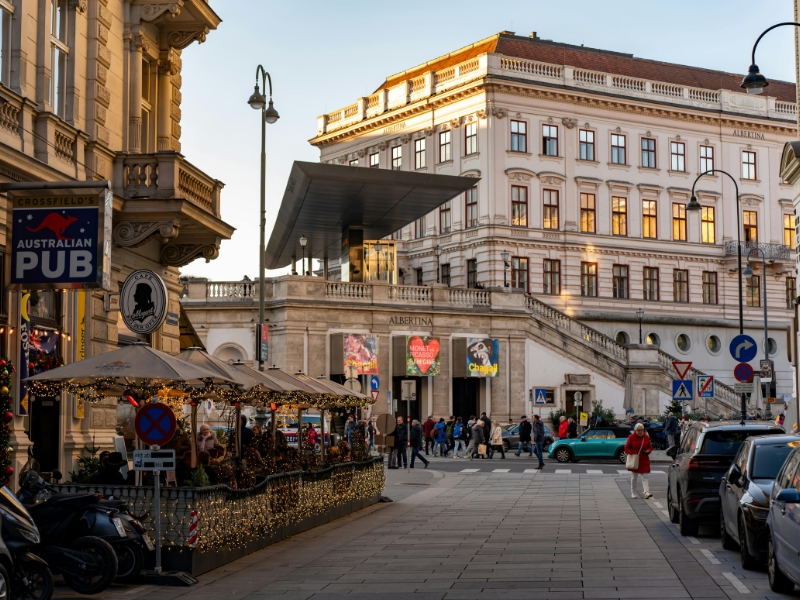
The Hofburg, the Albertina and the Museum of Natural History all grew out of the Habsburg court. The palace was the family's main residence, the Albertina was the home of an archduke's art collection, and the natural history collection began with the private purchases of Maria Theresa's husband. They stand within a few minutes of each other on the edge of the old town, and all three are stops on our Vienna scavenger hunt.
The Hofburg
The Hofburg was the winter residence of the Habsburgs from the 13th century until the end of the monarchy in 1918. Every generation added a wing, so the complex is a mix of styles, from the medieval core around the Swiss Courtyard to the curved Neue Burg on Heldenplatz, finished only in the early 20th century. Today it houses the office of the Austrian Federal President, several museums, the Austrian National Library and the Spanish Riding School.
Inside you can visit the Imperial Apartments and the Sisi Museum, devoted to Empress Elisabeth, as well as the Imperial Silver Collection. The Imperial Treasury holds the crown of the Holy Roman Empire, one of the most important objects of medieval Europe. On Sundays the Vienna Boys' Choir sings Mass in the Hofburg Chapel for much of the year.
Two of the grandest rooms belong to the baroque era. The Spanish Riding School performs its Lipizzaner horses in the white Winter Riding School, built in the 1730s to plans by Joseph Emanuel Fischer von Erlach. Next door, the State Hall of the National Library, designed by his father Johann Bernhard and finished by the son, is one of the most magnificent library halls in Europe, with frescoed ceilings and walls of leather-bound books.
- The red, black and gold Swiss Gate, dated 1552, which leads into the oldest part of the palace.
- Michaelerplatz, in front of the domed Michaeler wing, where excavations of Roman and later remains are open to view in the middle of the square.
- Heldenplatz, with the equestrian statues of Archduke Charles and Prince Eugene of Savoy.
- The balcony of the Neue Burg, from which Hitler announced the annexation of Austria in March 1938.
Albertina
The Albertina sits on one of the last surviving pieces of Vienna's old city wall, the Augustinian Bastion, at the southern tip of the Hofburg. It is named after Duke Albert of Saxe-Teschen, son-in-law of Maria Theresa, who started the collection in 1776. Today it holds over one million drawings and prints, one of the largest graphic collections in the world, along with the restored Habsburg state rooms where Albert and his successors lived.
Its most famous work is Albrecht Dürer's Young Hare, a watercolour from 1502. Works on paper are sensitive to light, so the original is shown only in special exhibitions. Alongside them, the museum shows modern art from its own collections, with paintings from Monet to Picasso, and changing exhibitions throughout the building.
The building has changed a lot over time. A bomb hit it in March 1945, and after the war much of the old decoration was stripped from the facade. A long renovation followed, and the museum reopened in 2003 with new exhibition halls, study rooms and the restored state rooms.
- The long, thin roof over the entrance ramp, designed by the architect Hans Hollein and added in 2003.
- The Albrechtsbrunnen fountain below the bastion, with the river god Danubius.
- Albertinaplatz in front, with Alfred Hrdlicka's Monument against War and Fascism.
Museum of Natural History Vienna
The Museum of Natural History opened in 1889 on the Ringstrasse, facing an almost identical twin, the Kunsthistorisches Museum, across Maria-Theresien-Platz. Both were designed by Gottfried Semper and Carl von Hasenauer. The collection goes back to the 18th century, when Francis Stephen of Lorraine, Maria Theresa's husband, bought a large private collection of minerals, fossils and shells, and it has grown into one of the largest natural history collections in the world.
The star of the museum is the Venus of Willendorf, a small limestone figure of a woman about 30,000 years old, found in the Wachau valley in 1908 and shown in her own darkened room. The building itself is part of the visit: the halls keep their 19th-century display cases, ceiling paintings and stucco.
- The meteorite hall, with one of the oldest and largest collections of meteorites anywhere.
- The dinosaur hall, with skeletons and a moving model of an Allosaurus.
- The bouquet of gemstones that Maria Theresa gave to her husband, in the mineral rooms.
- The Maria Theresa Monument in the square between the two museums, unveiled in 1888, with the empress seated high above her generals and advisers.
How to see them in one walk
Start at Maria-Theresien-Platz in front of the Museum of Natural History, then cross the Ringstrasse through the Outer Castle Gate to Heldenplatz and the Neue Burg. Walk through the palace courtyards to the Swiss Gate and out to Michaelerplatz. From there follow the edge of the Hofburg past Josefsplatz and the Augustinian Church to the Albertina. If you want a longer walk, St Stephen's Cathedral is a short stroll north along Kärntner Strasse, and the Burggarten, with the Mozart Monument, lies right behind the Albertina. Inside, each of the three can easily fill half a day, so on a short visit pick one and enjoy the others from the outside.
See Vienna with World City Trail
Our Vienna scavenger hunt turns the old town into a game you play on your phone. The route links 10 stops, from the University of Vienna to the Johann Strauss monument in the Stadtpark, and the Hofburg, the Museum of Natural History and the Albertina are all stops, along with St Stephen's Cathedral, the Anker Clock, the Mozart Monument and the State Opera. At each stop you solve a puzzle and learn a story, at your own pace.
There is also a self-guided walking tour and an outdoor escape game in Vienna, for people who prefer a different format.
Play the Vienna scavenger hunt →
Take the self-guided walking tour of Vienna →
Play the outdoor escape game in Vienna →
Facts checked in October 2026.