
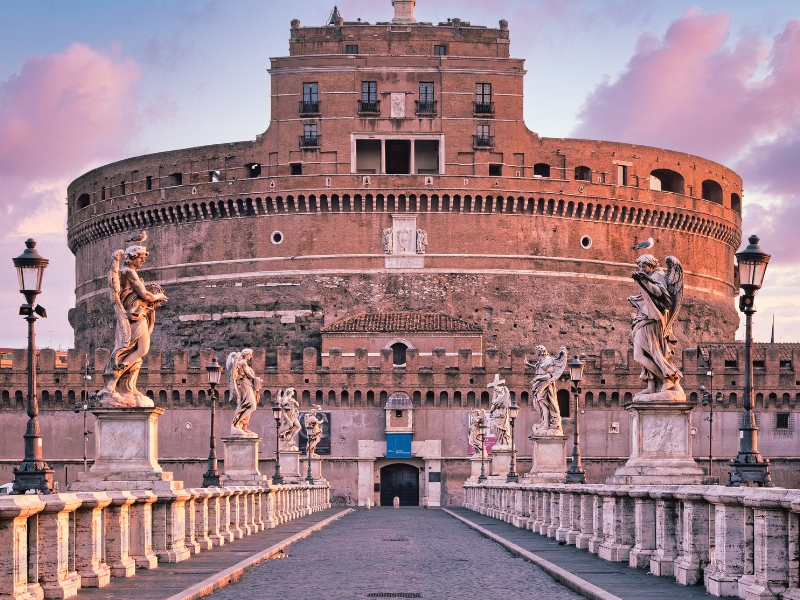
This guide follows a line across central Rome, from Castel Sant'Angelo on the Tiber to the Colosseum. On the way you pass the angel bridge, Piazza Navona, the Pantheon, Trajan's Forum and the Colosseum: six places that together show how the city reused its ancient buildings for almost two thousand years. All of them are stops on our Rome scavenger hunt, and you can link them on foot in one day.
Castel Sant'Angelo
The round fortress on the right bank of the Tiber began as a tomb. The emperor Hadrian had it built as a mausoleum for himself and his family, and it was finished in AD 139, the year after his death. In the Middle Ages the popes turned it into a castle and linked it to the Vatican by the Passetto di Borgo, a walled corridor that Pope Clement VII used to escape during the Sack of Rome in 1527.
Its name comes from a legend: in 590, during a plague, Pope Gregory the Great is said to have seen the Archangel Michael on top of the mausoleum, sheathing his sword as a sign the epidemic would end. A bronze angel has stood on the summit since 1753. Today the castle is a museum, and the last act of Puccini's opera Tosca is set on its terrace. It is the first stop of our scavenger hunt.
- The bronze Archangel Michael on the top, by the Flemish sculptor Peter Anton von Verschaffelt.
- The spiral ramp inside, part of Hadrian's original tomb.
- The covered Passetto di Borgo running along the old wall towards St Peter's.
Ponte Sant'Angelo
Hadrian also built the bridge, as a grand approach to his mausoleum, and it was opened in AD 134. Its present look dates from the 1660s, when Pope Clement IX had Gian Lorenzo Bernini design ten marble angels, each carrying an object from Christ's Passion, carved by Bernini's workshop and other sculptors. It is now a pedestrian bridge and the classic place to photograph the castle.
- The angels holding the crown of thorns and the inscription: Bernini carved these two himself, but the originals were kept indoors and are now in the church of Sant'Andrea delle Fratte; the bridge has copies.
- The statues of St Peter and St Paul at the southern end, older than the angels.
Piazza Navona
Piazza Navona keeps the long oval shape of the Stadium of Domitian, a 1st-century arena for athletic contests that once stood here. The square took its present form in the 17th century under Pope Innocent X, whose family palace is on the west side. In the middle is Bernini's Fountain of the Four Rivers, completed in 1651, with giant figures of the Nile, the Ganges, the Danube and the Río de la Plata around an ancient obelisk.
- The Nile figure with its head covered: a popular legend says it hides its eyes from Borromini's church of Sant'Agnese in Agone opposite, but the fountain was finished before the church's facade, and the veil more likely shows that the river's source was then unknown.
- The Fountain of the Moor at the southern end and the Fountain of Neptune at the northern end.
Pantheon and Piazza della Minerva
The Pantheon is the best-preserved building of ancient Rome. The inscription on the porch names Marcus Agrippa, who built the first temple here, but the building you see was put up under Hadrian in the early 2nd century AD. Its dome is still the largest unreinforced concrete dome in the world, and the only light comes through the open oculus at the top. Since 609 it has been a church, and it holds the tombs of the painter Raphael and of the first two kings of Italy.
- Raphael's tomb on the left side, with a Latin epitaph about nature fearing to be outdone by him.
- Just behind, in Piazza della Minerva, Bernini's little marble elephant carrying an Egyptian obelisk, set up in 1667 in front of the church of Santa Maria sopra Minerva.
Trajan's Forum
Trajan's Forum was the last and largest of the imperial forums, built with the spoils of the emperor Trajan's wars in Dacia (present-day Romania) and inaugurated in AD 112. The architect was Apollodorus of Damascus. Much of it now lies in ruins below street level, but Trajan's Column still stands complete. A spiral relief winds up its shaft, showing the Dacian campaigns in more than 2,500 figures.
- The statue on top: since 1587 it has been St Peter, placed there by Pope Sixtus V in place of the lost statue of Trajan.
Colosseum
The Flavian Amphitheatre was begun under the emperor Vespasian around AD 70 and opened by his son Titus in 80 with games that lasted 100 days. It held tens of thousands of spectators, who watched gladiator fights and animal hunts. The name Colosseum is later and probably comes from a colossal bronze statue of Nero that stood next to it.
After antiquity it was damaged by earthquakes and used as a quarry, which is why the outer ring survives only on the north side. Under the arena floor you can see the hypogeum, the network of passages and cages where animals and fighters waited before being lifted into the arena. It is the last stop of our scavenger hunt.
How to see them in one walk
Start at Castel Sant'Angelo and cross Ponte Sant'Angelo towards the centre. Turn into the lanes towards Piazza Navona, then continue east to the Pantheon and the elephant in Piazza della Minerva behind it. From there walk on to Piazza Venezia, where Trajan's Forum and Column are just beyond the Vittoriano monument, and follow Via dei Fori Imperiali to the Colosseum. Start early: the Pantheon and Piazza Navona get very busy by midday, and the Colosseum needs a timed ticket booked in advance.
See Rome with World City Trail
Our Rome scavenger hunt turns the historic centre into a game you play on your phone. The route links 10 stops, from Castel Sant'Angelo to the Colosseum, and every place in this guide is a stop, together with the basilica of Sant'Andrea della Valle, Piazza Venezia and the Capitoline Hill. At each stop you solve a puzzle and learn a story, at your own pace.
There is also a self-guided walking tour and an outdoor escape game in Rome, for people who prefer a different format.
Play the Rome scavenger hunt →
Take the self-guided walking tour of Rome →
Play the outdoor escape game in Rome →
Facts checked in October 2026.