What is the Vienna self-guided walking tour?
The Vienna self-guided walking tour takes in the Ringstrasse and the old town at a pace you set, with audio narration on your phone instead of a guide at the front. Allow about 3 hours: 70 minutes of that is walking, the route measures 6 km, and at 15 stops you stand still and listen. Nothing runs to a timetable and nobody sets off without you.
At the City Hall the narration measures the tower, 98 metres high or about 103 counting the armoured standard-bearer known as the Rathausmann, and counts the 1,575 rooms behind the arcades. On Hoher Markt the twelve figures of the Anker Clock parade past to music at noon. Later you hear why the Votivkirche was built, in thanks after Franz Joseph I survived a knife attack in 1853, and that the Imperial Crypt holds 145 Habsburgs in 107 metal sarcophagi.
- Durationabout 3 hours
- Walkingabout 70 min · 6 km
- Stops15
- LanguagesEnglish, German, French, Italian, Spanish, Dutch
What you do on the walking tour
Listen
At every stop the narration gives the history of the place, the legends around it and the details you would otherwise walk past. The same text is on screen for anyone who would rather read.
Walk the Ring
Google Maps points the way from one stop to the next: 70 minutes on foot and 6 km in all, at a pace you set yourself.
Break off
Sit down for a coffee or give an hour to a museum, then pick the walk up again, the same day or another one.
Eat and browse
Tips for food and shops near the route come with the stops. The opening stop and the order are yours to change in the app.
See the route and attractions →
How it works
- Book online Choose the number of people. Your booking reference arrives by email straight away.
- Get the app Download the World City Trail app from the App Store or Google Play and enter your booking reference.
- Walk when you like Start whenever you are ready, walk at your own pace and pause any time. No guide, no fixed schedule.
Who the walking tour is for
A first visit to Vienna
One walk separates the imperial city from the Ringstrasse city and explains what you are standing in front of.
Anyone who avoids groups
No raised umbrella and no roll call: you stay as long as something holds you and move on when you decide to.
A day in the city
3 hours covers the Ring and the old town, which leaves the afternoon for a museum or a long sit in a coffee house.
Good to know
- Bring a charged smartphone with mobile data; a power bank helps.
- No entry tickets needed: everything happens outside the buildings. Going inside is optional and paid separately.
- Family friendly; children must be accompanied by an adult.
- Not suitable for wheelchair users and difficult with strollers.
- Groups of up to 5 work best; larger groups split up, one ticket per person.
- Every purchase helps support stray cats and dogs in Greece.
The walk stop by stop: the City Hall, St Stephen's, the Hofburg, the Stadtpark
15 stops · about 70 min walking · start: Vienna City Hall (Rathaus) · finish: Johann Strauss Monument
The first stop is the Vienna City Hall on the Ringstrasse. The route follows the boulevard to the University of Vienna and the Votivkirche, then turns into the old town for the Clock Museum on the Schulhof and the Anker Clock on Hoher Markt. St Stephen's Cathedral and St Peter's Church lead on to the Hofburg, with the Natural History Museum across the Ring and the Mozart Monument in the Burggarten. The Vienna State Opera, the Albertina, the Imperial Crypt on the Neuer Markt and the House of Music follow one after another, and the Johann Strauss Monument in the Stadtpark ends the walk. Another opening stop or another order is set in the app, and no stop needs an entry ticket.
Open the route map ↗
1Vienna City Hall (Rathaus)Start
Friedrich von Schmidt built this neo-Gothic city hall on the Ringstrasse between 1872 and 1883, and the city council moved in two years later. Its tower reaches 98 metres, or about 103 metres counting the armoured standard-bearer by Alexander Nehr known as the Rathausmann on the tip. Behind the pointed arches and loggias are 1,575 rooms and 2,035 windows, and the Rathausplatz in front is flanked by two parks.
2University of Vienna
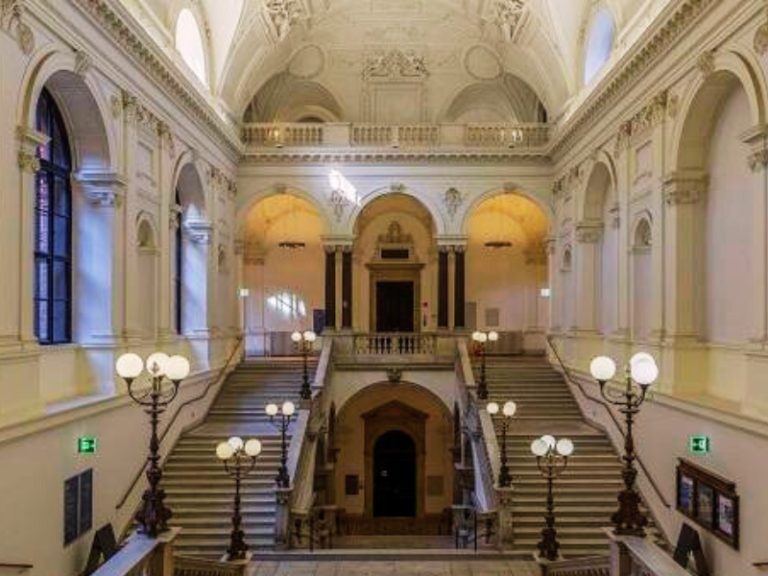
Founded by Duke Rudolf IV in 1365, the University of Vienna is the oldest university in today's German-speaking world. Its main building on the Ringstrasse was designed by Heinrich von Ferstel and opened in 1884, and its arcaded courtyard is lined with busts of famous scholars such as Sigmund Freud and Erwin Schrödinger.
3Votivkirche
This neo-Gothic church on the Ringstrasse was raised in thanks after Emperor Franz Joseph I survived a knife attack by the Hungarian nationalist Janos Libenyi on 18 February 1853. Donations collected across the empire paid for it, and Heinrich von Ferstel won the design competition in 1854. Building ran from 1856 to the consecration on 24 April 1879, the silver wedding of the emperor and Empress Elisabeth, and the twin towers reach 99 metres.
4Vienna Clock Museum (Uhrenmuseum)
The clock museum opened on 30 May 1921 in the Palais Obizzi on the Schulhof, one of the oldest houses in the old town. It grew out of the collection of the schoolteacher Rudolf Kaftan, who became its first director, with pocket watches from the estate of the writer Marie von Ebner-Eschenbach added soon after. About 700 clocks fill 19 rooms on three floors, among them the movement Joachim Oberkircher built for St Stephen's Cathedral in 1699.
5Anker Clock (Ankeruhr)
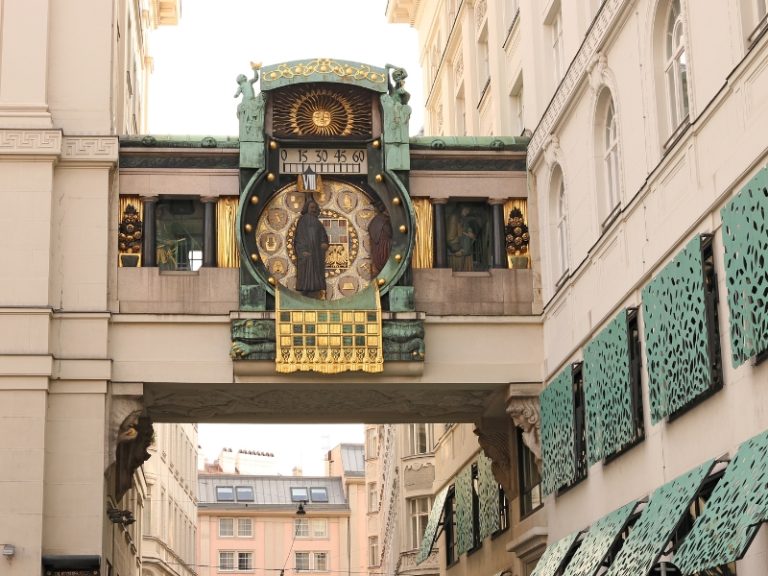
The Anker Clock on Hoher Markt is an Art Nouveau clock set on a bridge between two buildings of the Anker insurance company. The painter Franz von Matsch designed it and it was completed in 1914: twelve figures from Austrian history move slowly across its face, and at noon all of them parade to music.
Read the full story →
6St Stephen's Cathedral
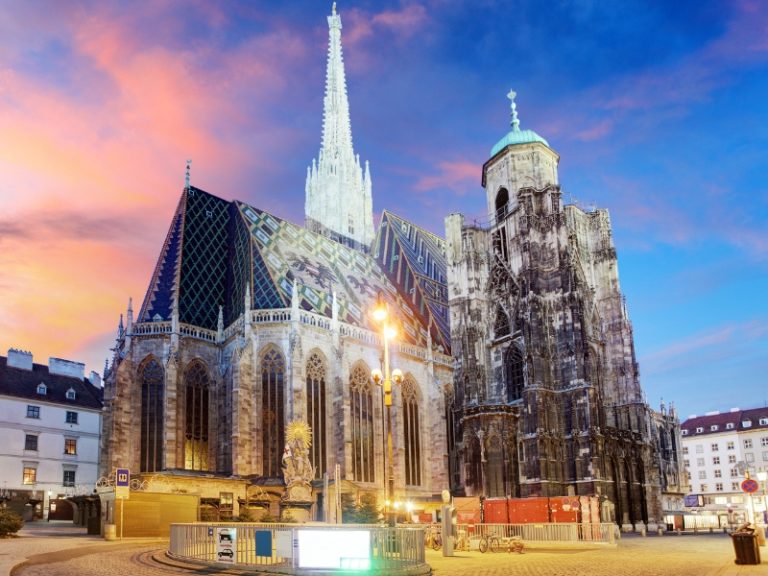
St Stephen's Cathedral has stood in the centre of Vienna since the Middle Ages, and its Gothic south tower, 136 metres high, is the tallest church tower in Austria. Look up at the steep roof: about 230,000 glazed tiles form the double-headed imperial eagle and the coats of arms of Vienna and Austria.
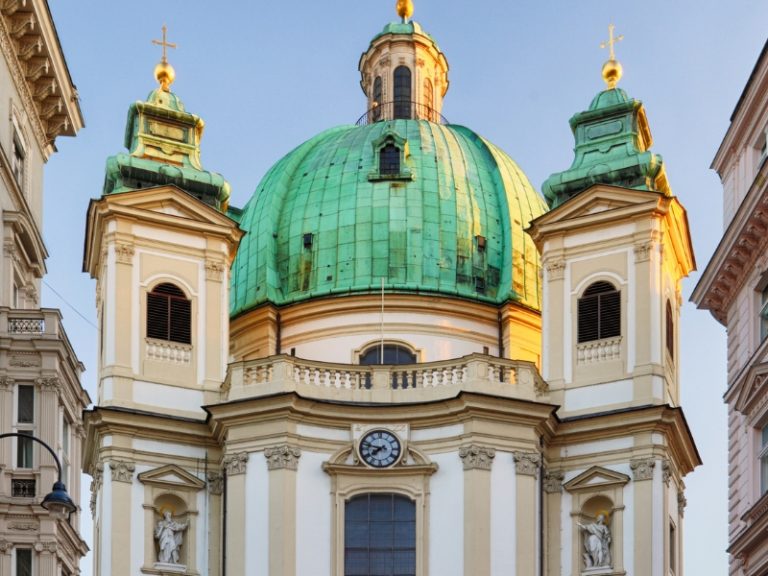
7St Peter's Church (Peterskirche)
St Peter's Church is a Baroque church modelled on St Peter's Basilica in Rome, built from about 1701 and consecrated in 1733, with Johann Lukas von Hildebrandt among its architects. Inside, Johann Michael Rottmayr painted the dome fresco of the Coronation of the Virgin, and a relief outside recalls the legend that Charlemagne founded the first church here.
Read the full story →
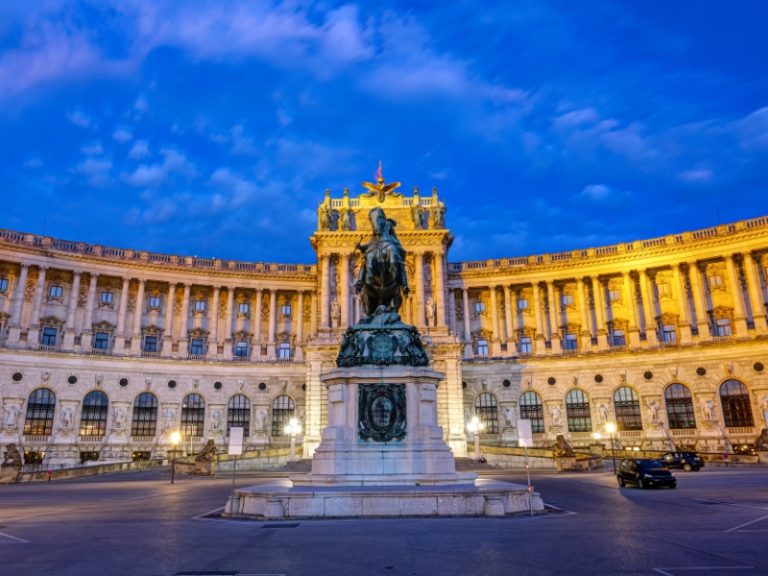
8Hofburg
The Hofburg was the main residence of the Habsburgs and the seat of the emperors of Austria until 1918. Over the centuries it grew into a vast complex of wings, courtyards and squares, including the Spanish Riding School and Heldenplatz, and since 1946 it has been the official seat of the Austrian Federal President.
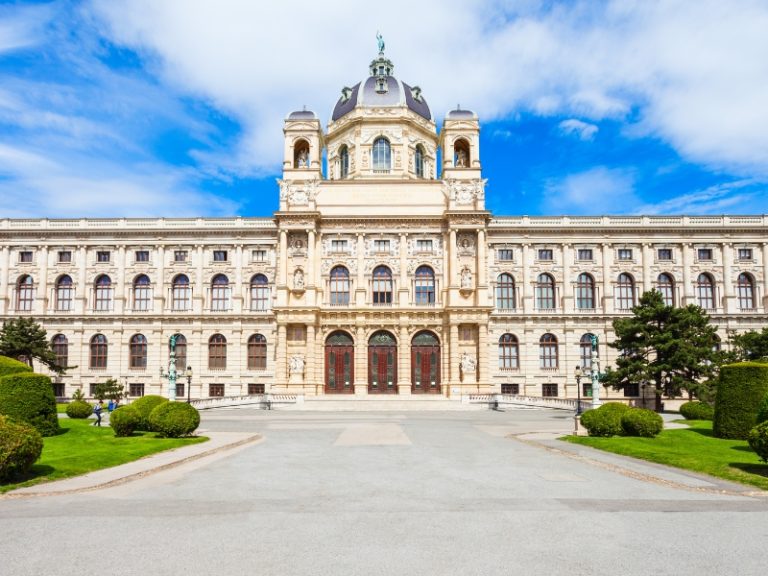
9Natural History Museum
The Natural History Museum opened in 1889 and faces its twin, the Kunsthistorisches Museum, across Maria-Theresien-Platz, both planned by Gottfried Semper and Carl von Hasenauer for the imperial collections. Its best-known treasure is the Venus of Willendorf, a small stone figure about 30,000 years old.
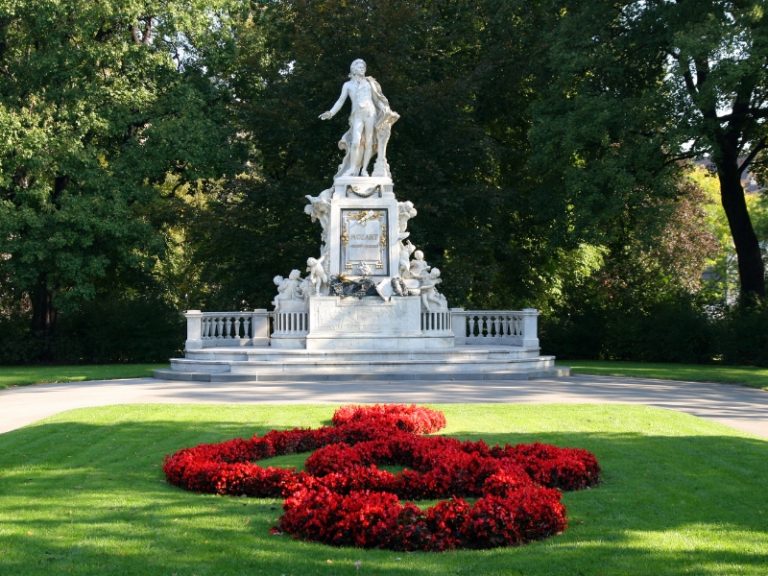
10Mozart Monument
This white marble monument to Wolfgang Amadeus Mozart was created by Viktor Tilgner and unveiled in 1896 on today's Albertinaplatz. Damaged in the bombing of 1945, it was restored and moved to the Burggarten in 1953, where you can study the reliefs on its pedestal.
Read the full story →
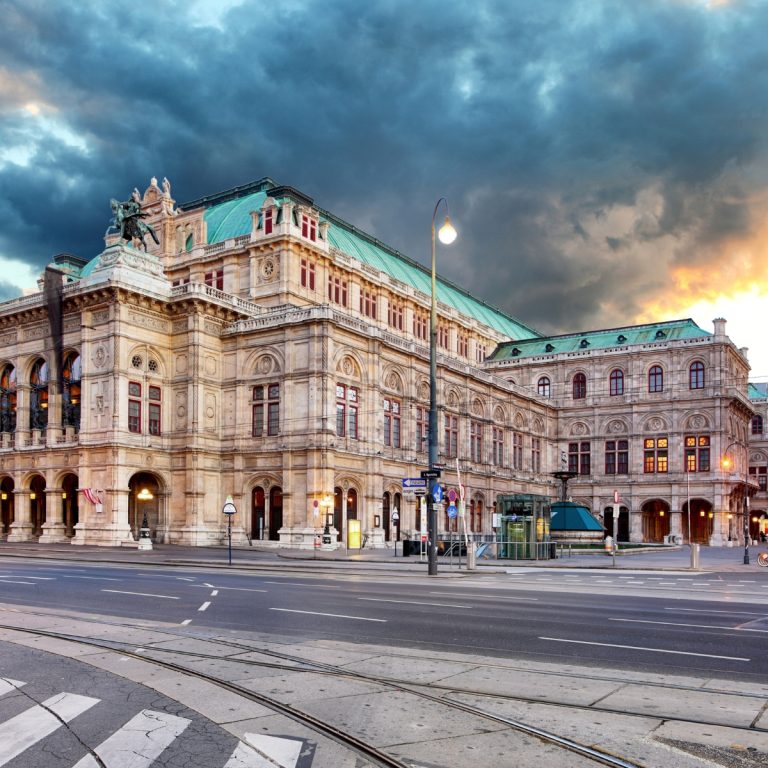
11Vienna State Opera
The Vienna State Opera opened on 25 May 1869 with Mozart's Don Giovanni. Its architects, Eduard van der Nüll and August Sicard von Sicardsburg, died before the opening after harsh public criticism of their building, and after bombs destroyed most of it in 1945 the house reopened in 1955 with Beethoven's Fidelio.
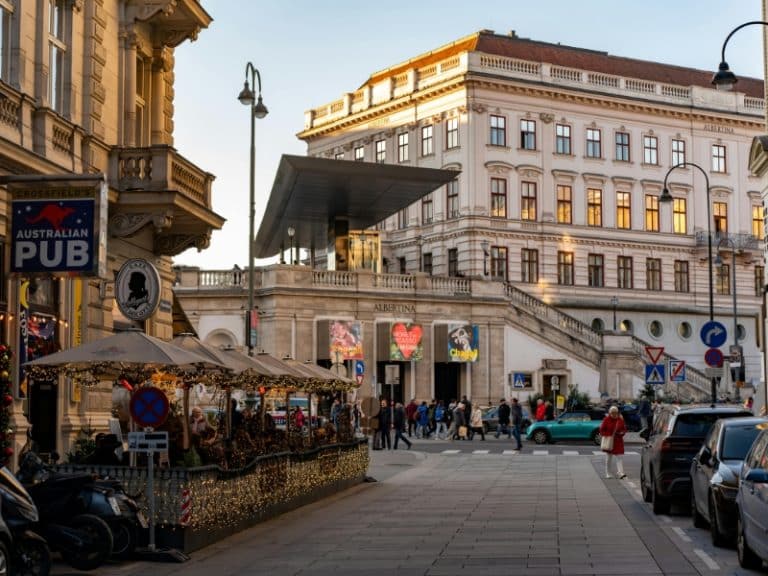
12Albertina
The Albertina is a former Habsburg palace at the southern tip of the Hofburg, standing on one of the last surviving sections of Vienna's old city walls. It is named after Duke Albert of Saxe-Teschen, son-in-law of Empress Maria Theresa, who founded its collection in 1776, and it holds Albrecht Dürer's famous Young Hare.
13Imperial Crypt (Kaisergruft)
The burial vault under the Capuchin church on the Neuer Markt was paid for under the 1617 will of Empress Anna of Tyrol, begun in 1618 and dedicated in 1632, and the Habsburgs have been laid to rest here since 1633. It holds the remains of 145 members of the family, among them 12 emperors and 18 empresses, in 107 metal sarcophagi. The largest is the double sarcophagus of Maria Theresa and Francis Stephen of Lorraine, carved by Balthasar Ferdinand Moll.
14House of Music (Haus der Musik)
The House of Music opened on 15 June 2000 in the palace of Archduke Charles at Seilerstätte 30, where Otto Nicolai lived from 1841. He conducted the first Philharmonic concert in the Hofburg on 28 March 1842 and counts as the founder of the Vienna Philharmonic. The first floor holds the orchestra's own museum, the floors above sound experiments and the Viennese classical composers, and the fourth a virtual conductor on a large screen.
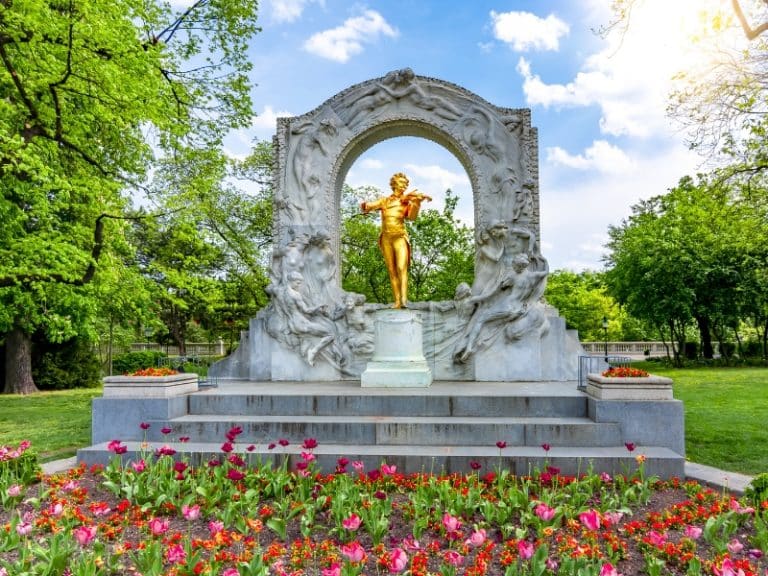
15Johann Strauss MonumentFinish
In the Stadtpark stands the gilded bronze statue of Johann Strauss the Younger, the Waltz King who composed The Blue Danube. Designed by Edmund Hellmer and unveiled in 1921, it shows Strauss playing the violin in front of a white marble arch.
Read the full story →
Only logged in customers who have purchased this product may leave a review.



Anja– Austria –
Collected on GetYourGuide
F?r den Preis war es angemessen. Hatte allerdings “versteckte Juwelen” erwartet und nicht die klassischen Sehensw?rdigkeit in bzw. um die Inneren Stadt herum. Die Informationen zu den Stationen k?nnten noch mehr in die Tiefe gehen, die Zwischengestreuten sind recht unterhaltsam. Alles in allem ein sch?ner Zeitvertreib, va f?r Leute, die noch nie in Wien waren. H?tte ohneweiteres den doppelten Preis f?r mehr Insiderwissen oder wenig bekannte Informationen gezahlt. Hat Spa? gemacht und App funktioniert wunderbar!
Big– Germany –
Collected on GetYourGuide
empfehlenswert ??
Germa– Netherlands –
Collected on GetYourGuide
Best leuk om te doen Soms een beetje onlogisch qua wandeling
Spain –
Collected on GetYourGuide
Hat Spa? gemacht und man hat wirklich sch?ne Geb?ude und Orte gesehen