
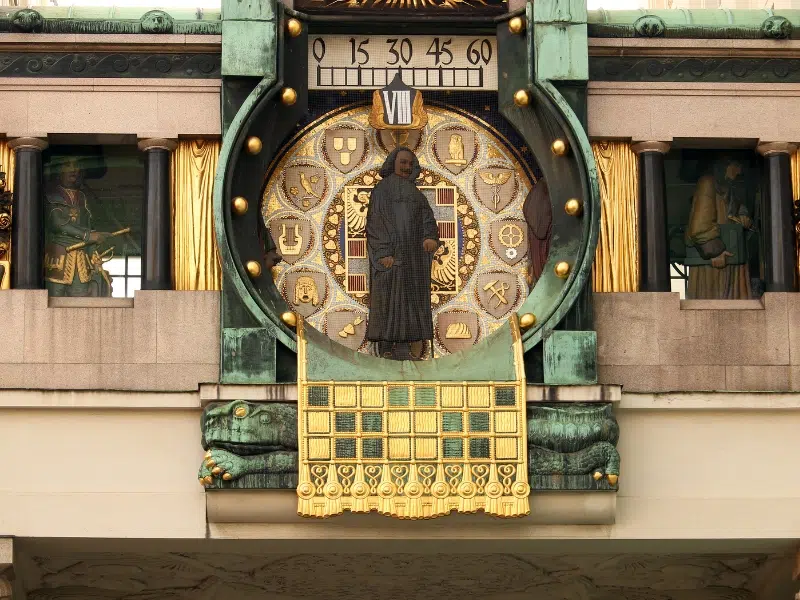
The Ankeruhr is a giant Art Nouveau clock that forms a bridge between two office buildings on Hoher Markt, Vienna's oldest square. Instead of hands, figures from Austrian history glide slowly across its face, one for each hour, and at noon all twelve of them parade past to music. It was made for the Anker insurance company, which is where its name, 'Anchor Clock', comes from.
The Ankeruhr at a glance
- Where: Hoher Markt, on the bridge over the Bauernmarkt lane, a few minutes' walk north of St Stephen's Cathedral.
- Created: planned from 1911 and finished during the First World War; the mechanism first ran in 1914 and 1915.
- By: designed by the painter Franz Matsch, with the clockwork by Franz Morawetz.
- What it is today: a protected monument, still owned by the insurance company in the building, and one of the most-watched clocks in Vienna.
- Time needed: 15 minutes for the noon parade; a minute or two at any other hour.
An insurer's clock on Vienna's oldest square
Around 1911 the Anker insurance company decided to link the two parts of its building on Hoher Markt with a bridge, and to turn that bridge into an advertisement nobody could miss. The painter Franz Matsch, who had worked with Gustav Klimt early in his career, designed a bridge about ten metres wide with a clock face four metres across, framed by gilded ornament and a mosaic background. The figures are between 2.6 and 2.8 metres tall, so they read clearly from the square below. A mechanical organ with some 800 pipes originally played the music.
The clock was badly damaged by fire in April 1945, in the last days of the war in Vienna. It was put back into service in 1956, when the organ was replaced by recorded sound, and the twelve tunes you hear today were recorded in 1978. It was fully restored in the mid-2000s under the supervision of the Austrian monuments office.
What to look for
- The parade of history: figures or couples move across the clock face one per hour, starting with the Roman emperor Marcus Aurelius and including Charlemagne, Rudolf of Habsburg, Maximilian I, Prince Eugene of Savoy and Maria Theresa with Francis I.
- The last figure: Joseph Haydn closes the sequence, accompanied by music from his oratorio The Creation.
- The time scale: watch the scale along the top edge of the clock; the moving figure points to the minutes as it travels across.
- The bracket figures: four sculpted figures support the bridge from below. Look up as you walk underneath through the Bauernmarkt.
- The mosaic and gilding: the background behind the figures is a mosaic of around 12 square metres, typical of Viennese Art Nouveau.
Who's who in the parade
Each figure comes with its own tune. Marcus Aurelius, the Roman emperor who campaigned on the Danube, is accompanied by an ancient Greek ode; Leopold VI of Babenberg appears with his wife Theodora to the Nibelungenlied; Maximilian I to 'Innsbruck, ich muss dich lassen'; Mayor Johann Andreas von Liebenberg, who led Vienna during the Turkish siege of 1683, to 'O du lieber Augustin'; Prince Eugene to the soldiers' song that bears his name; Maria Theresa and Francis I to a Mozart minuet. Together they form a quick lesson in Viennese history, set in motion every day.
Tips for your visit
- Arrive a few minutes before 12:00 to get a good spot on the square: the noon parade is the only time all the figures appear with music, and it lasts several minutes.
- Stand back towards the centre of Hoher Markt rather than directly underneath, so you can see the whole clock face.
- If you can't make noon, any hour still shows one figure on its way across.
Nearby
- Vermählungsbrunnen: the baroque Marriage Fountain in the middle of Hoher Markt, showing the wedding of Mary and Joseph.
- Römermuseum: a small museum on Hoher Markt with remains of the Roman legionary camp of Vindobona under the square.
- Ruprechtskirche: one of the oldest churches in Vienna, a few minutes' walk away above the Danube Canal.
- St Stephen's Cathedral: Vienna's great Gothic cathedral with its patterned tile roof, a short walk south.
See Vienna with World City Trail
Our Vienna scavenger hunt turns the city centre into a game you play on your phone. The route links 10 stops and takes around 3 hours, with about 64 minutes of walking, and it includes places such as the University of Vienna, St Stephen's Cathedral and the Hofburg.
If you prefer a different format, Vienna also has a self-guided walking tour and an outdoor escape game.
Play the Vienna scavenger hunt →
Take the self-guided walking tour of Vienna →
Play the outdoor escape game in Vienna →
Facts checked in October 2026.