
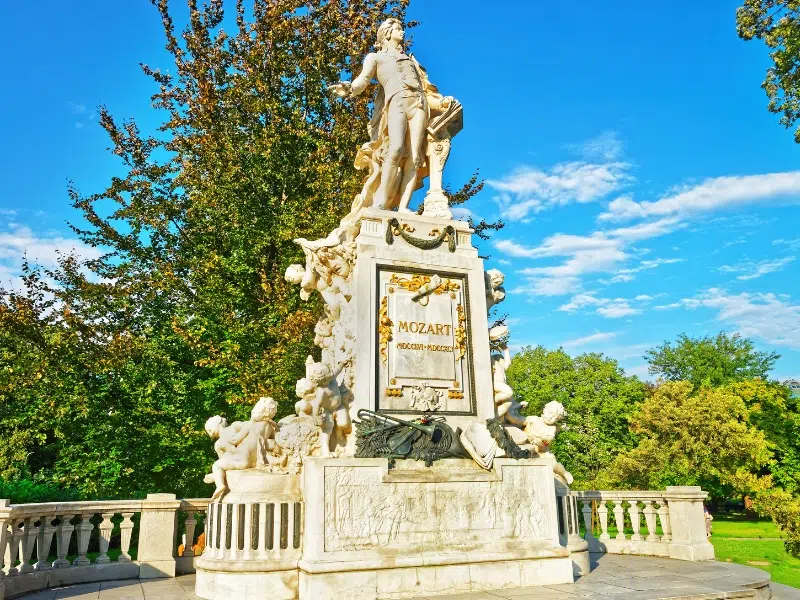
The Mozart Monument is a white marble statue of Wolfgang Amadeus Mozart in the Burggarten, the palace garden beside the Hofburg in Vienna. It was unveiled in 1896, five days after its sculptor died, and in summer it stands behind a flower bed planted in the shape of a treble clef.
The Mozart Monument at a glance
- Where: in the Burggarten, just inside the entrance from the Ringstrasse (Burgring), Vienna's 1st district.
- Created: unveiled on 21 April 1896 on what is now Albertinaplatz; moved to the Burggarten in 1953.
- By: the sculptor Viktor Tilgner, with the architect Karl König.
- What it is today: one of Vienna's best-known monuments, about 7.5 metres high, in a public park open to everyone.
- Time needed: 10 to 15 minutes, or longer if you sit in the garden.
A long road to a monument
Vienna started collecting money for a Mozart monument 77 years before this one was unveiled, but choosing a site and a design took decades. Sites such as the Rathauspark and the Stadtpark were considered, and it took two competitions to pick a design. Viktor Tilgner's proposal only came second with the expert jury, but the Mozart Monument Committee preferred it to the winning design by Edmund von Hellmer. Tilgner died on 16 April 1896; the monument was unveiled on Albrechtsplatz, today's Albertinaplatz, five days later, and his date of death was added to his signature.
On 12 March 1945 a bombing raid on Vienna damaged the monument. After restoration it was set up in its present place in the Burggarten on 5 June 1953, with two new pillars added and a new entrance to the garden created from the Ring. In 1992 the city of Vienna gave a copy of the monument to Tokyo.
What to look for
- Mozart himself, standing at a music stand, carved in white marble from Laas in South Tyrol.
- The relief on the front, showing two scenes from the opera Don Giovanni, including the appearance of the stone guest.
- The relief on the back, based on a drawing by Louis Carmontelle: Mozart aged about six making music with his father Leopold and his sister Nannerl.
- The lively putti around the base, standing for the power of Mozart's music, already close in style to Art Nouveau, and the masks and wreaths on the pedestal.
- The treble clef in the flower bed in front of the statue, planted in the growing season, and the curved balustrade framing the whole monument.
Mozart in Vienna
Mozart moved to Vienna in 1781 and spent the last ten years of his life here, writing some of his most famous operas, including The Marriage of Figaro and Don Giovanni. He died in the city in 1791 and was buried in St Marx Cemetery. The monument in the Burggarten is the city's grandest tribute to him; the only one of his Vienna homes that survives, the Mozarthaus near St Stephen's Cathedral, is now a museum.
Tips for your visit
- Come between late spring and early autumn to see the treble clef in flower; in winter the bed is bare.
- Morning light falls nicely on the front of the statue, and the garden is quieter before the lunchtime crowds.
- Walk round to the back to see the family relief, which many visitors miss.
- Combine it with the Hofburg and the Albertina, both a few minutes' walk away.
Nearby
- Palmenhaus: the large Art Nouveau glasshouse at the back of the Burggarten, with a café and the Butterfly House.
- Albertina: the art museum on Albertinaplatz, the square where the Mozart Monument first stood.
- Hofburg and Heldenplatz: the imperial palace complex right next to the garden, with the curved Neue Burg wing behind the statue.
See Vienna with World City Trail
Our Vienna scavenger hunt turns the old town into a game you play on your phone. The route links 10 stops and takes around 3 hours, with about 64 minutes of walking. It includes the University of Vienna, St Stephen's Cathedral and the Hofburg.
If you prefer a different format, Vienna also has a self-guided walking tour and an outdoor escape game.
Play the Vienna scavenger hunt →
Take the self-guided walking tour of Vienna →
Play the outdoor escape game in Vienna →
Facts checked in October 2026.