
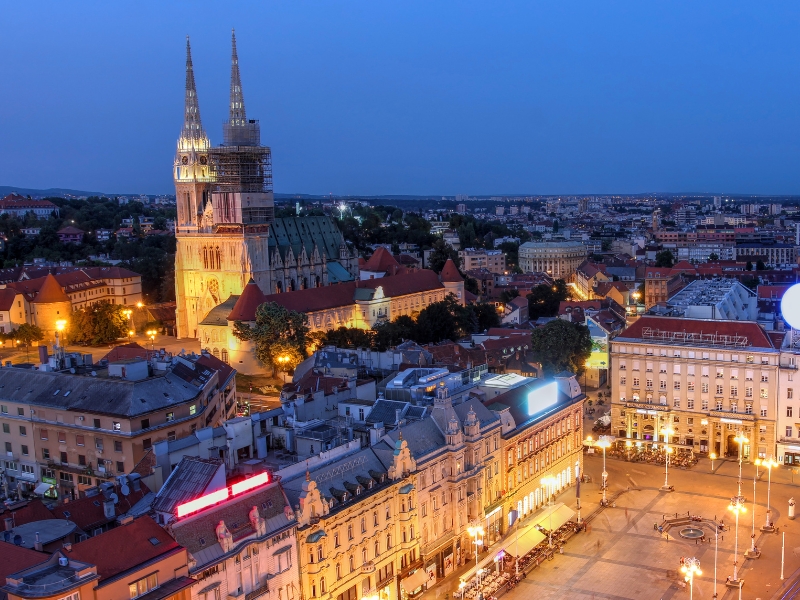
Zagreb Cathedral stands on Kaptol, the hill where the city's bishops settled in the 11th century, and its twin neo-Gothic spires have long been Zagreb's landmark. Most of what you see is the work of the architect Hermann Bollé, who rebuilt it after the earthquake of 1880; a clock stopped at 7:03, the minute that quake struck, is kept as a reminder. Another earthquake in March 2020 damaged it badly, and the restoration is still going on.
Zagreb Cathedral at a glance
- Where: Kaptol square, on the hill just north-east of Ban Jelačić Square, a few minutes' walk from Dolac Market.
- Built: first cathedral consecrated in 1217; Gothic rebuilding from the late 13th century to the early 16th; neo-Gothic restoration after the 1880 earthquake.
- By: Hermann Bollé (the neo-Gothic restoration and the twin spires).
- What it is today: the seat of the Archdiocese of Zagreb and the tallest church in Croatia. Closed for years after the 2020 earthquake, it was due to reopen at Christmas 2025, while work on the exterior continues; check before you go.
- Time needed: 20 to 40 minutes, longer if you stay for Mass.
Tatars, Ottomans and two earthquakes
King Ladislaus of Hungary founded the diocese of Zagreb in 1094, and the first real cathedral on Kaptol was consecrated in 1217. Only 25 years later, in 1242, Tatar (Mongol) raiders burned it almost to the ground. Bishop Timotej began rebuilding it in the new Gothic style, starting with the three apses at the east end, and work went on slowly until the early 16th century. After Ottoman raiders reached the Sava in 1469, the bishops ringed Kaptol and the cathedral with stone walls and round towers, and parts of them still stand.
On 9 November 1880 an earthquake badly damaged the cathedral. Hermann Bollé then led a restoration that turned it into the neo-Gothic church we know, with two slender spires over 100 metres high. On 22 March 2020 another earthquake struck: the top of the south spire broke off, and the north spire was so damaged that it had to be taken down. The cathedral closed for almost six years of structural repairs, and rebuilding the towers and facade will take years more.
What to look for
- The west front: Bollé's tall portal and the two towers dominate the square. Since 2020 they have been under repair, so expect scaffolding and cranes.
- The Marian column: in front of the cathedral, a golden statue of the Virgin Mary stands on a tall column, surrounded by four angels designed by the sculptor Anton Dominik Fernkorn.
- The stopped clock: a clock whose hands still point to 7:03, the moment the earthquake of 9 November 1880 hit Zagreb.
- The fortifications: the walls and round towers built around the cathedral against the Ottomans. Walk round the north side towards Ribnjak park to see them best.
- The tombs: inside lie Cardinal Alojzije Stepinac, beatified in 1998, and Petar Zrinski and Fran Krsto Frankopan, Croatian nobles executed in 1671 after a failed conspiracy against the Habsburgs.
- The list of bishops: in the niches of the main apse, stone tablets uncovered during Bollé's works name every bishop and archbishop of Zagreb.
Kaptol and Gradec: two rival towns
For centuries Zagreb was two separate towns on two hills: Kaptol, ruled by the bishop and the cathedral chapter, and Gradec, the royal free town of craftsmen and merchants on the hill opposite. They quarrelled over land, mills and trade, and at times fought openly. The street between them is still called Krvavi most, the Bloody Bridge, after a bridge over the stream that once divided them. The two towns were only joined into a single city of Zagreb in 1850.
Tips for your visit
- The west front faces the setting sun, so late afternoon is the best time for photos of the facade and the Marian column.
- Restoration work changes which parts are open, so check the current situation before you go. Dress modestly and keep quiet inside, as this is a working cathedral.
- For a distant view of the spires, look east from the Upper Town, for example from the top of Lotrščak Tower.
- Combine your visit with Dolac Market in the morning, when the stalls are busiest.
Nearby
- Dolac Market: Zagreb's main open-air market under red umbrellas, a few minutes' walk away; best in the morning.
- Tkalčićeva Street: a lively street of cafés and bars that follows the course of the old stream between Kaptol and Gradec.
- Ban Jelačić Square: the city's main square, with the equestrian statue of Ban Josip Jelačić, a few minutes' walk downhill.
- Stone Gate: the last surviving gate of Gradec, with a shrine to a painting of the Virgin that survived the great fire of 1731.
See Zagreb with World City Trail
Our Zagreb scavenger hunt turns the city centre into a game you play on your phone. The route links 10 stops and takes around 2 hours, with about 42 minutes of walking, and includes places such as the Botanical Garden and the Croatian National Theatre.
If you prefer a different format, there is also a self-guided walking tour and an outdoor escape game in Zagreb.
Play the Zagreb scavenger hunt →
Take the self-guided walking tour of Zagreb →
Play the outdoor escape game in Zagreb →
Facts checked in October 2026.