
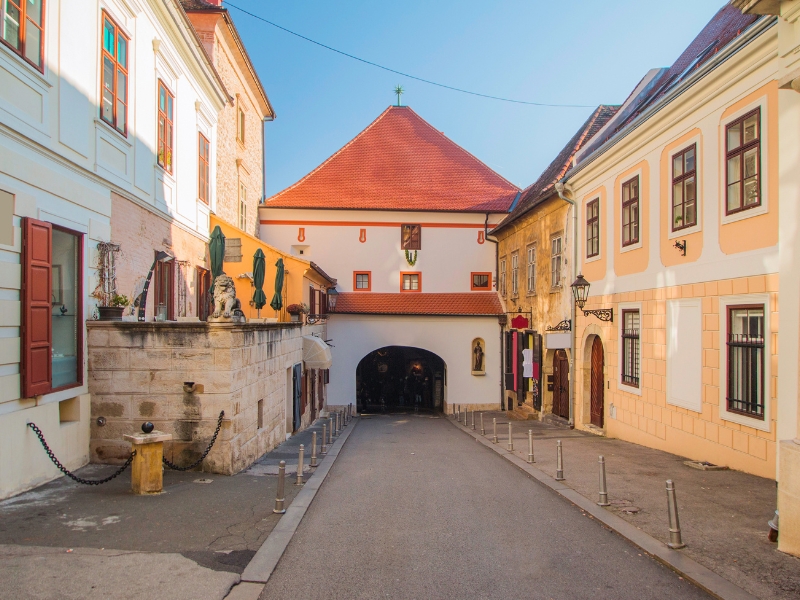
The Stone Gate (Kamenita vrata) is the only one of the medieval gates of Gradec, Zagreb's Upper Town, that still stands. Inside its dark, curving passage is a shrine with a painting of the Virgin Mary. When the great fire of 1731 swept through the Upper Town, the painting was found in the ashes with only its wooden frame burnt, and since 1991 Our Lady of the Stone Gate has been the patron saint of Zagreb.
The Stone Gate at a glance
- Where: on Kamenita ulica in the Upper Town (Gornji grad), between St Mark's Square and Radićeva street.
- Built: the walls of Gradec went up between 1242 and 1266; the gate is first recorded in 1362 and took its present form in 1760, as an inscription above the north entrance records.
- What it is today: a public passage and a working Marian shrine, with an altar, benches and candles inside the arch.
- Time needed: 10–15 minutes, longer if you sit for a quiet moment or walk on to St Mark's Square.
From city gate to city shrine
In 1242 King Béla IV issued the Golden Bull that made Gradec a free royal town, and with that privilege came the duty to build walls. They were finished by 1266, with several gates; the Stone Gate is first named in a document of 1362. It was the largest entrance to the town and the only one wagons could use, and during outbreaks of plague it was the only way in at all. Fires damaged it in 1645, 1674 and 1706, and in 1760 it was rebuilt so thoroughly that the town records called it newly built.
The turning point was the fire that broke out on 30 May 1731 in St Joseph's seminary and spread across the Upper Town. On the third day, a widow named Modlar, who lived in the flat above the gate, searched the ruins and found the painting of the Virgin and Child undamaged except for its frame. She had a small altar set up under the arch, and the gate became a place of pilgrimage. In 1778 the Zagreb craftsman Ivan Korta made the wrought-iron grille around the altar, and for the 200th anniversary in 1931 the painting received a gold crown set with jewels. In the early 20th century a citizens' society saved the gate from demolition, and on 31 May 1991 Cardinal Franjo Kuharić proclaimed Our Lady of the Stone Gate patron saint of Zagreb.
What to look for
- The painting: a small picture of the Virgin and Child, about 57 by 47 centimetres, set in the altar on the side of the passage. Its painter is not known.
- The iron grille: Ivan Korta's Rococo railing of 1778 around the altar, one of the finest pieces of 18th-century metalwork in Zagreb.
- The thank-you plaques: the walls are covered with small stone tablets, many carved with the word 'Hvala' (thank you), left by people who believe their prayers were answered.
- Dora Krupićeva: in a niche on the west side of the gate stands Ivo Kerdić's statue of Dora, the heroine of August Šenoa's novel Zlatarovo zlato (The Goldsmith's Gold), placed there in 1929.
- St George and the dragon: close to the gate, a statue of the saint over the slain dragon by A. Winder and A. Kompatscher, given to the city in 1938 and set on its present pedestal in 1994.
The goldsmith's daughter
Šenoa's novel grew out of a real 16th-century quarrel. The keeper of the gate's keys was then a goldsmith, Petar Krupić; when he opened the gate for the deputy ban Stjepan Gregorijanac, the nobleman slapped him, and a long lawsuit followed. Šenoa gave Krupić a fictional daughter, Dora, and a love story with the nobleman's son that ends in tragedy. The novel, published in 1871, made Dora one of the best-known characters in Croatian literature, and her statue is a reminder that the gate belongs to the city's stories as much as to its history.
Tips for your visit
- Come early in the morning or in the evening, when the passage is quiet and the candles glow in the dark arch. It gets busier during the day.
- This is an active place of prayer: keep your voice down, don't block people kneeling at the altar, and switch off your flash.
- If you are in Zagreb on 31 May, the City of Zagreb Day, a procession is held in honour of Our Lady of the Stone Gate.
Nearby
- St Mark's Church: the small church with the tiled roof showing the coats of arms of Zagreb and of the old Kingdom of Croatia, Dalmatia and Slavonia, a few minutes' walk up Kamenita ulica.
- Lotrščak Tower: a 13th-century defence tower on the edge of the Upper Town, where a cannon is fired every day at noon.
- Dolac Market: Zagreb's main open-air market, with its red umbrellas, just below the Upper Town next to the cathedral.
- Museum of Broken Relationships: a small, much-talked-about museum of objects left behind after break-ups, beside Lotrščak Tower.
See Zagreb with World City Trail
Our Zagreb scavenger hunt turns the old town into a game you play on your phone. The route links 10 stops and takes around 2 hours, with about 42 minutes of walking. Among the places it includes are the Botanical Garden and the Croatian National Theatre.
If you prefer a different format, there is also a self-guided walking tour and an outdoor escape game in Zagreb.
Play the Zagreb scavenger hunt →
Take the self-guided walking tour of Zagreb →
Play the outdoor escape game in Zagreb →
Facts checked in October 2026.