
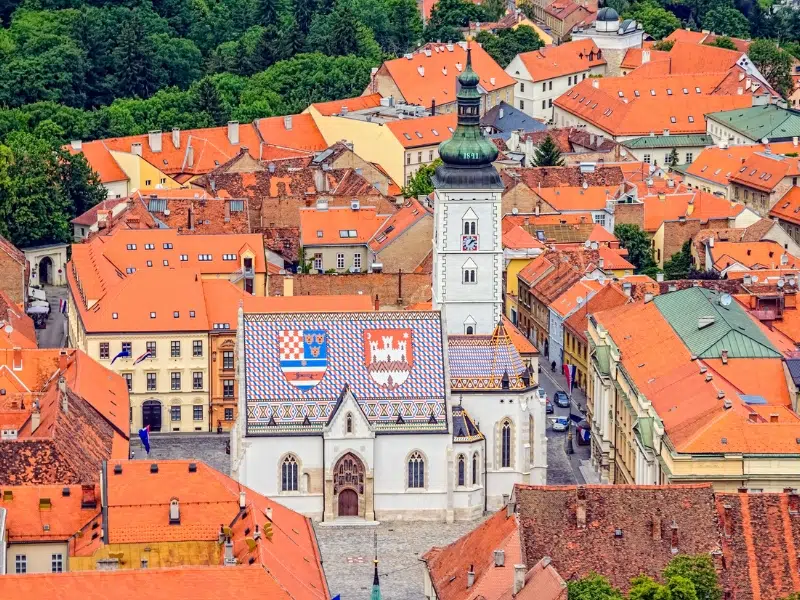
St. Mark's Church (Crkva svetog Marka) stands in the middle of St. Mark's Square in Zagreb's Upper Town, between the Croatian Parliament and the government palace. It is one of the oldest buildings in the city, but what everyone photographs is its roof: thousands of glazed tiles forming two coats of arms, one for Zagreb and one for the old Kingdom of Croatia, Slavonia and Dalmatia.
St. Mark's Church at a glance
- Where: St. Mark's Square (Markov trg) in Gornji grad, the Upper Town, a short walk up from Ban Jelačić Square through the Stone Gate or by the funicular.
- Built: begun in the 13th century; rebuilt as a late Gothic three-aisled church in the second half of the 14th century; the tiled roof dates from the restoration of 1878–1882.
- By: the south portal is attributed to sculptors of the Parler family workshop from Prague; the 19th-century restoration was led by Friedrich von Schmidt with Hermann Bollé.
- What it is today: a Catholic parish church, restored after the 2020 earthquake and reopened with a Mass on 3 December 2023.
- Time needed: 15–20 minutes outside, longer if the interior is open.
From Gothic parish church to symbol of the Upper Town
St. Mark's was the parish church of Gradec, the medieval royal free town on the hill that later merged with the bishop's Kaptol to form Zagreb. A Romanesque window on the south side shows that a church stood here by the 13th century. In the second half of the 14th century it was rebuilt as a Gothic hall church, and the richly carved south portal was added, probably at the end of that century. An earthquake brought down the original bell tower in 1502, and a clock was placed on the new belfry in 1588. By the 18th and 19th centuries the church was in such poor shape that demolition was proposed more than once; in 1860 the city chose to restore it instead.
The restoration of 1878–1882, led by the Viennese architect Friedrich von Schmidt with Hermann Bollé, gave the church its neo-Gothic look and the famous roof. In the 1920s and 1930s a second restoration removed much of the neo-Gothic interior; the sculptor Ivan Meštrović contributed works in stone and bronze, and the painter Jozo Kljaković covered the walls with frescoes. On 22 March 2020 an earthquake badly damaged the vaults and ribs, and the keystone of the south portal fell. After a full renovation the church reopened in December 2023.
What to look for
- The roof: on the left, the red, white and blue coat of arms of the Triune Kingdom of Croatia, Slavonia and Dalmatia; on the right, the arms of Zagreb, a white castle on a red field. The city's official arms today use a blue field; the roof shows the older red arms of Gradec.
- The south portal: fifteen figures in eleven niches, carved in the late 14th century. Four of the statues are wooden replacements for originals that were destroyed.
- The Romanesque window: a small round-arched window on the south wall, the oldest visible part of the church.
- The bell tower and clock: the present tower dates from after the 1502 earthquake; look for the clock face high up.
- The square around it: the Croatian Parliament (Sabor) on the east side and Banski dvori, the seat of the government, on the west, so the church sits between Croatia's two main political buildings.
A crown of red-hot iron
The square has a grim tradition. Matija Gubec, leader of the Croatian-Slovenian peasant revolt of 1573, was executed in Zagreb after the rebels were defeated, and the story told ever since is that he was crowned with a red-hot iron crown on St. Mark's Square to mock him as the 'peasant king'. Treat the details as legend. A stone base near the church was long said to be part of his 'throne', but historians have rejected that idea.
Tips for your visit
- Come early in the morning or around sunset, when the square is quieter and the low light makes the colours of the roof glow.
- For the best photo of the roof, step back to the edge of the square and use a wide angle, so you get both coats of arms and the tower in one frame.
- The church is a working parish and the interior is not always open; your best chance is around Mass times.
Nearby
- Stone Gate (Kamenita vrata): the old town gate with a shrine to a painting of Mary that, by tradition, survived a fire in 1731. People light candles there all day, a few minutes' walk away.
- Lotrščak Tower: the 13th-century tower at the top of the funicular, where a cannon is fired every day at noon, with a view over the Lower Town.
- Museum of Broken Relationships: a small museum of objects left over from ended relationships, each with its owner's story, just around the corner.
- Strossmayer Promenade (Strossmayerovo šetalište): the tree-lined walk along the old walls of the Upper Town, with views over the rooftops of the Lower Town.
See Zagreb with World City Trail
Our Zagreb scavenger hunt turns the city centre into a game you play on your phone. The route links 10 stops and takes around 2 hours, with about 42 minutes of walking. It includes places such as the Botanical Garden and the Croatian National Theatre.
If you prefer a different format, there is also a self-guided walking tour and an outdoor escape game in Zagreb.
Play the Zagreb scavenger hunt →
Take the self-guided walking tour of Zagreb →
Play the outdoor escape game in Zagreb →
Facts checked in October 2026.