
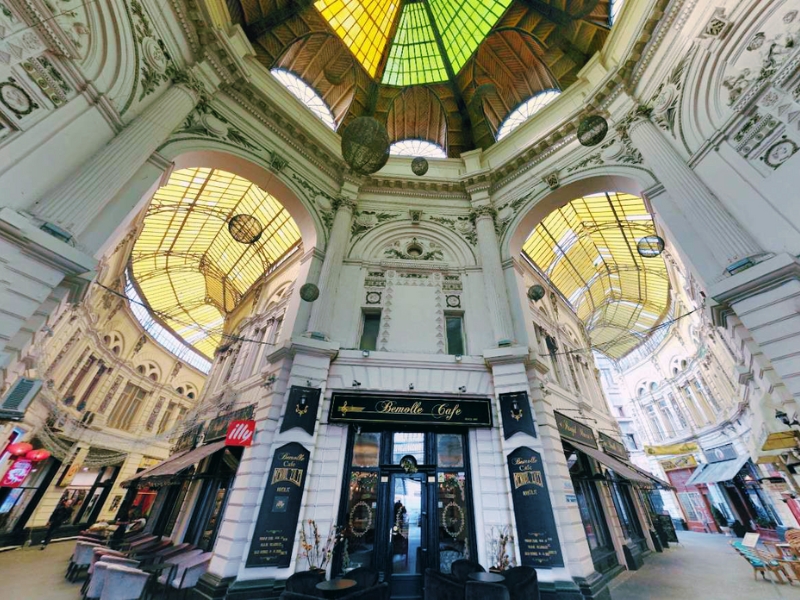
The Macca-Vilacrosse Passage is a covered shopping street in central Bucharest, roofed with yellowish glass and lined with cafés, between Calea Victoriei and the old town. It opened in 1891 and has an unusual fork shape: two arms leave Calea Victoriei and join before the far exit. The reason is simple: the owner of a hotel in the middle of the plot refused to sell, so the passage was built around it.
Macca-Vilacrosse Passage at a glance
- Where: between Calea Victoriei and Strada Eugeniu Carada, on the edge of the Lipscani old town, a short walk from the National Bank of Romania.
- Built: completed in 1891, on the site of an early 19th-century inn.
- By: the architect Felix Xenopol.
- What it is today: a listed historic monument whose ground floors are filled with cafés and restaurants, with tables set out under the glass roof.
- Time needed: 10 to 15 minutes to walk through and look up; longer if you stop for coffee.
From a city inn to a covered street
In the first half of the 19th century, the Câmpineanu Inn stood here, at the corner of Podul Mogoșoaiei, the street now called Calea Victoriei. It was bought by Petros Serafim, who divided his property among his daughters as dowries. In 1843 his daughter Polixenia married Xavier Villacrosse, a Catalan-born architect who was then the chief architect of Bucharest, and the inn took his name. Another daughter, Anastasia, married Mihalache Macca, who owned luxury shops on the neighbouring land.
Towards the end of the century the old inn was pulled down and replaced by modern buildings with glass-covered passages, on the model of the arcades of Paris and other European cities. A small hotel, the Pesht, stood in the middle of the site, and its owner would not sell, so the architect Felix Xenopol designed two branches running around it, named Macca and Villacrosse after the families. The passage was finished in 1891. Bucharest's first stock exchange met here before it got its own building, and between 1950 and 1990 the passage was known as Pasajul Bijuteria, after a jewellery shop on Calea Victoriei. The old name returned after 1989.
What to look for
- The fork: stand on Calea Victoriei and you will see two separate entrances a few metres apart. Walk in through one and out through the other to understand the shape.
- The yellow glass: the roof was glazed with yellowish glass, which gives the passage a warm, golden light even on grey days.
- The far end: at the Eugeniu Carada exit, the two arms meet in a rotunda with a stained-glass roof, beyond which stands a monumental portal.
- The upper floors: look above the café awnings for the stucco decoration on the façades. The ground floor was meant for shops, the upper rooms for rent.
- The two names: signs and maps spell the second name both Vilacrosse and Villacrosse; the architect himself is usually written with two l's.
Napoleon's interpreter and his daughters
According to Romanian sources, Petros Serafim had worked as a dragoman, an interpreter, at the French embassy in Constantinople, and in 1812 he was sent to Napoleon as an interpreter during the campaign in Russia. After Napoleon's defeat he planned to return to Constantinople, but he stopped in Bucharest, married a Romanian woman and had five daughters. Two of their dowries, the inn and the shops beside it, are why one of the city's best-known arcades carries the names of two sons-in-law.
Tips for your visit
- Come early in the morning if you want photos of the empty passage; by evening the café tables fill most of the space.
- The terraces belong to the restaurants, so walk through without blocking them, and ask before photographing people at their tables.
- Look up: the glass roof and the decorated upper floors are the most interesting part, and most visitors miss them.
- Combine it with a walk along Calea Victoriei and into the Lipscani streets of the old town, which start right behind the passage.
Nearby
- National Museum of Romanian History: in the former Postal Palace on Calea Victoriei, a few minutes' walk away, with a full-size cast of Trajan's Column.
- Stavropoleos Monastery Church: a small church of 1724 with carved stone arches and a quiet courtyard, a few minutes away in the old town.
- Cărturești Carusel: a bookshop in a restored 19th-century building on Strada Lipscani, with white spiralling balconies.
- National Bank of Romania: the grand neoclassical bank palace on Strada Lipscani, which the passage was meant to link with Calea Victoriei.
See Bucharest with World City Trail
Our Bucharest scavenger hunt turns the city centre into a game you play on your phone. The route links 10 stops and takes around 3 hours, with about 44 minutes of walking, and includes places such as the National Museum of Romanian History, Stavropoleos Monastery Church and the Cărturești Carusel bookshop. You can play in English, German, French, Italian or Romanian.
If you prefer a different format, there is also a self-guided walking tour and an outdoor escape game in Bucharest.
Play the Bucharest scavenger hunt →
Take the self-guided walking tour of Bucharest →
Play the outdoor escape game in Bucharest →
Facts checked in October 2026.