What is the Bucharest outdoor escape game?
The Bucharest outdoor escape game is an escape room moved out into the open air: the puzzles are built into the city's landmarks and you work on them from your phone, using logic and whatever you can see around you. Set aside roughly 3 hours, of which 44 minutes go on walking the 3.2 km between the 10 stops, and choose any day that fits your plans.
Puzzles are waiting at Stavropoleos Church, inside the glass-roofed Macca-Vilacrosse Passage, on Revolution Square and below the dome of the Romanian Athenaeum. Each one stands alone, with no storyline running between them, and three levels of hints are there if one refuses to crack. Bucharest fits the format because Calea Victoriei lines up most of the landmarks along a single avenue, with the old town only a few streets off it.
- Durationabout 3 hours
- Walkingabout 44 min · 3.2 km
- Stops10
- LanguagesEnglish, German, French, Italian, Romanian
What you do on the escape game
Solve
At every landmark a puzzle is waiting that you work out from the surroundings and plain logic. Nothing has to be looked up first.
Look closer
What you need is already in front of you: carvings, inscriptions, rooflines and the shape of the square itself.
Walk
Google Maps takes over between the stops, which adds up to 44 minutes on foot across roughly 3.2 km.
Take your time
Nothing counts down. Call up a hint whenever you want one, stop for a coffee on Lipscani and carry on later or another day.
See the route and attractions →
How it works
- Book online Choose the number of players. Your booking reference arrives by email straight away.
- Get the app Download the World City Trail app from the App Store or Google Play and enter your booking reference.
- Play when you like Start whenever you are ready, walk at your own pace and pause any time. No guide, no fixed schedule.
Who it suits
Friends on a day out
Everyone throws in a theory at the next landmark, and nobody needs to have read up on the city first.
Couples
One puzzle at a time keeps the conversation going along Calea Victoriei, and no clock pushes you forward.
Team building
Up to 5 people per team, each on their own phone, which makes the logistics simple for colleagues.
Good to know
- Bring a charged smartphone with mobile data; a power bank helps.
- Best started in daylight, so you can see the details the puzzles ask about.
- No entry tickets needed: everything happens outside the buildings. Going inside is optional and paid separately.
- Family friendly; children must be accompanied by an adult.
- Not suitable for wheelchair users and difficult with strollers.
- Teams of up to 5 work best; bigger groups split into several teams, one ticket per player.
- Every purchase helps support stray cats and dogs in Greece.
Puzzle route: from the History Museum to the Romanian Athenaeum
10 stops · about 44 min walking · start: National Museum of Romanian History · finish: Romanian Athenaeum
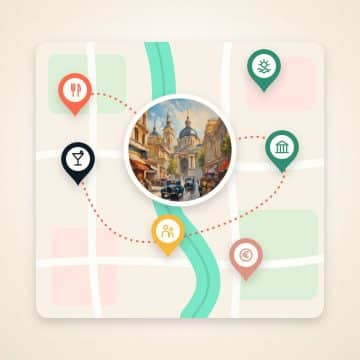
The opening puzzle is set at the National Museum of Romanian History on Calea Victoriei and the final one at the Romanian Athenaeum. Between them you work through the old town at Stavropoleos Church, the Cărturești Carusel bookshop and the Macca-Vilacrosse Passage, then University Square, the Odeon Theatre, Revolution Square, the National Museum of Art and the Royal Palace. Starting in daylight makes sense, because you solve everything outdoors and rain slows the pace. Google Maps handles the navigation, the order of the stops can be rearranged in the app, and no entry tickets come into it.
Open the route map ↗
1National Museum of Romanian HistoryStart
The museum occupies the former Postal Palace on Calea Victoriei, a neoclassical building completed in 1900 to designs by Alexandru Săvulescu. Its collections include the national treasury and a full cast of Trajan's Column, and on its steps stands a much-debated bronze of Emperor Trajan holding the Capitoline she-wolf, unveiled in 2012.
2Stavropoleos Church
This small church was built in 1724 for a monastery founded by the Greek monk Ioanichie Stratonikeas, and its name comes from the Greek Stavropolis, city of the cross. It is a fine example of the Brâncovenesc style, with a porch of carved stone columns and a painted façade, and its courtyard keeps old carved gravestones.
Read the full story →
3Cărturești Carusel
Cărturești Carusel is a bookshop at Lipscani 55 in the old town. The building came into the hands of the Chrissoveloni banking family in 1903, and after years of decay it was restored and reopened as a bookshop in 2015. Inside, white balconies and natural light from a skylight rise through six floors linked by curved staircases.
Read the full story →
4Macca-Vilacrosse Passage
This covered passage was built in 1891 and links Calea Victoriei with the streets of the old town through two curving arms under a roof of yellow glass. It is named after its former owners, the Macca family and the architect Xavier Villacrosse, and its arcades recall the Parisian passages that inspired them.
Read the full story →
5University Square
University Square takes its name from the University of Bucharest, whose main building was raised in the 1850s and 1860s to designs by Alexandru Orăscu. Nearby stand statues of Michael the Brave and three figures of Romanian culture and education, and the square was a key site of the 1989 revolution and of the protests of 1990.
Read the full story →
6Odeon Theatre
The Odeon Theatre stands on Calea Victoriei, laid out in the 1690s as Podul Mogoșoaiei and renamed after Romania's War of Independence of 1877–1878. Its building with a classical façade dates from the early 20th century, and the company is one of the city's best-known drama theatres.
7Revolution Square
In this square Nicolae Ceaușescu gave his last speech from the balcony of the former Communist Party Central Committee building on 21 December 1989, and the next day he fled by helicopter from its roof. In the middle rises the Memorial of Rebirth, unveiled in 2005, and the square is framed by the Royal Palace and the Athenaeum.
Read the full story →
8National Museum of Art of Romania
The National Museum of Art of Romania has filled the former Royal Palace since the years after the Second World War. It shows Romanian art from medieval icons to modern painting, including works by Nicolae Grigorescu and early sculptures by Constantin Brâncuși, as well as a gallery of European art.
9Royal Palace
The present Royal Palace was built between 1927 and 1937 to designs by Nicolae Nenciulescu, after a fire in 1926 damaged the older palace on this site. It was the residence of Romania's kings until the monarchy ended in 1947, and parts of it were damaged in the fighting of December 1989.
Read the full story →
10Romanian AthenaeumFinish
The Romanian Athenaeum, a domed concert hall designed by the French architect Albert Galleron, opened in 1888. Much of the money came from a public appeal that asked people to give one leu each, and today it is the home of the George Enescu Philharmonic.
Read the full story →
Only logged in customers who have purchased this product may leave a review.






Anonymous (verified owner) –
fun!