
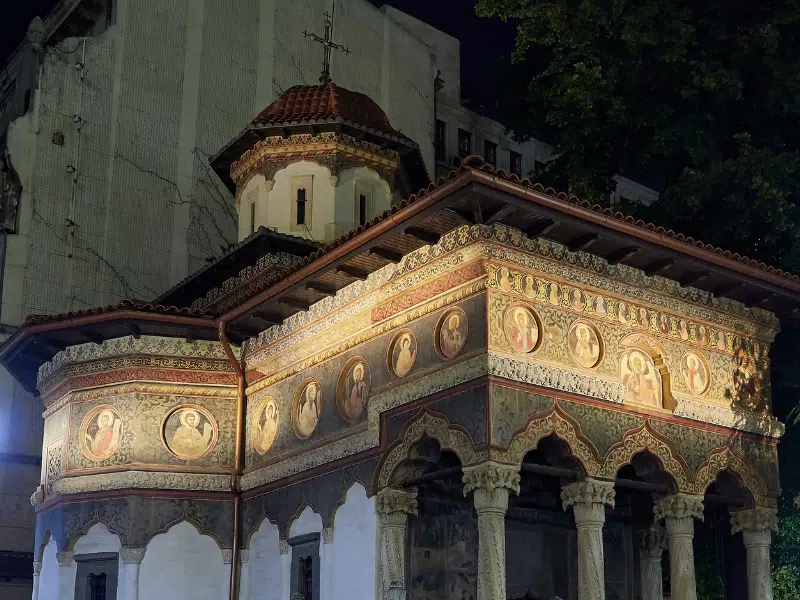
Stavropoleos is a small Orthodox monastery church on a side street of Bucharest's Old Town, just off Calea Victoriei. A Greek monk finished it in 1724 and paid for it with the income of an inn he built around it. The inn is long gone, but the church, with its carved stone porch and painted façade, is one of the finest examples of the Brâncovenesc style in the city.
Stavropoleos Monastery at a glance
- Where: Strada Stavropoleos 4, in the Old Town, a minute's walk from Calea Victoriei and the National History Museum of Romania.
- Built: the church was completed on 30 October 1724, during the reign of Prince Nicholas Mavrocordatos of Wallachia.
- By: founded by the Greek archimandrite Ioanichie Stratonikeas; restored from the late 1890s under the architect Ion Mincu.
- What it is today: a working Orthodox monastery for nuns, dedicated to the Archangels Michael and Gabriel, known for its Byzantine choir and its library.
- Time needed: 20–30 minutes for the church and the courtyard.
From a monk's inn to a city monastery
Ioanichie, a Greek monk from Pogoniani in Epirus, bought land here in 1722 and built an inn, whose rents were meant to support a small monastery. A stone inscription in Greek and Romanian records that the church was complete on 30 October 1724. In 1726 Ioanichie was made Metropolitan of Stavropolis, an old bishopric in Caria in Asia Minor, and the monastery took its name from that see: Stavropoleos is the Greek genitive of Stavropolis, 'the city of the cross'. He died on 7 February 1742, aged 61, and was buried in his church.
The 19th century was hard on the building. The earthquake of 1802 forced urgent repairs, and after the earthquake of 1838 the tower over the nave was judged unsafe and taken down in 1841. By 1888 the church was described as almost in ruins, and the inn and the monastery's outbuildings were demolished at the end of the century. The architect Ion Mincu was put in charge of saving it in 1897; consolidation began in 1904, and the tower, the roof and the carved stone band around the walls were rebuilt. Mincu also designed the new building beside the church, with its arcaded courtyard.
What to look for
- The porch: an open portico of slim stone columns and arches, with carved foliage on the columns, the arches and the door frame, typical of the Brâncovenesc style.
- The painted façade: colourful floral patterns and painted panels in the upper part of the walls, under the overhanging roof.
- The tower: the slender tower over the nave is Mincu's reconstruction of the one removed in 1841.
- The courtyard: Mincu's arcaded gallery, where old carved stone crosses and gravestones line the walls.
- Inside: the carved and gilded iconostasis and painted walls in a church so small that you take it in at a glance. The founder, Ioanichie, lies buried here.
Byzantine chant and a library of old music
Stavropoleos is better known among Romanians for its music than for its stones. The Stavropoleos Byzantine Choir, founded in 1994, sings neo-Byzantine chant at the services and has performed in Romania and abroad. The monastery's library holds more than 8,000 books, including over 80 manuscripts and some 400 old printed works in Romanian, Greek and Church Slavonic, and its collection of Byzantine music is the largest in Romania. The community also restores old books, icons and vestments, and keeps fragments of wall paintings rescued from churches demolished under communism.
Tips for your visit
- Come in the morning on a weekday, when the Old Town is still quiet and you may have the courtyard almost to yourself.
- This is a working monastery: cover shoulders and knees, speak quietly, and ask before taking photos inside the church.
- If you can, step in during a service to hear the chant; keep to the back and do not walk around while it is going on.
- Look at the church from the corner of the street and from the courtyard: the porch and the painted façade are best seen from a few steps back.
Nearby
- National History Museum of Romania: the large museum in the former Post Palace on Calea Victoriei, right around the corner; the building is due for a major restoration, so check what is open.
- CEC Palace: the domed savings-bank palace of 1900 facing the museum across Calea Victoriei, one of Bucharest's grandest façades.
- Cărturești Carusel: the white, multi-storey bookshop in a restored 19th-century building on Strada Lipscani, a few minutes' walk away.
- Old Princely Court (Curtea Veche): the ruins of the palace of the princes of Wallachia, at the other end of the Old Town, with the city's oldest surviving church beside it.
See Bucharest with World City Trail
Our Bucharest scavenger hunt turns the old town into a game you play on your phone. The route links 10 stops and takes around 3 hours, with about 44 minutes of walking. Stavropoleos Monastery Church is one of the stops, along with the National Museum of Romanian History and the Cărturești Carusel bookshop. You can play in English, German, French, Italian and Romanian.
If you prefer a different format, there is also a self-guided walking tour and an outdoor escape game in Bucharest.
Play the Bucharest scavenger hunt →
Take the self-guided walking tour of Bucharest →
Play the outdoor escape game in Bucharest →
Facts checked in October 2026.