
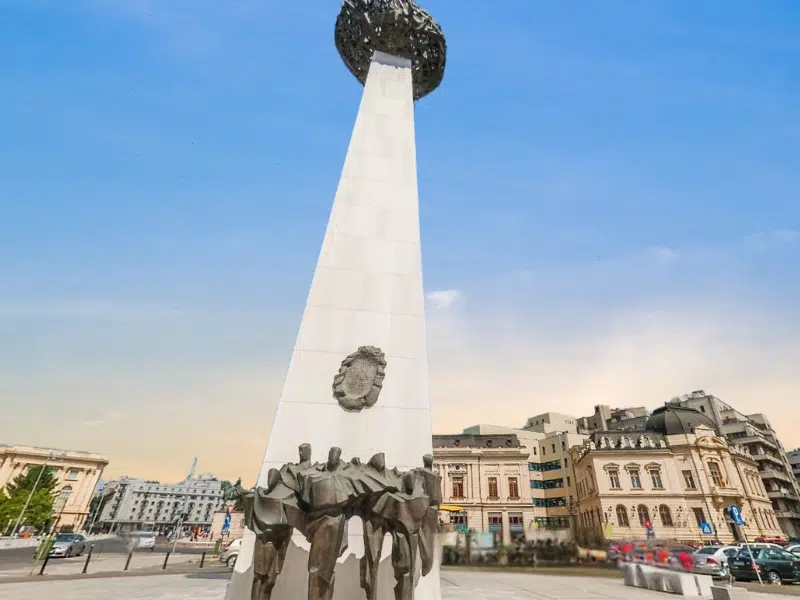
Revolution Square (Piața Revoluției) is the wide square on Calea Victoriei in central Bucharest where Nicolae Ceaușescu's rule collapsed in December 1989. From a balcony of the Communist Party's Central Committee building he gave his last speech on 21 December, and the next day he fled by helicopter from its roof. Around the square stand the former Royal Palace, now the National Museum of Art, the Central University Library and the Romanian Athenaeum.
Revolution Square at a glance
- Where: on Calea Victoriei, Bucharest's grand old avenue, a short walk north of the Old Town.
- Created: the square in front of the royal palace took shape in the 19th century; it was called Palace Square (Piața Palatului) until the revolution of 1989.
- What it is today: the city's main memorial site for the 1989 revolution, framed by a museum, a library, a concert hall, an 18th-century church and the former Central Committee building, now the Ministry of Internal Affairs.
- Time needed: 30–45 minutes for the square and its memorials; add a few hours if you visit the art museum.
From Palace Square to Revolution Square
The square grew up around the royal palace, which began as a boyar's mansion built in 1812–1815 and became the residence of Romania's princes and kings. After a fire in 1926 it was rebuilt in the 1930s to designs by Nicolae Nenciulescu. Opposite, the French architect Paul Gottereau built the Carol I University Foundation library in 1891–1893, and in front of it an equestrian statue of King Carol I by Ivan Meštrović was unveiled in 1939. When the communists took power and the king was forced to abdicate at the end of 1947, the statue was pulled down and destroyed, and the palace became the National Museum of Art in 1950.
On 21 December 1989 Ceaușescu called a mass rally here to condemn the uprising in Timișoara. Minutes into his speech, booing and whistles broke out in the crowd, and state television cut the live broadcast. The next day, as protesters forced their way into the Central Committee building, he and his wife Elena escaped by helicopter from the roof; they were captured and executed on 25 December. Fighting around the square in the following days set the library on fire, destroying more than 500,000 books and 3,700 manuscripts, and badly damaged the palace. The library reopened in 2001.
What to look for
- The balcony: on the front of the former Central Committee building, where Ceaușescu spoke for the last time. The helicopter took off from the roof of the same building.
- The Memorial of Rebirth: a 25-metre white marble spike piercing a dark metal crown, inaugurated in 2005 and designed by Alexandru Ghilduș. Its shape has earned it nicknames such as 'the potato on a stick' and 'the olive on a toothpick'.
- The smaller memorials: bronze figures, walls listing the names of people killed in December 1989 and a low marble pyramid to 'our glorious martyrs'.
- King Carol I on horseback: a new equestrian statue by Florin Codre, unveiled in 2010 in front of the library, on the spot where Meštrović's statue once stood.
- Kretzulescu Church: the small red-brick church of 1720–1722 at the south end of the square, built in the Brâncovenesc style by the boyar Iordache Crețulescu and his wife Safta, a daughter of Prince Constantin Brâncoveanu.
- Traces of 1989: look closely at some of the surrounding façades, where bullet marks from the fighting can still be seen.
The speech that went wrong
The rally of 21 December was meant to show the nation that Ceaușescu still had the support of the people. Workers had been brought in from factories, with banners and portraits. When the noise started at the back of the crowd, he stopped, raised his hand and looked bewildered, a moment millions of Romanians saw on live television before the picture went off. He tried to win back the square by promising higher wages and pensions, but within a day his regime had collapsed.
Tips for your visit
- Calea Victoriei runs straight through the square and carries a lot of traffic, so use the marked crossings to move between the palace side and the memorial side.
- Stand by the Memorial of Rebirth and look across at the balcony: it is the best spot to picture the crowd of 1989.
- Around 21–22 December each year people bring flowers and candles to the memorials. Visit quietly, especially near the names of the dead.
Nearby
- Romanian Athenaeum: the domed concert hall of 1888, home of the George Enescu Philharmonic, on the north-east side of the square.
- National Museum of Art of Romania: in the former Royal Palace, with Romanian and European art from medieval icons to the 20th century.
- Calea Victoriei: walk south along the avenue, laid out at the end of the 17th century, past palaces, banks and cafés towards the Old Town.
- Cărturești Carusel: the white, many-levelled bookshop in a restored 19th-century building on Lipscani street, in the Old Town.
See Bucharest with World City Trail
Our Bucharest scavenger hunt turns the old town into a game you play on your phone. The route links 10 stops and takes around 3 hours, with about 44 minutes of walking. It includes the National Museum of Romanian History, Stavropoleos Monastery Church and the Cărturești Carusel bookshop. You can play in English, German, French, Italian and Romanian.
If you prefer a different format, there is also a self-guided walking tour and an outdoor escape game in Bucharest.
Play the Bucharest scavenger hunt →
Take the self-guided walking tour of Bucharest →
Play the outdoor escape game in Bucharest →
Facts checked in October 2026.