
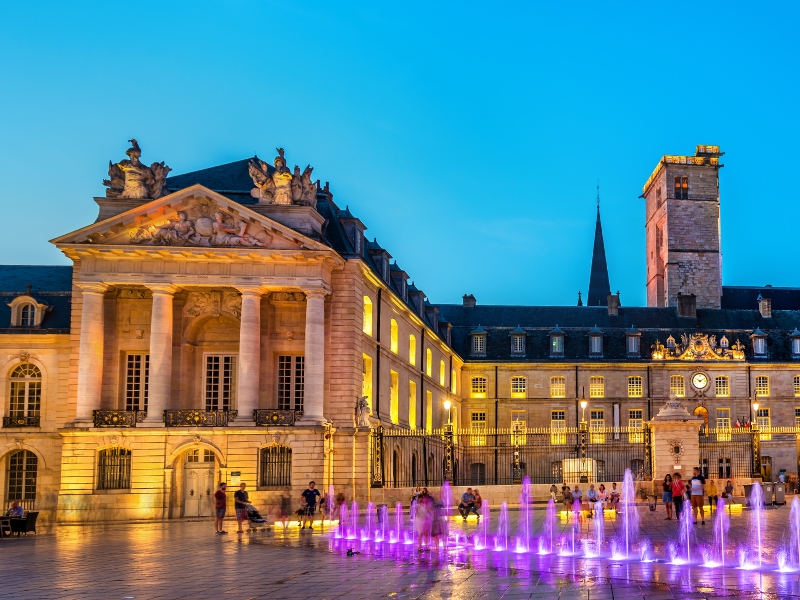
The Palace of the Dukes and Estates of Burgundy fills one side of central Dijon, wrapped around the half-moon of Place de la Libération. Behind its classical 17th- and 18th-century front hides the Gothic residence of the Valois dukes of Burgundy, and today the same buildings hold both Dijon's town hall and its Museum of Fine Arts.
The Palais des Ducs at a glance
- Where: Place de la Libération, with entrances also from Place des Ducs and Place de la Sainte-Chapelle, in the centre of Dijon.
- Built: the ducal palace from 1365 (Tour de Bar) to 1455 (Tour Philippe le Bon); the classical palace of the Estates of Burgundy mainly in the 17th and 18th centuries.
- By: the classical layout and the half-moon square follow plans by Jules Hardouin-Mansart, the architect of Versailles; the grand staircase is by Jacques Gabriel.
- What it is today: Dijon's town hall and the Musée des Beaux-Arts, a listed historic monument.
- Time needed: 20 minutes for the courtyards and square; two hours or more with the museum, plus about 45 minutes for the tower climb.
From ducal court to town hall
The palace grew from an older castle into the residence of the four Valois dukes who ruled Burgundy from 1363 to 1477: Philip the Bold, John the Fearless, Philip the Good and Charles the Bold. Philip the Bold began rebuilding in 1365 with the Tour de Bar. Under Philip the Good came the ducal kitchens, the great hall now known as the Salle des Gardes and the 46-metre lookout tower that bears his name, finished in 1455. The ducal chapel next door became the seat of the Order of the Golden Fleece, the knightly order Philip the Good founded.
When Charles the Bold died in 1477, Burgundy passed to the French crown and the palace became a royal residence and the meeting place of the Estates of Burgundy, the province's assembly. They rebuilt it in classical style, and the square in front was laid out as Place Royale with an equestrian statue of Louis XIV, which revolutionaries pulled down in 1792. The ducal chapel was demolished in 1802, the town council moved in during the 19th century, and the drawing school founded in the palace in the 1760s grew into the museum.
What to look for
- The half-moon arcades of Place de la Libération, framing the palace front. The square was named after the liberation of 1944.
- The Tour Philippe le Bon rising behind the classical wings: compare its plain Gothic stone with the polished façades around it.
- The Gothic ducal residence, best seen from the small Place des Ducs behind the palace, with its steep roof and pointed windows.
- Inside the museum, the tombs of Philip the Bold and of John the Fearless and his wife in the Salle des Gardes, ringed by small carved mourners in hooded robes.
- The ducal kitchens of the 1430s off the Cour de Bar, a square vaulted room with huge fireplaces built to feed the court.
Climbing the Tour Philippe le Bon
The 46-metre tower is the best viewpoint in Dijon: 316 steps lead to a terrace with a 360-degree view over the rooftops and the colourful glazed tiles of Burgundy. You can only go up on a guided climb of about 45 minutes in small groups, booked through the Dijon tourist office. In the 19th century the tower served as a station on the Chappe optical telegraph line.
Tips for your visit
- Book the tower climb ahead in summer, as the groups are small and fill quickly.
- Come back to Place de la Libération after dark, when the curved arcades and the palace front are lit.
- The town hall is a working building: walk through the courtyards quietly and respect any signs closing parts of it for events.
- Leave time for the museum's tomb hall even if you skip the rest; it is the room that best explains why the dukes mattered.
Nearby
- Église Notre-Dame: a Gothic church with a row of false gargoyles on its front, the Jacquemart clock family on the tower and the stone owl on its side wall that people touch for luck.
- Rue des Forges and Rue de la Chouette: old streets lined with timber-framed and Renaissance houses, a few minutes' walk from the palace.
- Les Halles: Dijon's covered market hall, a good stop for Burgundy cheese and mustard.
- Place François Rude: a lively little square with a grape-treading statue, just west of the palace.
See Dijon with World City Trail
Our Dijon scavenger hunt turns the old town into a game you play on your phone. The route links 10 stops and takes around 2 hours, with about 25 minutes of walking. Among the places it includes are the Jardin des Cloches, Porte Guillaume, Saint-Bénigne Cathedral and Place François Rude. You can play in English, German, French, Italian, Spanish or Dutch.
For people who prefer a different format, there is also a self-guided walking tour and an outdoor escape game in Dijon.
Play the Dijon scavenger hunt →
Take the self-guided walking tour of Dijon →
Play the outdoor escape game in Dijon →
Facts checked in October 2026.