
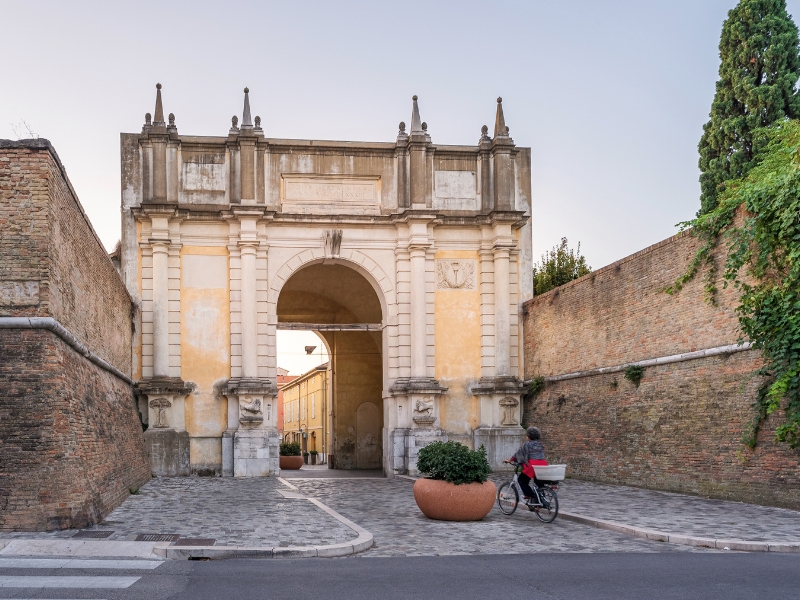
Porta Adriana is the grand stone gate at the western end of Via Cavour, where Ravenna's old town meets the ring road. It looks like a single Renaissance monument, but it has been moved, rebuilt and enlarged many times, and its decoration was taken from the Porta Aurea, the Roman triumphal gate of the city.
Porta Adriana at a glance
- Where: between Via Cavour and Piazza Baracca, on the western edge of Ravenna's historic centre, a short walk from San Vitale.
- Built: a gate probably stood here from around the 10th century; the present form dates from a rebuilding in the 1580s, enlarged in 1857.
- What it is today: the city's best-preserved monumental gate, which locals often simply call Porta Cavour.
- Time needed: 10–15 minutes, or longer if you add the stretch of old walls and the Domus dei Tappeti di Pietra next door.
A gate made from older gates
Ravenna was walled from Roman times, and its main western entrance was the Porta Aurea, a double-arched gateway built in 42 AD under Emperor Claudius, said to be named after a gilded shield on its top. In the 16th century, when Ravenna belonged to the Papal States, it was pulled down. In the 1580s Cardinal Legate Guido Ferreri gave the nearby Porta Adriana a new monumental front, reusing marble pieces and round medallions from the Roman gate. The inscription on the gate, PORTA AUREA NOVA, the new Golden Gate, makes the link explicit.
Later centuries kept changing it. Around 1700 the side columns were replaced by two square towers, and in 1857 the gate was widened for the visit of Pope Pius IX, with extra columns, an attic and side walkways. In 1904 the cornices and side columns were rebuilt in cement and the old medallions were removed; another major restoration followed in 1968. What you see is therefore a mix of Roman spolia, Renaissance design and 19th- and 20th-century additions.
What to look for
- The inscription PORTA AUREA NOVA on the upper part, naming the gate after its Roman predecessor.
- The pine trees carved on the pedestals of the side columns. The pine is a symbol of Ravenna, home of the famous pine forests along its coast.
- The two side towers from around 1700, and the pedestrian passages opened beside the main arch in 1857.
- The difference between old stone and the smoother cement of the 1904 rebuilding on the cornices and columns.
- The remains of the brick city walls on either side, with a decorative course of white and red Verona stone.
Where the Roman Porta Aurea went
Nothing of the Porta Aurea stands today, but its surviving fragments are kept in the National Museum of Ravenna, in the cloisters next to San Vitale. Seeing them after the gate helps you picture how grand the Roman entrance to the imperial city must have been. Next to Porta Adriana you can also see remains of the older Porta Teguriense from the late Roman period, and the bend in Via Cavour behind the gate follows the line of a former watercourse.
Tips for your visit
- Approach from Piazza Baracca to see the full front of the gate, then walk through it into Via Cavour as travellers once did.
- Come early in the morning, when the junction is quieter, for photos with fewer cars in front of the arch.
- Watch the traffic: the gate stands on a busy junction, so use the pedestrian crossings.
- Combine it with San Vitale and the Mausoleum of Galla Placidia, which are only a few minutes away on foot.
Nearby
- Domus dei Tappeti di Pietra: the 'house of the stone carpets', a Byzantine-era mansion with mosaic and marble floors preserved below a church, a couple of minutes from the gate.
- Basilica of San Vitale: the 6th-century church with the mosaics of Justinian and Theodora, a short walk away.
- National Museum of Ravenna: in the former monastery of San Vitale, with the remains of the Porta Aurea.
- Via Cavour: the old town's main shopping street, which leads from the gate towards Piazza del Popolo.
See Ravenna with World City Trail
Our Ravenna scavenger hunt turns the old town into a game you play on your phone. The route links 10 stops and takes around 2 hours, with about 38 minutes of walking. Among the places it includes are the Giardini Pubblici. You can play in English, German, French, Italian, Spanish or Dutch.
For people who prefer a different format, there is also a self-guided walking tour and an outdoor escape game in Ravenna.
Play the Ravenna scavenger hunt →
Take the self-guided walking tour of Ravenna →
Play the outdoor escape game in Ravenna →
Facts checked in October 2026.