What is the Ravenna outdoor escape game?
The Ravenna outdoor escape game takes the logic of an escape room out for a walk through the city. You play on your smartphone, and at each of the 10 stops a puzzle asks you to study your surroundings closely and reason your way to the answer. Allow about 2 hours, including 38 minutes on foot over 2.8 km, and start on whichever day suits you.
Every puzzle belongs to one landmark, from the Basilica of Sant'Apollinare Nuovo and Dante's Tomb to the Basilica of San Vitale. The puzzles stand on their own, so there is no storyline to follow, and up to three levels of hints are there if you get stuck. Ravenna suits this format because its early Christian monuments and squares sit close together and are easy to reach on foot, so the game feels like one relaxed walk.
- Durationabout 2 hours
- Walkingabout 38 min · 2.8 km
- Stops10
- LanguagesEnglish, German, French, Italian, Spanish, Dutch
What you do on the escape game
Solve
Work out the puzzle at each stop from what you can see and from your own reasoning. No prior knowledge of the city is needed.
Observe
The clues are in the surroundings of each landmark, so look up and take in what is around you.
Walk
Google Maps guides you from stop to stop: about 38 minutes of walking across 2.8 km.
Set your pace
No countdown runs while you play. Use hints when you want them, stop for a coffee and carry on later or another day.
See the route and attractions →
How it works
- Book online Choose the number of players. Your booking reference arrives by email straight away.
- Get the app Download the World City Trail app from the App Store or Google Play and enter your booking reference.
- Play when you like Start whenever you are ready, walk at your own pace and pause any time. No guide, no fixed schedule.
Who it suits
Friends
Everyone follows the puzzles on their own phone, the discussion at each landmark is shared, and nobody has to know Ravenna beforehand.
Couples
A challenge you solve side by side, at your own speed between mosaics and squares, with no clock ticking away.
Team building
Teams of up to 5 play on their own phones, and the outdoor format gives colleagues plenty to talk about as they walk.
Good to know
- Bring a charged smartphone with mobile data; a power bank helps.
- Best started in daylight, so you can see the details the puzzles ask about.
- No entry tickets needed: everything happens outside the buildings. Going inside is optional and paid separately.
- Family friendly; children must be accompanied by an adult.
- Not suitable for wheelchair users and difficult with strollers.
- Teams of up to 5 work best; bigger groups split into several teams, one ticket per player.
- Every purchase helps support stray cats and dogs in Greece.
Puzzle route: from the Giardini Pubblici to the Mausoleum of Galla Placidia
10 stops · about 38 min walking · start: Giardini Pubblici · finish: Mausoleum of Galla Placidia
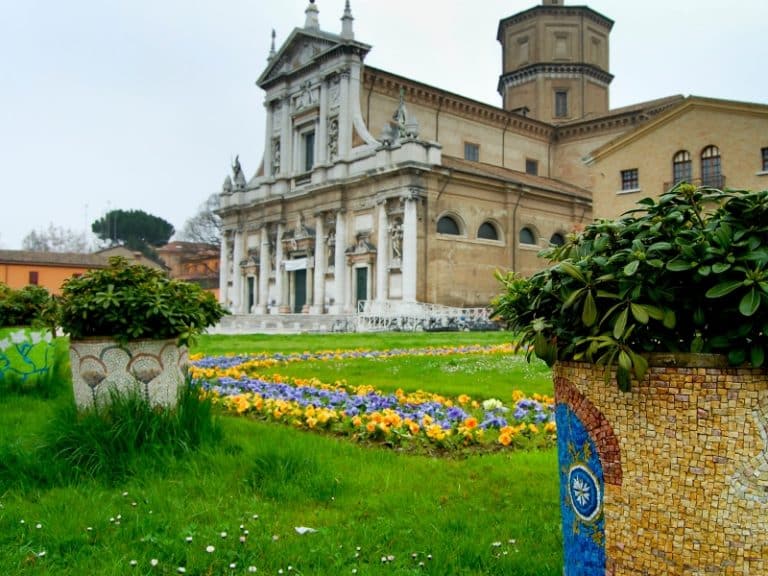
You begin at the Giardini Pubblici, which the Loggetta Lombardesca overlooks, then pass the Basilica of Sant'Apollinare Nuovo, the Teatro Alighieri and Dante's Tomb before reaching the Neonian Baptistery and Piazza del Popolo. The route continues past the Mercato Coperto and the Porta Adriana, and the last puzzle sits at the Mausoleum of Galla Placidia, after the Basilica of San Vitale. Start in daylight, since the game is played outdoors. You can change the order in the app, and no entry tickets are needed.
Open the route map ↗
1Giardini PubbliciStart
Ravenna's public gardens are a green park of shady paths and old trees on the edge of the historic centre. They are overlooked by the Loggetta Lombardesca, the Renaissance loggia of the former monastery of Santa Maria in Porto, which now houses the city's art museum, MAR.
2Basilica of Sant'Apollinare Nuovo
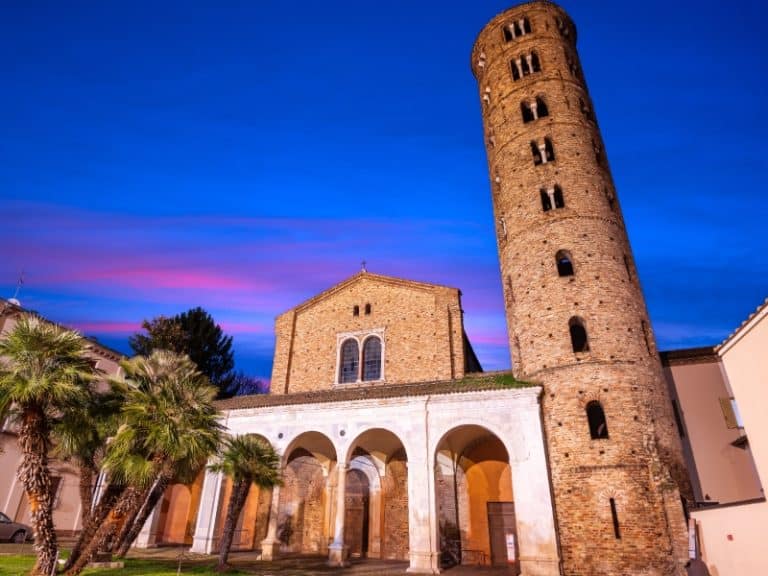
The Ostrogothic king Theodoric built this church in the early 6th century as his palace church for Arian worship. Inside, long mosaic processions of martyrs and virgins line the nave, and one panel shows his palace. From the street, look for the round brick bell tower beside the portico.
Read the full story →
3Teatro Alighieri
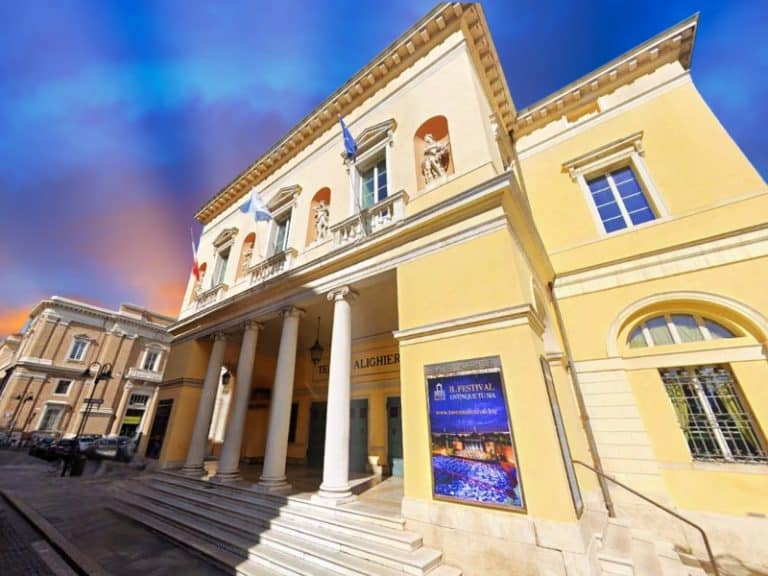
Ravenna's opera house is named after Dante Alighieri and opened in 1852. It was designed by the Venetian architects Tommaso and Giovan Battista Meduna, who had also rebuilt Venice's La Fenice. Its neoclassical columned front faces Via Mariani, and it is one of the main venues of the Ravenna Festival.
4Dante's Tomb
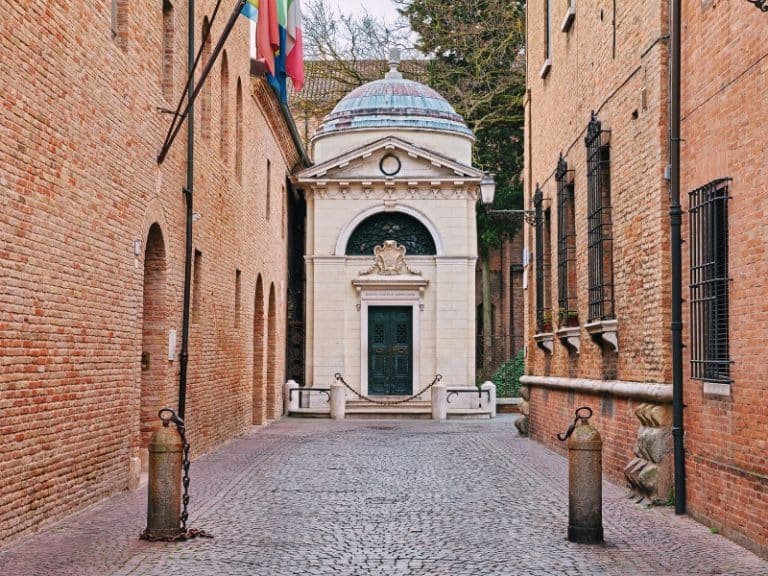
Dante Alighieri died in exile in Ravenna in 1321 and was buried beside the Basilica of San Francesco. The small neoclassical temple over his tomb was built in 1780–1781 to designs by Camillo Morigia. Inside hangs a votive lamp whose oil is donated every year by Florence, the city that had banished him.
Read the full story →
5Neonian Baptistery
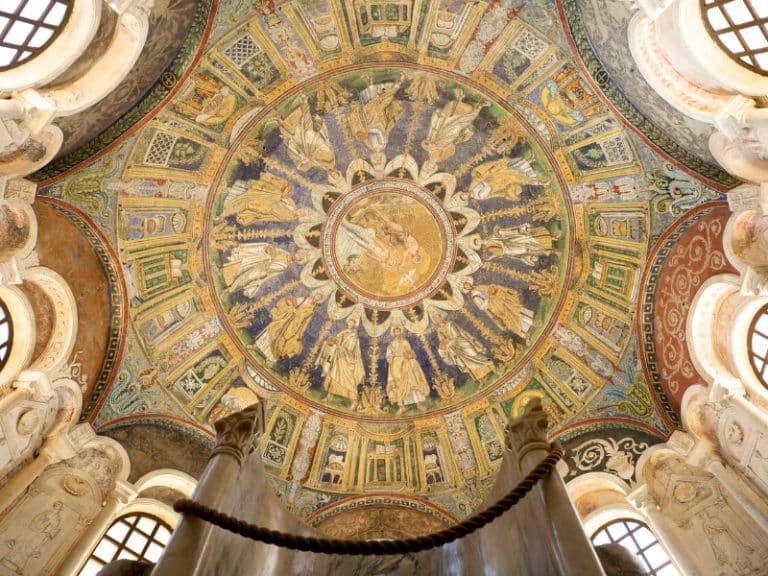
This octagonal brick baptistery next to the cathedral, also called the Baptistery of the Orthodox, is one of the oldest monuments in Ravenna. Bishop Neon had it decorated with mosaics in the mid-5th century, and the dome shows the Baptism of Christ surrounded by the Twelve Apostles. Notice how it sits below today's street level.
Read the full story →
6Piazza del Popolo
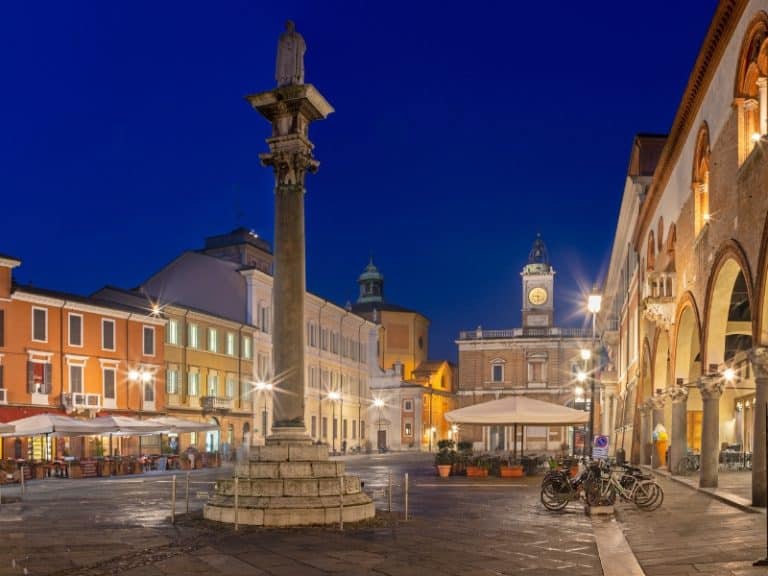
Ravenna's main square took its present shape under Venetian rule in the 15th century. Two granite columns raised by the Venetians in 1483 now carry statues of the city's patron saints, Apollinaris and Vitalis. The battlemented Palazzo Comunale, known as Palazzo Merlato, is Ravenna's town hall.
Read the full story →
7Mercato Coperto
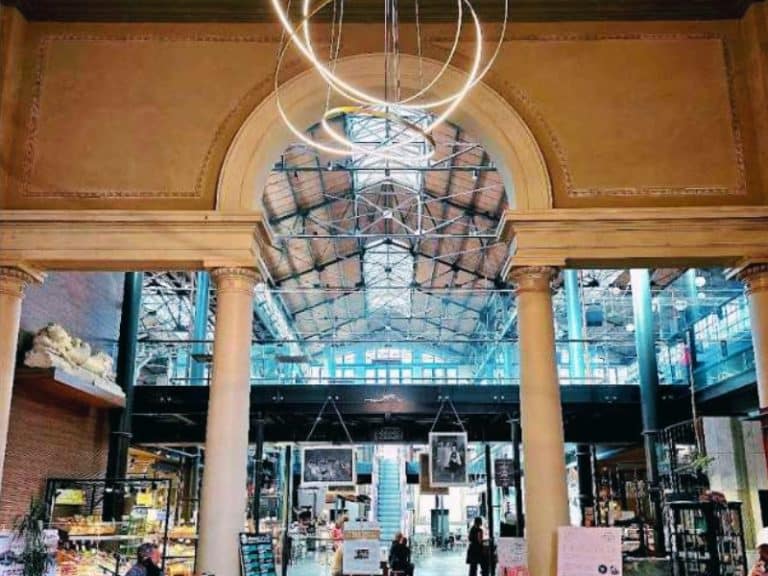
Ravenna's covered market hall on Piazza Andrea Costa was built in the early 20th century, a few steps from Piazza del Popolo. After a renovation it reopened as a food market, where local produce and Romagna specialities such as piadina are sold under the original roof.
Read the full story →
8Porta Adriana
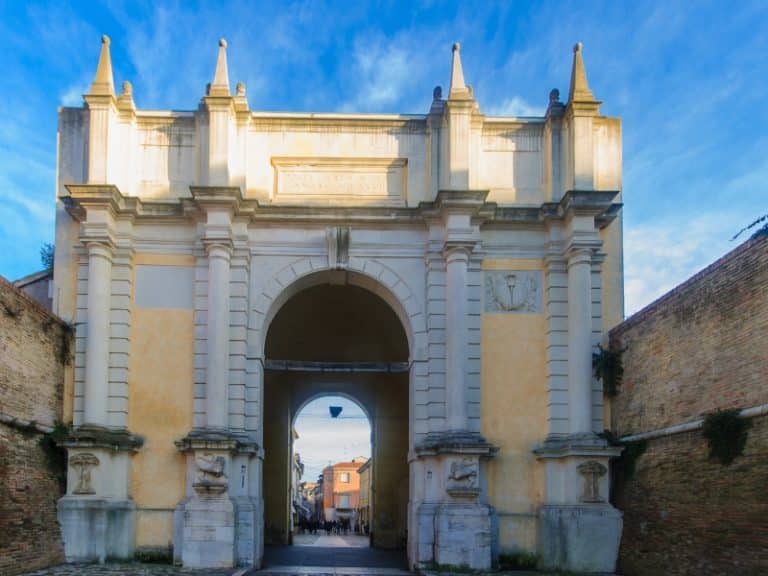
This monumental stone gate stands at the western end of Via Cavour, one of the main streets leading into the centre. Its present form dates from the late 16th century, when an older gate in the city walls was rebuilt. Its name is often linked to the Roman emperor Hadrian, but its origin is debated.
Read the full story →
9Basilica of San Vitale
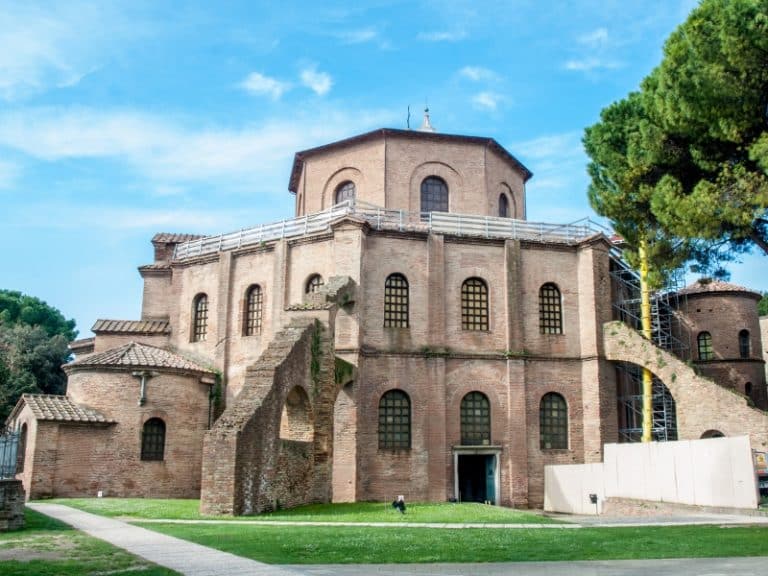
Begun around 526 and consecrated in the 540s, this octagonal church is one of the most important monuments of early Christian art in Europe. Its apse mosaics show the Byzantine emperor Justinian and empress Theodora with their courts. Since 1996 it has been part of the UNESCO World Heritage site of Ravenna's early Christian monuments.
10Mausoleum of Galla PlacidiaFinish
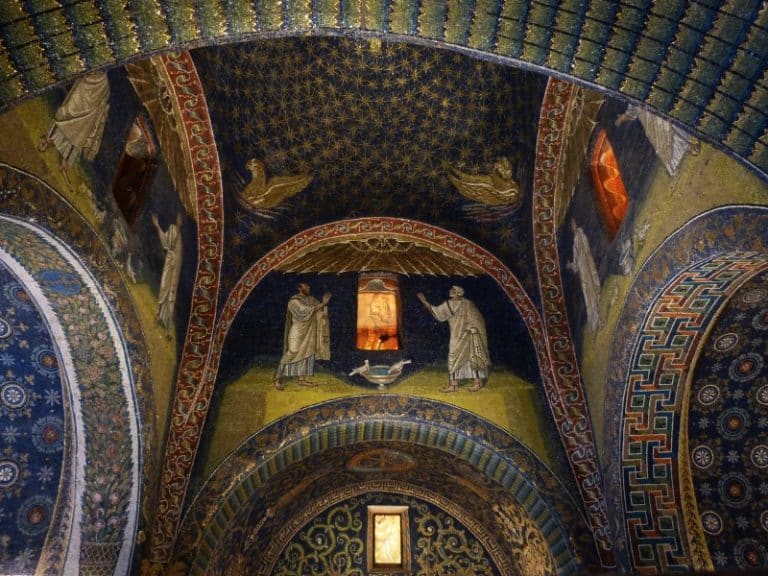
This small cross-shaped brick building dates from the first half of the 5th century and bears the name of Galla Placidia, daughter of Emperor Theodosius I, who ruled the Western Empire for her young son. Its plain walls hide a vault of deep blue mosaics with golden stars. Despite its name, she was most probably not buried here.
Read the full story →
Only logged in customers who have purchased this product may leave a review.




Reviews
There are no reviews yet.