
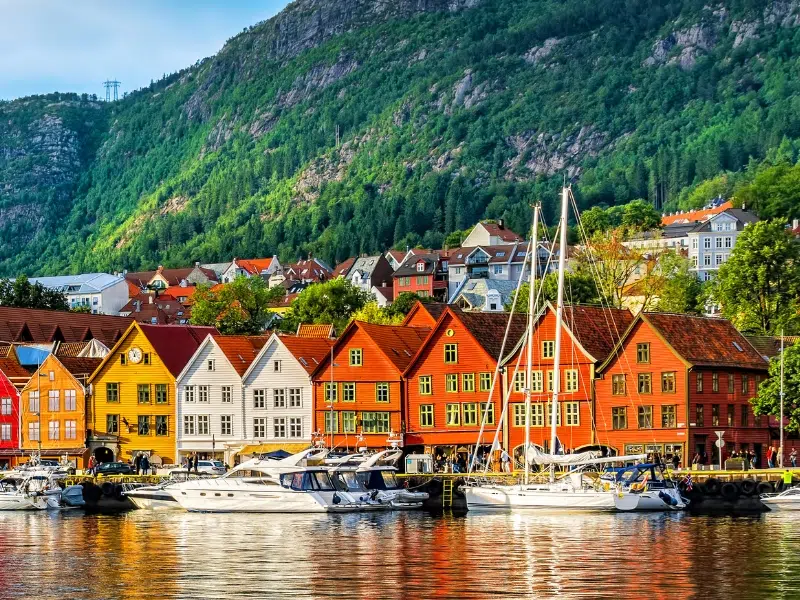
Bergen lies between the mountains and the sea, and for centuries it was Norway's largest city and its window on the world. Its wooden wharf recalls the Hanseatic merchants who ran the trade in dried fish, and the fjords begin almost on its doorstep. Here are the facts and stories that make the city special.
10 fun facts about Bergen
- Founded by a king: by tradition, King Olav Kyrre founded Bergen in 1070, and in the 13th century it was the main seat of Norway's kings.
- A royal hall from 1261: Haakon's Hall, the great stone hall at Bergenhus Fortress, was finished in time for the wedding and coronation of King Magnus the Lawmender in 1261.
- A wharf on the UNESCO list: Bryggen, the row of wooden merchant houses along the harbour, has been a World Heritage Site since 1979. It has burned many times and was always rebuilt on the old pattern; most of what stands today dates from after the fire of 1702.
- A cannonball in the cathedral wall: since 1665, a cannonball has been stuck in the outer wall of Bergen Cathedral, a souvenir of a sea battle fought in the harbour below.
- Ibsen's first theatre job: the National Stage began in 1850 as Det Norske Theater, founded on the initiative of the violinist Ole Bull. A young Henrik Ibsen worked there as a writer and director in the 1850s, and the present Art Nouveau building opened in 1909.
- Grieg's hometown: the composer Edvard Grieg was born in Bergen in 1843. His villa at Troldhaugen, south of the centre, is now a museum with a concert hall.
- A fire that reshaped the centre: on the night of 15 to 16 January 1916, a fire destroyed 380 buildings in central Bergen. The broad square of Torgallmenningen was rebuilt afterwards, and at its top stands the Sailor's Monument by Dyre Vaa, unveiled in 1950.
- A funicular since 1918: the Fløibanen has carried passengers from the centre up Mount Fløyen, one of the mountains that ring the city, since 1918.
- A town made of gingerbread: every Christmas since 1991, children, schools and businesses have built Pepperkakebyen, a town of gingerbread houses billed as one of the largest in the world.
- Boys with drums: the buekorps, uniformed boys' brigades that march with drums and wooden crossbows, are a tradition found almost only in Bergen and go back to the 1850s.
The Battle of Vågen
In August 1665, during a war between England and the Netherlands, a Dutch fleet of 66 ships returning from the East Indies with valuable cargo took refuge in Bergen's harbour, Vågen. English warships followed. King Frederick III of Denmark-Norway had secretly agreed with the English to let them seize the ships and share the loot, but nobody had told his commanders in Bergen. When the English opened fire on 2 August, the defenders thought Norway itself was under attack and fired back from the fortress. After about three hours, the English fleet withdrew, with several hundred men killed or wounded. The town was damaged too, and the cathedral still carries a cannonball from that day.
Bryggen, explained
From about 1360 to 1754, the Hanseatic League ran one of its main trading offices, the Kontor, at Bryggen. German merchants bought stockfish, cod dried in the wind of northern Norway, and shipped grain back in exchange. The apprentices who worked here lived in cramped wooden buildings, and fire was forbidden except in separate assembly rooms. Even so, the wharf kept burning. After a fire in 1955, archaeologists dug beneath it and found hundreds of runic inscriptions, from business notes to love messages.
What to eat in Bergen
- Bergensk fiskesuppe: Bergen's creamy fish soup with vegetables and white fish, a staple of the city's restaurants.
- Skillingsboller: large cinnamon buns that Bergen claims as its own, best bought fresh from a bakery.
- Fiskekaker: fish cakes made from fresh minced fish, sold by the fishmongers and eaten hot or cold.
- Raspeballer: dense potato dumplings, also called komle in western Norway, served with salted meat and mashed swede.
- Brunost: sweet brown cheese made from whey, sliced thin with a cheese slicer, a Norwegian invention.
Good to know before you go
- Bergen is one of the wettest cities in Europe. Pack a waterproof jacket whatever the forecast says.
- The Fløibanen gets long queues on summer days when cruise ships are in. You can also walk up Mount Fløyen on a marked path through the woods.
- For a bigger view, a cable car climbs Ulriken, at 643 metres the highest of the mountains around the city.
- Bergen is the starting point for many fjord trips, and the Bergen Railway to Oslo, opened in 1909, crosses Norway's high mountain plateau.
Explore Bergen with World City Trail
Our Bergen scavenger hunt turns these sights into a game you play on your phone. The route links 10 stops and takes around an hour and a half, with about 37 minutes of walking, and leads you past the National Stage, the Sailor's Monument and Bergen Cathedral, among other sights.
At each stop you solve a puzzle and hear a short story, at your own pace. You can start whenever you like.
Play the Bergen scavenger hunt →
Facts checked in October 2026.