
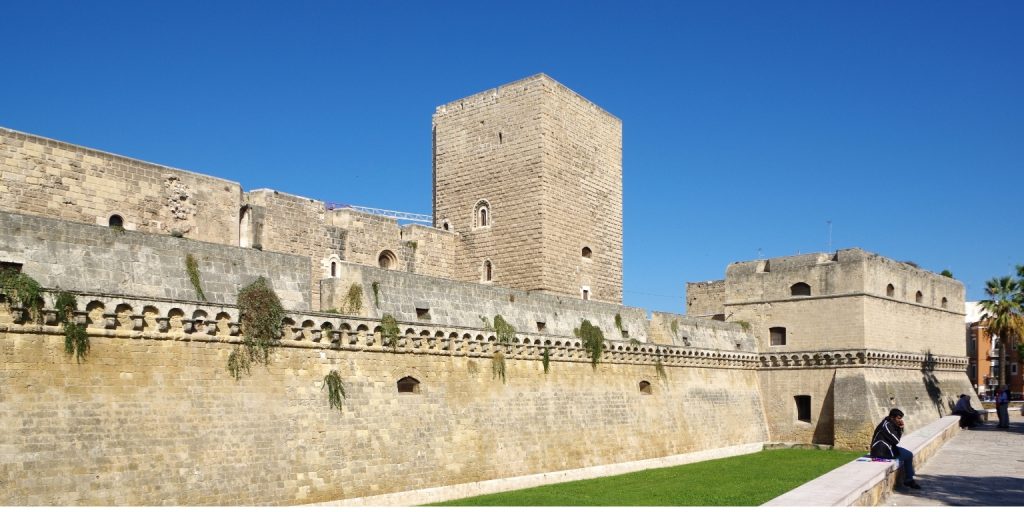
Dominating the western edge of bustling old town, Castello Normanno-Svevo in Bari stands as a colossal testament to the city’s strategic importance and its turbulent history. This formidable fortress, with its imposing stone walls, bastions, and moats, is a living chronicle of the powerful empires that shaped Southern Italy, from its early Norman conquerors to the Holy Roman Emperors and later Spanish rulers. A visit to this magnificent castle offers a profound journey through Bari’s multi-layered past, revealing centuries of architectural evolution and military might.
From Byzantine Roots to Norman Might
The site of the Castello Normanno-Svevo in Bari has been strategically vital for millennia. While its most prominent structures date from the medieval period, archaeological evidence suggests that a much earlier fortification, possibly a Byzantine stronghold, stood here. However, the true origins of the current castle lie with the Normans.
After their conquest of Southern Italy in the 11th century, the Normans, recognizing Bari’s crucial role as a port city on the Adriatic, began constructing a robust fortress. Historical records indicate that Roger II of Sicily, the first Norman King of Sicily, initiated significant work on the castle in the mid-12th century. He aimed to solidify Norman control and establish a strong defensive point against both internal rebellions and external threats.
Frederick II and the Swabian Splendor
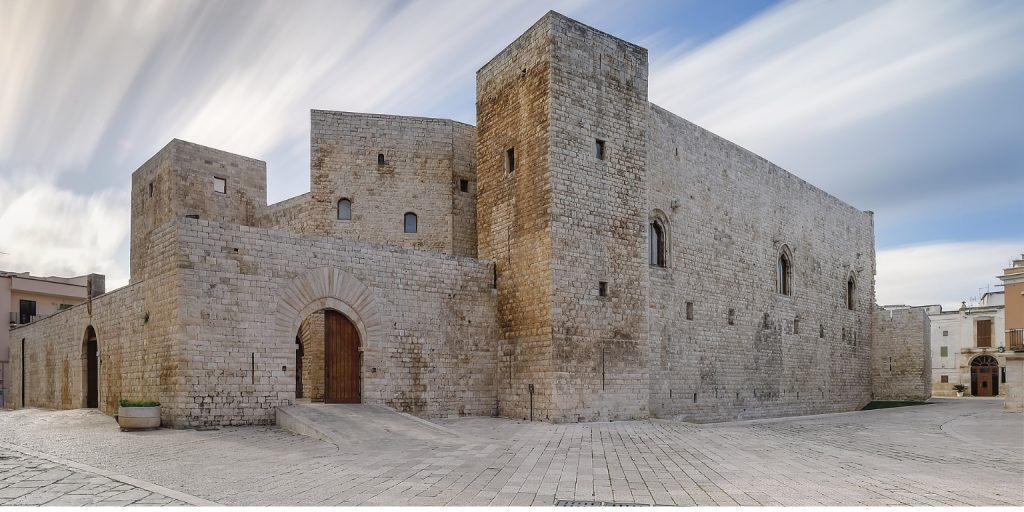
The castle, however, faced destruction in 1156 when it was largely demolished by William I (“the Bad”) of Sicily during a period of revolt. Its true rebirth and architectural grandeur came with the arrival of the Hohenstaufen dynasty and the remarkable reign of Frederick II, Holy Roman Emperor (reigned 1220-1250).
Frederick II, known as “Stupor Mundi” (Wonder of the World) for his intellectual curiosity and ambition, embarked on an extensive rebuilding and expansion of the castle between 1233 and 1240. He transformed the Norman structure into a magnificent Swabian castle, suitable both as a formidable military stronghold and a prestigious imperial residence. The design of the castle, with its imposing quadrangular shape, corner towers, and central courtyard, is largely attributed to his vision. He incorporated elements of Romanesque and early Gothic architecture, reflecting his sophisticated tastes and the advanced military engineering of his era. The inner, more refined courtyard, likely for residential use, dates from this period.
Angevin, Aragonese, and Bourbon Transformations
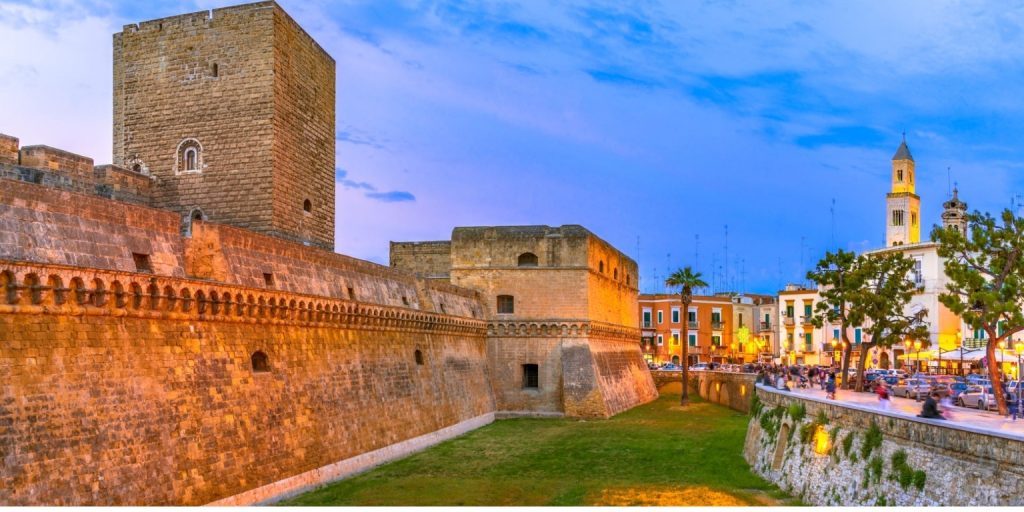
Following the fall of the Hohenstaufens, the castle passed into the hands of the Angevin dynasty in the mid-13th century. While they made some modifications, the next major period of transformation occurred under the Aragonese (Spanish) rule, particularly in the 16th century.
During this time, especially under Isabella of Aragon and Bona Sforza, Duchess of Bari, the castle was significantly adapted to withstand the advent of gunpowder artillery. Massive, sloping bastions and a wide moat were added to the outer perimeter, transforming it into a true Renaissance-era fortress. These later additions contrast sharply with the earlier medieval walls, showcasing the evolution of defensive architecture.
In later centuries, under the Bourbon kings of Naples (18th-19th centuries), the castle’s military role diminished. It was often used as a prison and, for a period, as a barracks.
From Barracks to Cultural Hub
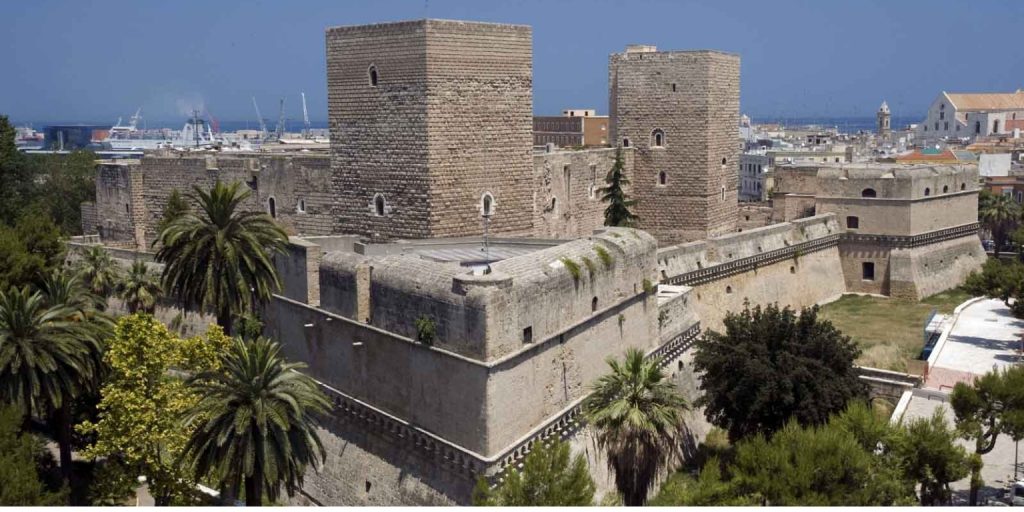
By the 20th century, the Castello Normanno-Svevo in Bari was in a state of disrepair. However, extensive restoration efforts throughout the latter half of the 20th century, particularly starting in the 1930s and continuing for decades, brought it back to its former glory.
Today, the Castello Normanno-Svevo in Bari is one of Puglia’s most impressive and well-preserved medieval castles. It serves as a museum and cultural exhibition space, managed by the Direzione Regionale Musei Puglia. Visitors can explore the vast courtyards, walk along the imposing battlements, delve into its various halls that once served as royal chambers or military quarters, and view archaeological finds from its long history. It regularly hosts temporary exhibitions, concerts, and cultural events, keeping its ancient stones alive with contemporary activity.
From its foundational construction by the Normans in the 12th century, its grand imperial rebuild by Frederick II in the 13th century, and its later bastions added in the 16th century, the Castello Normanno-Svevo in Bari is a powerful symbol of the city’s strategic importance and its enduring legacy as a crossroads of Mediterranean power and culture. It is an indispensable visit for anyone seeking to understand the layered history of this captivating Adriatic port.