
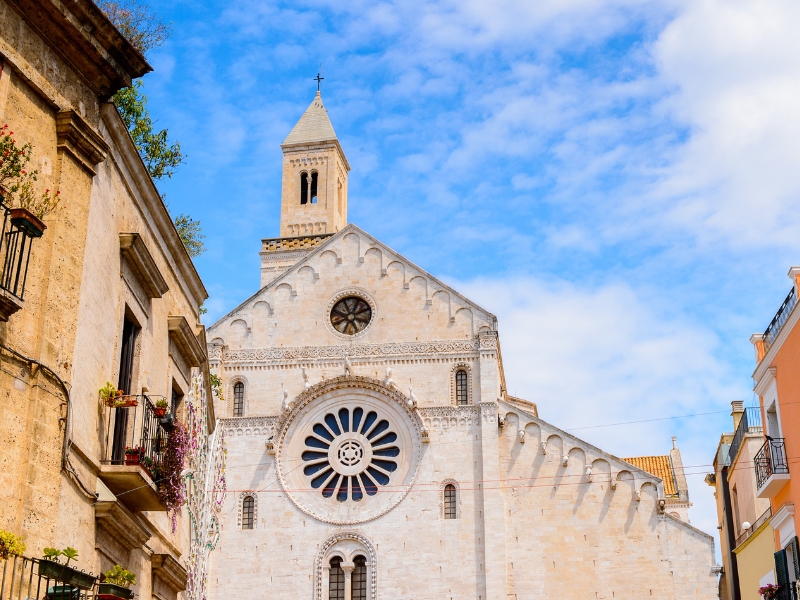
The Cathedral of San Sabino is Bari's Romanesque cathedral, in the old town a few minutes' walk from the Basilica of San Nicola. It was rebuilt after William I of Sicily destroyed Bari in 1156 and consecrated in 1292. Every year on 21 June, late in the afternoon, the sun shining through its rose window projects the whole rose onto the marble floor in front of the altar.
Bari Cathedral at a glance
- Where: Piazza dell'Odegitria in Bari Vecchia, the old town, between the Norman-Swabian Castle and the Basilica of San Nicola.
- Built: rebuilt from the late 12th century under Archbishop Rainaldo on the site of earlier cathedrals; consecrated on 4 October 1292.
- What it is today: the seat of the Archbishop of Bari-Bitonto, dedicated to Saint Sabinus, a bishop of Canosa, and one of the main examples of Apulian Romanesque.
- Time needed: 30–45 minutes, longer with the crypt and the excavations beneath the church.
From a Byzantine-era cathedral to Apulian Romanesque
Bari has had bishops since at least 347, and this site has held a cathedral for well over a thousand years. Floor mosaics naming Bishop Andrea, who led the diocese in 758–761, probably belonged to the first cathedral. An 11th-century church stood here when, in 1156, King William I of Sicily destroyed the city. Archbishop Rainaldo began rebuilding at the end of the 12th century, reusing older materials and following the model of the Basilica of San Nicola. The new cathedral was consecrated on 4 October 1292.
In the 18th century Archbishop Muzio Gaeta gave the facade, the nave, the aisles, the round baptistery and the crypt a Baroque makeover designed by Domenico Antonio Vaccaro. In the 1950s restorers removed most of it and brought back the bare stone of the Romanesque interior, and later restoration work, including a campaign between 2002 and 2005, has continued since. Beneath the nave, excavations have uncovered traces of the older churches and their mosaic floors.
What to look for
- The facade and the rose window: three portals below a large rose window framed by carvings of monsters and fantastic creatures.
- The interior: three aisles divided by sixteen columns, with plain stone walls that let the architecture speak for itself.
- The crypt: the relics of Saint Sabinus lie in its main altar; they were brought to Bari in 844. Here too is the icon of the Madonna Odegitria, the Virgin who shows the way, much venerated in Bari.
- The Trulla: a round 12th-century building beside the cathedral, built as a baptistery and now used as the sacristy.
- The bell tower: it looks medieval, but it is largely a modern rebuild in the same pale stone.
The solstice rose
On 21 June each year, at around ten past five in the afternoon, sunlight comes through the rose window in the west front and casts the full shape of the rose onto the marble floor a few steps from the presbytery. Other Romanesque churches have light effects in which a single beam hits a single point; here the whole outline of the window appears on the floor. The sacristan Michele Cassano first noticed it in 2005, just after a restoration, and since then people come every year to watch it. It needs a clear sky.
The diocesan museum next to the cathedral keeps another treasure: the Exultet, an illuminated medieval scroll with the Easter hymn. Its pictures are painted upside down in relation to the text, so that as the deacon unrolled it over the pulpit, the congregation in front of him could follow the story in the images.
Tips for your visit
- This is a working cathedral: cover shoulders and knees, keep your voice down and avoid moving around during Mass.
- If you are in Bari on 21 June, come well before five o'clock to find a spot where you can see the floor.
- Visit the cathedral and the Basilica of San Nicola together. The two churches are a few minutes apart, and seeing both shows how the Romanesque style was shared between them.
Nearby
- Basilica of San Nicola: the great pilgrimage church built for the relics of St Nicholas, brought from Myra in 1087, a few minutes' walk away.
- Norman-Swabian Castle: the fortress at the edge of the old town, rebuilt under Emperor Frederick II in the 13th century, a short walk west.
- Strada Arco Basso: the lane near the castle where local women make orecchiette pasta by hand at tables outside their doors.
- Piazza Mercantile: the main square of the old town, with its stone column once used to shame debtors, a short walk east.
See Bari with World City Trail
Our Bari scavenger hunt turns the old town into a game you play on your phone. The route links 10 stops and takes around 2 hours, with about 35 minutes of walking. It includes Bari Vecchia and the Basilica of San Nicola, a few minutes from the cathedral.
If you prefer a different format, there is also a self-guided walking tour and an outdoor escape game in Bari.
Play the Bari scavenger hunt →
Take the self-guided walking tour of Bari →
Play the outdoor escape game in Bari →
Facts checked in October 2026.