
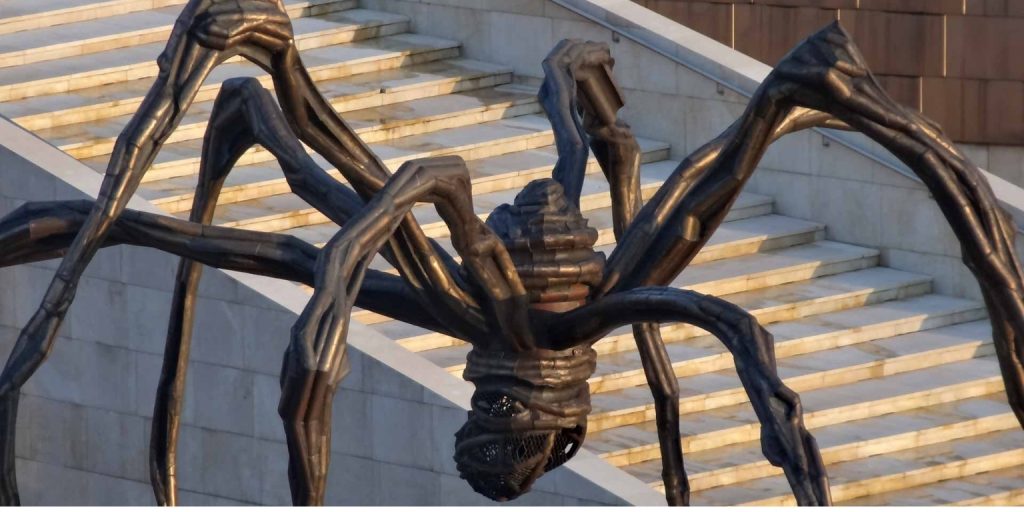
Maman is the giant bronze spider on the riverside walk beside the Guggenheim Museum Bilbao, overlooking the Nervión. The French-American artist Louise Bourgeois made it as a tribute to her mother, and under its body hangs a sac of marble eggs. At around 9 metres tall it is big enough to walk under, and because it stands outdoors you can see it at any hour.
Maman at a glance
- Where: on the museum's promenade along the Nervión, next to the footbridge and in front of Frank Gehry's titanium building.
- Created: 1999; Bilbao's bronze was cast in 2001 and is number 2 in an edition of six.
- By: Louise Bourgeois (1911–2010), born in Paris and based in New York from 1938.
- What it is today: part of the permanent collection of the Guggenheim Museum Bilbao, displayed outdoors beside a public walkway.
- Time needed: 10–15 minutes, more if you also look at the museum's other outdoor works.
From London's Turbine Hall to the Nervión
Spiders turn up in Bourgeois's drawings from the 1940s, but they only became a central theme of her work in the 1990s, when she was in her eighties. Maman, French for 'Mum', is dated 1999 and was first shown in 2000 as part of her commission for the opening of the Turbine Hall at Tate Modern in London. That first version is made of steel and marble. Six bronzes were later cast from it: Bilbao's in 2001, and others are on permanent display in Ottawa, Tokyo and Seoul.
The sculpture is about Bourgeois's mother, Joséphine, who ran the family workshop restoring old woven textiles in France and died in 1932. 'The Spider is an ode to my mother,' the artist said. She saw the spider as a weaver and a repairer, like her mother, and as a protector. But her work often draws on a difficult childhood, which the Guggenheim describes as marked by an unfaithful father and a loving but complicit mother, so the image is not simply tender.
What to look for
- The egg sac: look up between the legs to find the mesh sac under the body, filled with marble eggs.
- The legs: eight long, thin bronze legs, bent like Gothic arches, ending in points that barely seem to touch the ground.
- The ribbed body: the abdomen and thorax are made of ribbed bronze, with a rough, hand-worked surface you can see up close.
- The scale: stand under the spider and look up. The body hangs high above your head, and the legs form a kind of room around you.
- The frame: from the walkway the spider lines up with the curved titanium of the museum behind it, which opened in 1997.
Shelter or trap?
The Guggenheim reads Maman as deliberately two-sided. A spider spins silk to build a cocoon and to catch prey, so the legs that shelter the eggs also enclose them like a cage. The huge body balanced on thin points looks threatening at first and fragile the longer you stand under it. Bourgeois saw spiders as ambiguous symbols of motherhood, protective and frightening at once, which is why the sculpture can feel unsettling and moving at the same time.
Tips for your visit
- Come early in the morning, before groups gather along the promenade, if you want photos without crowds under the legs.
- For the classic shot of the spider with the museum, step back along the river walk or cross the Pedro Arrupe footbridge to the Deusto bank and look back.
- Don't climb on the legs or touch the egg sac: it is an artwork in a museum collection, even though it stands outside.
Nearby
- Guggenheim Museum Bilbao: Frank Gehry's titanium-clad museum of modern and contemporary art, opened in 1997, right behind the spider.
- Puppy: Jeff Koons's giant terrier covered in flowering plants, more than 12 metres tall, on the city side of the museum.
- La Salve Bridge: the road bridge that passes over the east end of the museum, marked since 2007 by Daniel Buren's red arch.
- Doña Casilda Iturrizar Park: Bilbao's main city park, a short walk inland, with a pond, fountains and shady paths.
See Bilbao with World City Trail
Our Bilbao scavenger hunt turns the city into a game you play on your phone. The route links 10 stops and takes around 3 hours, with about 52 minutes of walking. It includes the Guggenheim Museum, the Zubizuri bridge and Doña Casilda Iturrizar Park. You can play in English, German, French, Italian, Spanish and Dutch.
If you prefer a different format, there is also a self-guided walking tour and an outdoor escape game in Bilbao.
Play the Bilbao scavenger hunt →
Take the self-guided walking tour of Bilbao →
Play the outdoor escape game in Bilbao →
Facts checked in October 2026.