
Stepping onto the Royal Route in Gdańsk is like embarking on a journey back in time, tracing the footsteps of Polish monarchs and wealthy patricians through the city’s most splendid and historically significant thoroughfares. This iconic path, an essential highlight for any visitor, encapsulates the grandeur and prosperity of Gdańsk (Danzig) during its golden age. The Royal Route in Gdańsk is more than just a street; it’s a living museum, lined with architectural masterpieces that tell tales of power, trade, and art.

The Ceremonial Path of Kings
The Royal Route is not an officially named street but a traditional itinerary that Polish kings would follow upon entering Gdańsk for official visits, a custom dating back to 1457 with King Kazimierz Jagiellończyk. It served as a ceremonial entrance, a display of the city’s wealth and loyalty, and a stage for royal parades and festivities. The route stretches from the Upland Gate (Brama Wyżynna) at its western end, passing through the Golden Gate, along Długa Street (Long Street) and Długi Targ (Long Market), finally concluding at the Green Gate (Zielona Brama) by the Motława River.
This roughly 900-meter-long stretch showcases the architectural pinnacle of Gdańsk, largely reconstructed after the devastation of World War II, yet painstakingly restored to reflect its former glory.

The Majestic Gateway: Upland Gate and Golden Gate
The journey begins at the Upland Gate, a magnificent Renaissance structure built in 1574, serving as the outer defensive gate and a symbolic threshold. Immediately behind it lies the former Foregate complex, comprising the Prison Tower (Wieża Więzienna) and the Torture House (Katownia). This grim but historically significant duo once served as the city’s prison, courtroom, and execution site, offering a stark contrast to the opulence that follows.
Passing through this complex, one arrives at the iconic Golden Gate (Złota Brama), built between 1612 and 1614. Designed in the Dutch Mannerist style by Abraham van den Blocke, this triumphant arch is adorned with allegorical sculptures on both sides, symbolizing civic virtues such as Peace, Freedom, Wealth, Fame (facing outwards), and Concord, Justice, Piety, and Prudence (facing inwards). Its inscription, “Concordia res publicae parvae crescunt, discordia magnae dilabuntur” (“Small republics flourish in concord, great ones fall in discord”), speaks volumes about the city’s civic ideals.

The Heart of the City: Długa Street and Długi Targ
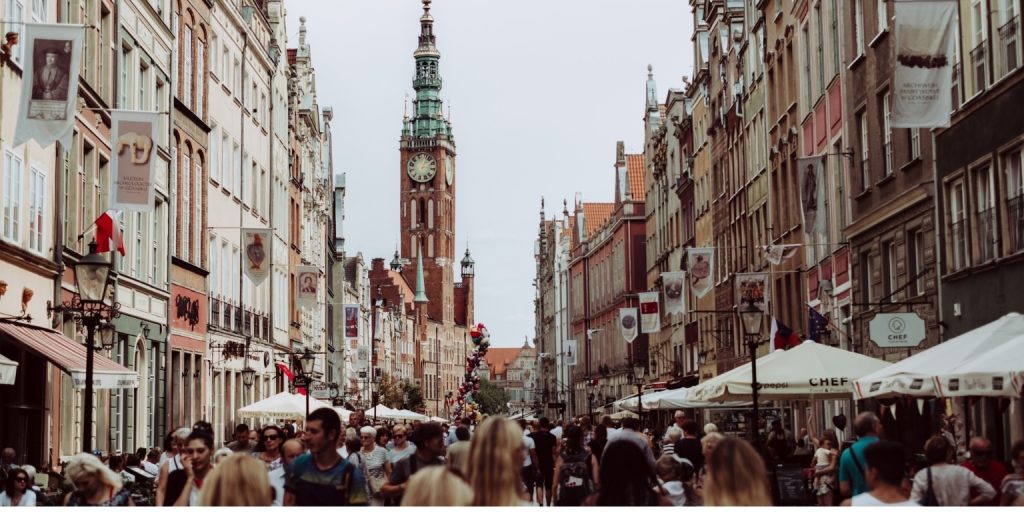
Beyond the Golden Gate unfolds Długa Street, the initial segment of the Royal Route. This thoroughfare was once the primary residential street for Gdańsk’s wealthiest merchants and patricians. The opulent, narrow tenement houses with their richly decorated facades, ornate gables, and intricately carved portals stand as a testament to the immense prosperity of the city’s elite. Each house often tells its own story, reflecting the individual tastes and fortunes of its former owners.
Długa Street then seamlessly transitions into Długi Targ (Long Market), the ceremonial and commercial heart of the Royal Route. This broad, bustling square, historically a market place where everything from meat to piglets was sold, is framed by some of Gdańsk’s most celebrated landmarks:
- Main Town Hall (Ratusz Głównego Miasta): Dominating the square, this Gothic-Renaissance masterpiece, with its impressive 83-meter tower, was the seat of the city authorities. Its lavish interiors, particularly the “Red Chamber” (Great Council Hall), are adorned with intricate woodwork and paintings, including Isaac van den Blocke’s “The Apotheosis of Gdańsk.”
- Neptune’s Fountain (Fontanna Neptuna): Situated directly in front of Artus Court, this bronze statue of the Roman god of the sea, cast in 1617, is one of Gdańsk’s most recognizable symbols, representing the city’s deep connection to the Baltic Sea and maritime trade. A local legend links Neptune to the creation of the famous Goldwasser liqueur.
- Artus Court (Dwór Artusa): Inspired by the legendary King Arthur and his Knights of the Round Table, this grand building was historically a meeting place for merchants, a venue for guilds, and a social hub for the city’s elite. Its richly decorated interior features an impressive tiled stove, towering 11 meters high.
The Final Flourish: The Green Gate
The Royal Route culminates at the Green Gate, an impressive Mannerist structure built between 1564 and 1568. Though named a “gate,” it functions more like a magnificent city residence, inspired by the Antwerp City Hall, and was intended as a royal guesthouse for visiting Polish monarchs (though none ever actually stayed there). Today, it houses a branch of the National Museum in Gdańsk, serving as a grand portal to the Motława River embankment.
The Royal Route in Gdańsk, from the defensive symbolism of the Upland Gate to the open vista of the Motława River at the Green Gate, offers a captivating journey through the city’s rich past. It is a harmonious blend of architectural brilliance, historical narrative, and vibrant contemporary life, making it the undisputed crown jewel of Gdańsk’s tourist attractions.
Further reading on Wikipedia: Długa Street, Gdańsk