What is the Gdańsk outdoor escape game?
The Gdańsk outdoor escape game is an escape room played out in the old town: you use your phone, and each of the 10 stops holds a puzzle that you solve by observing the surroundings and reasoning it through. Walking adds up to 24 minutes across 2 km, and the whole game usually fills about 2 hours.
Each puzzle is tied to a site such as Artus Court, Neptune's Fountain or the Royal Chapel, and each one stands alone, so no storyline links the stops. Stuck? Nobody has to abandon a puzzle, since up to three levels of hints can be unlocked. The Main Town suits this format because the sites sit a short stroll apart, so the puzzles keep you moving at a relaxed pace along the old Royal Route.
- Durationabout 2 hours
- Walkingabout 24 min · 2 km
- Stops10
- LanguagesEnglish, German, French, Italian, Spanish, Dutch, Polish
What you do on the Gdańsk escape game
Solve
Work out the puzzle at every stop from what is in front of you. No prior knowledge of Gdańsk is needed.
Look closer
The clues sit in the details of each site, from gate façades to the layout of the square and the riverside.
Walk
Google Maps guides you from stop to stop: about 24 minutes on foot across roughly 2.0 km.
Take your time
No countdown runs. Use a hint when you need one, stop for a coffee, and come back later or another day.
See the route and attractions →
How it works
- Book online Choose the number of players. Your booking reference arrives by email straight away.
- Get the app Download the World City Trail app from the App Store or Google Play and enter your booking reference.
- Play when you like Start whenever you are ready, walk at your own pace and pause any time. No guide, no fixed schedule.
Who it suits
Friends
The puzzles give everyone something to debate at the next site, and nobody has to know the city beforehand.
Couples
A shared challenge that keeps you talking from gate to gate, with no clock ticking in the background.
Team building
Teams of up to 5 play on their own phones, which makes it a practical choice for colleagues.
Good to know
- Bring a charged smartphone with mobile data; a power bank helps.
- Best started in daylight, so you can see the details the puzzles ask about.
- No entry tickets needed: everything happens outside the buildings. Going inside is optional and paid separately.
- Family friendly; children must be accompanied by an adult.
- Not suitable for wheelchair users and difficult with strollers.
- Teams of up to 5 work best; bigger groups split into several teams, one ticket per player.
- Every purchase helps support stray cats and dogs in Greece.
Puzzle route: from the High Gate to the Crane
10 stops · about 24 min walking · start: High Gate · finish: The Crane (Żuraw)
The first puzzle waits at the High Gate and the last at the Crane on the Motława, with eight sites in between: the Golden Gate, Artus Court, Neptune's Fountain, Long Market, the Green Gate, St Mary's Gate, St Mary's Basilica and the Royal Chapel. Daylight makes the best start, because the puzzles are solved outdoors and rain or wind slow everything down. Google Maps guides you between stops, the app lets you change the start or the order, and the puzzles need no entry tickets.
Open the route map ↗
1High GateStart
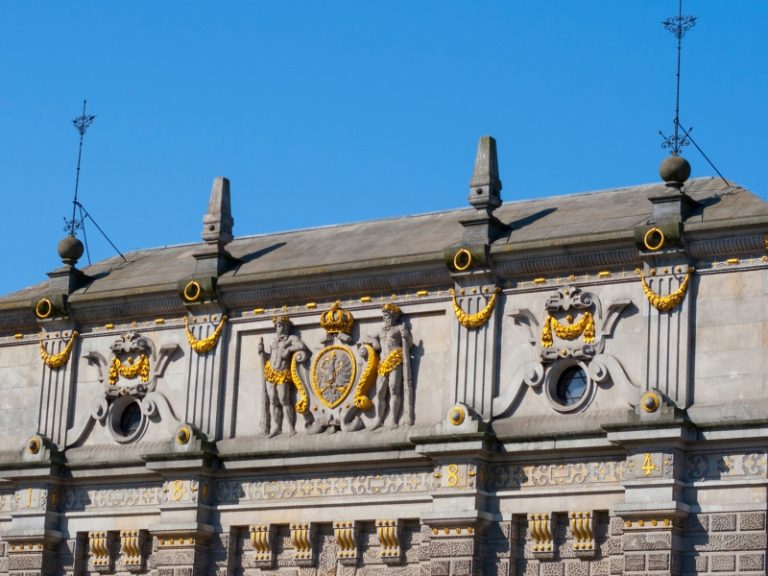
Built in the 1570s and decorated in 1588 by Willem van den Blocke, the High Gate was the main entrance to the city from the west and the start of the Royal Route. Its façade carries the coats of arms of Royal Prussia, Poland and Gdańsk, held by unicorns, angels and lions. A Latin inscription praises justice and piety as the foundations of every state.
Read the full story →
2Golden Gate
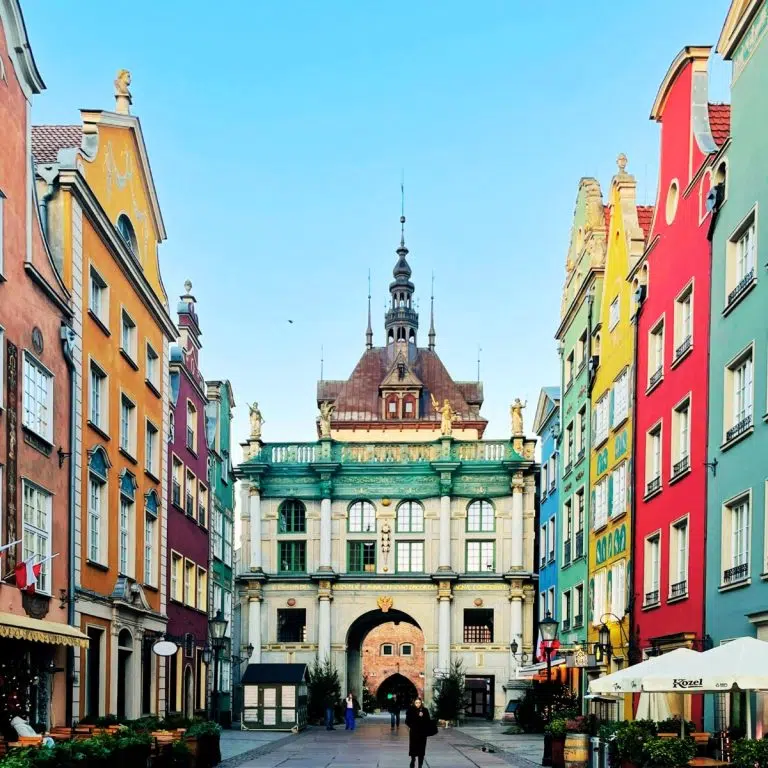
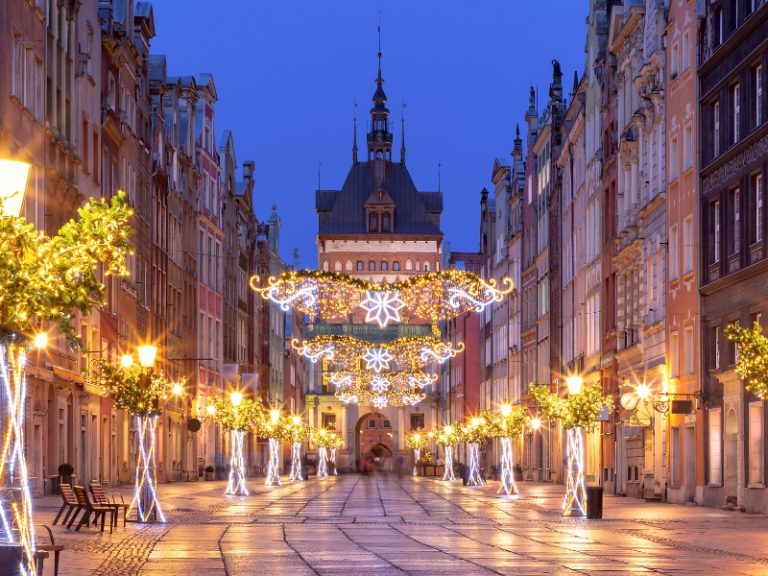
The Golden Gate was built between 1612 and 1614 to designs by Abraham van den Blocke, at the head of Długa Street. Statues on top of the gate represent civic virtues such as peace, freedom, justice and prudence. It was badly damaged in 1945 and rebuilt after the war.
Read the full story →
3Artus Court
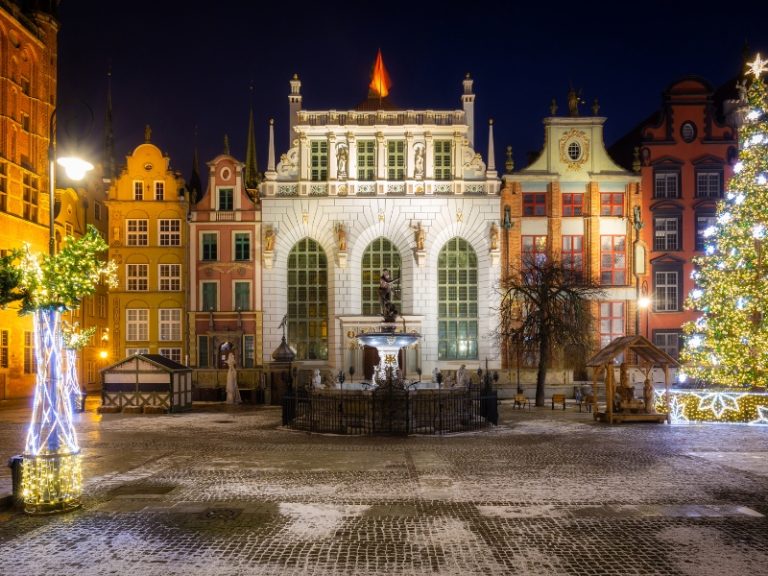
Named after the legendary King Arthur, Artus Court was the meeting place of Gdańsk's merchants and brotherhoods. Its present façade dates from the early 17th century. Inside stands a tiled stove that is one of the largest in Europe.
Read the full story →
4Neptune's Fountain
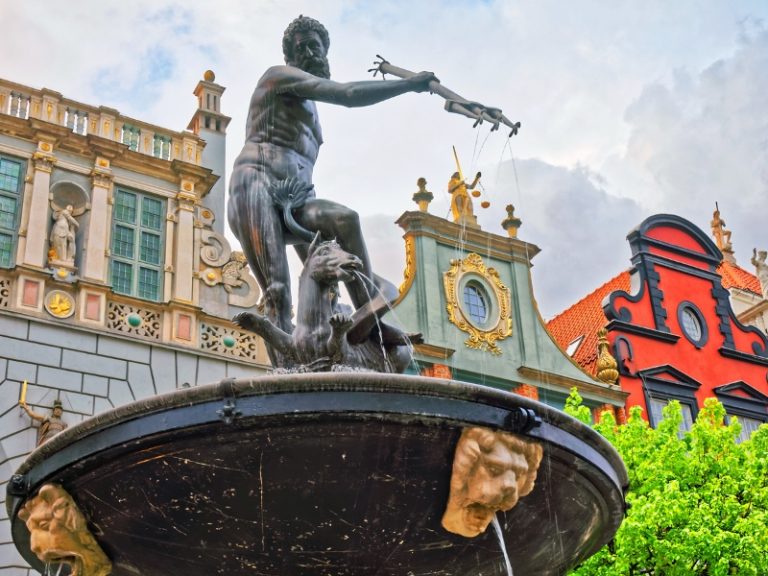
The bronze Neptune was designed by Abraham van den Blocke and cast in 1615, and the fountain has stood in front of Artus Court since 1633. It became a symbol of the city's bond with the sea. Legend says Neptune struck the water with his trident and turned the coins thrown into it into the gold flakes of Goldwasser liqueur.
Read the full story →
5Long Market
Long Market, the wide final stretch of the Royal Route, is lined with tall patrician houses, including the richly decorated Golden House. At its western end rises the Main Town Hall, whose tower is crowned by a gilded statue of King Sigismund II Augustus. Like most of the Main Town, it was rebuilt after its destruction in 1945.
Read the full story →
6Green Gate
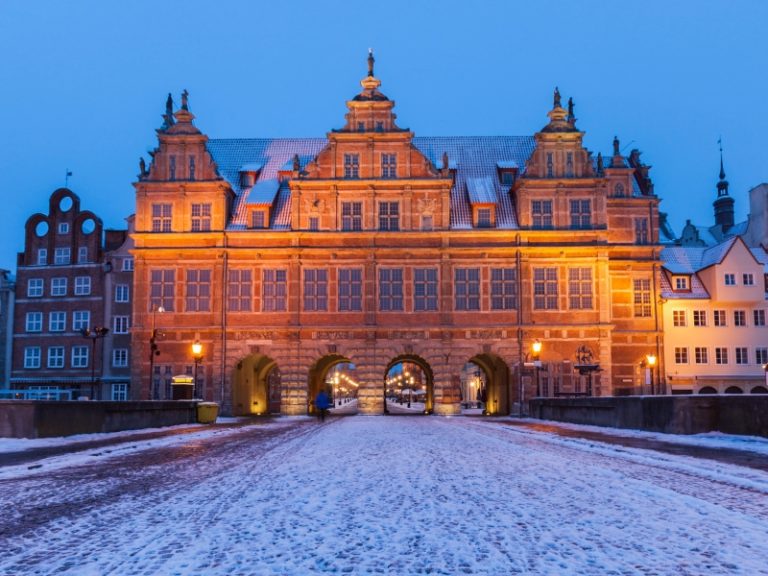
Built in the 1560s in the style of Dutch Mannerism, the Green Gate closes Long Market on the side of the Motława river. It was meant as a residence for Polish kings visiting the city, although they hardly ever stayed here. Its arches frame the view across the river to Granary Island.
Read the full story →
7St Mary's Gate
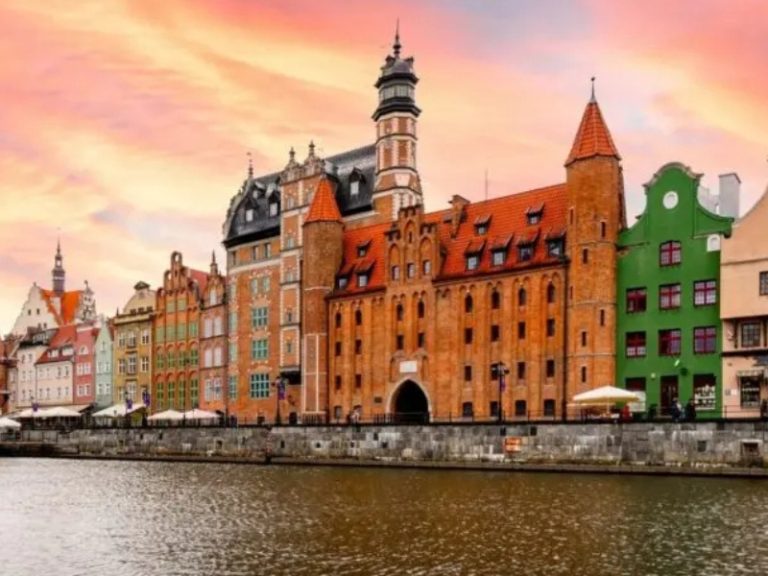
This Gothic brick gate from the 15th century leads from the Long Embankment on the Motława into Mariacka Street. The street, with its stone terraces and amber shops, runs towards St Mary's Church, one of the largest brick churches in the world. Next to the gate stands the Naturalists' House, home to the archaeological museum.
Read the full story →
8St Mary's Basilica
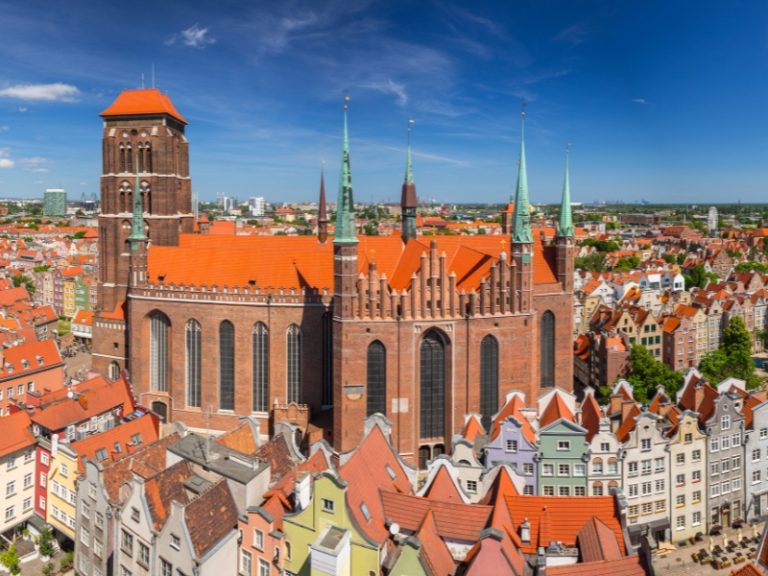
St Mary's Church was built between 1343 and 1502 and is one of the largest brick churches in the world. Its massive tower rises above the rooftops of the Main Town, and inside stands an astronomical clock made by Hans Düringer in the 1460s. Like most of the old town, it was badly damaged in 1945 and rebuilt.
Read the full story →
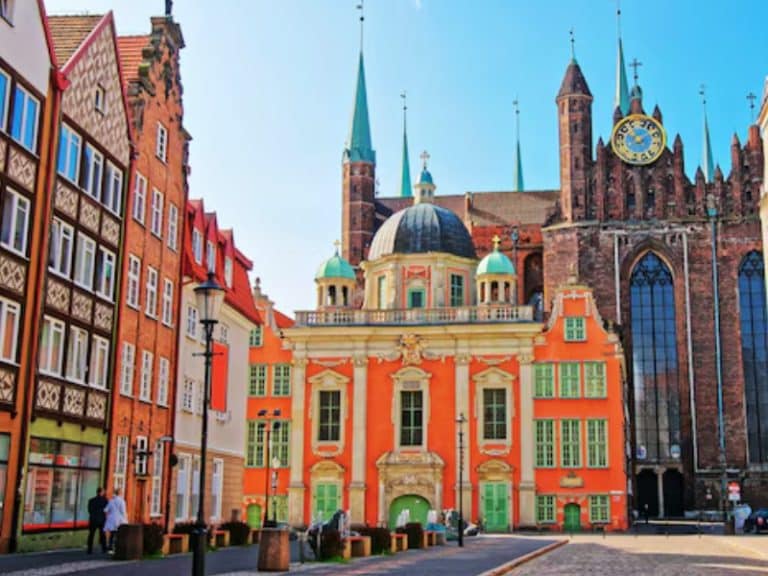
9Royal Chapel
The Royal Chapel was built between 1678 and 1681 to designs by Tylman van Gameren, with support from King John III Sobieski. It served the city's Catholics at a time when the neighbouring St Mary's was a Lutheran church. Its narrow Baroque façade stands squeezed between the houses right next to the basilica.
Read the full story →
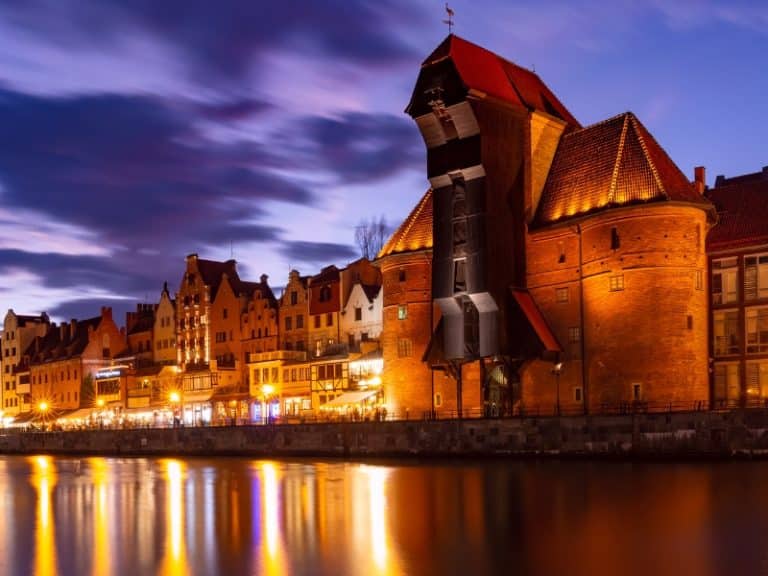
10The Crane (Żuraw)Finish
The Crane on the Motława took its present form in the mid-15th century and was one of the largest port cranes of medieval Europe. Workers walking inside its huge wooden treadwheels lifted cargo and set masts on ships. Rebuilt after 1945, it is now a branch of the National Maritime Museum.
Only logged in customers who have purchased this product may leave a review.





Nicole (verified owner) –
Ingrid (verified owner) –
Nice way to see some sights in old town Gdansk. We liked that the walk wasn’t too long, and enjoyed the amount of facts. Some riddles were difficult, some easy, some fun and some boring (like the one were we should find differences between a picture and the real building, and give the right amount of differences as the answer – not a lot of fun). Everything worked well and we like that there is no time limit.
Benita– Germany –
Collected on GetYourGuide
Prima Motivation, vor allem mit Kindern, um die Rechtsstadt zu erkunden.