
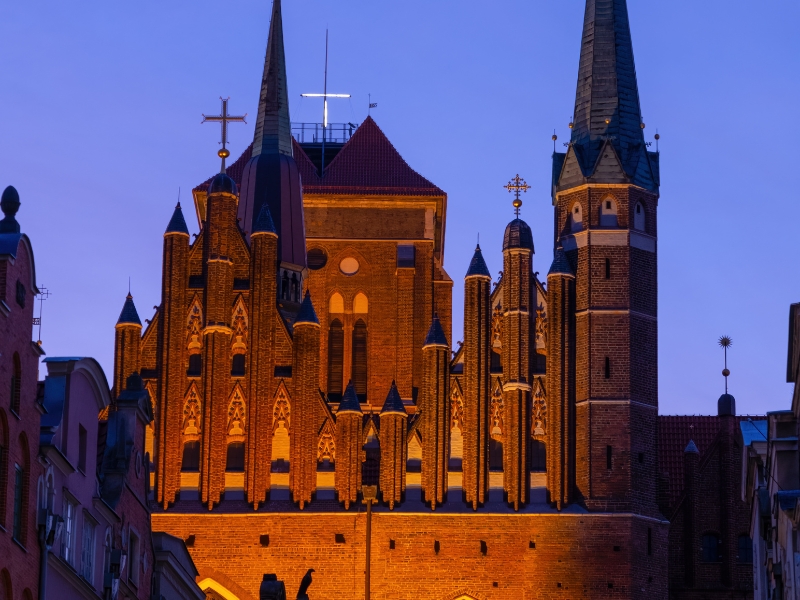
St Mary's Church (Bazylika Mariacka) is the huge red-brick church that rises above the rooftops of Gdańsk's Main Town, a short walk north of Long Market. Built between 1343 and 1502, it is one of the largest brick churches in the world, with room for over 20,000 people. Inside, look for a 15th-century astronomical clock that once again tells the time, the date and the phases of the moon.
St Mary's Church at a glance
- Where: in the Main Town (Główne Miasto), between Piwna Street and Mariacka Street, a few minutes' walk from Long Market.
- Built: 1343–1502, in several stages over about 160 years.
- What it is today: a Catholic basilica, still used for services, with a tower you can climb and a white, airy interior full of altars, epitaphs and tombstones.
- Time needed: 45 minutes for the interior; add about half an hour if you climb the tower.
Six centuries of a city church
Gdańsk built St Mary's as the parish church of its Main Town, and the work dragged on for more than a century and a half as the merchants' money allowed. It was far bigger than the city needed: a show of wealth and confidence by one of the richest ports on the Baltic. In the 16th century, as Gdańsk turned Protestant, the church passed to the Lutherans, and it remained a Lutheran church until 1945. They kept many of the Gothic altars and paintings, which is why the interior is so rich in medieval art.
In 1945 the church was badly damaged by fire, which destroyed the roof and brought down part of the vaulting. Some of its treasures had been taken away for safekeeping, but much of the furnishing was lost, and the walls were later whitewashed. After the war St Mary's became a Catholic church again and was rebuilt. In the early 1980s, during martial law, it gave shelter and support to members of the Solidarity movement. The tower was restored more recently, so the climb to the top is once again part of a visit.
What to look for
- The astronomical clock: about 14 metres tall, made by Hans Düringer in 1464–1470. Its dials show the time, the date, the phases of the moon, the sun and moon against the zodiac and a calendar of saints. Adam and Eve strike the hour, and around midday a procession of figures, including the Apostles and Death, passes by.
- The copy of Hans Memling's Last Judgment: the original triptych, painted in Bruges around 1467–1471, hung here for centuries and is now in the National Museum in Gdańsk.
- The high altar: a late Gothic altarpiece from the early 16th century showing the Coronation of the Virgin, surrounded by scenes from the Bible.
- The Beautiful Madonna: a late Gothic statue of a smiling Virgin with the Child, one of the most loved works in the church.
- The vaults: look up at the side aisles for the 'crystal' vaults, a late Gothic Baltic speciality, with sharp folded cells instead of ribs.
- The tower: about 400 steps lead to a terrace at around 80 metres, the highest viewpoint in the old town.
A painting seized at sea
Memling's Last Judgment was never meant for Gdańsk. It was commissioned by an Italian banker for a chapel near Florence and was on its way to Italy in 1473 when the Gdańsk privateer Paul Beneke captured the galley carrying it near the mouth of the Thames. The triptych was brought to Gdańsk and given to St Mary's. A separate story belongs to the clock: legend says Düringer was blinded so that he could never build a better one for another city. Similar tales are told about other astronomical clocks in Europe, so treat it as a legend.
Tips for your visit
- Come in the morning on a weekday for the quietest visit, and step aside or wait during services.
- The tower stairs are narrow and steep, with a long climb; if you go, take your time and avoid it if you dislike tight spaces.
- For the best view of the church itself, look up from Mariacka Street or from the waterfront by the Motława, where the tower rises above the rooftops.
Nearby
- Mariacka Street: the street of stone terraces and amber shops that runs from the church's east end down to the river.
- The Royal Chapel: the Baroque chapel right next to St Mary's, designed by Tylman van Gameren in the late 17th century.
- Long Market: the old market square with the Neptune Fountain and the Artus Court, a few minutes' walk south.
- The Crane (Żuraw): the medieval wooden port crane on the Motława waterfront, the city's best-known landmark.
See Gdańsk with World City Trail
Our Gdańsk scavenger hunt turns the old town into a game you play on your phone. The route links 10 stops and takes around 2 hours, with about 24 minutes of walking. It includes places such as the High Gate, the Golden Gate, the Artus Court and Neptune's Fountain. You can play in English, German, French, Italian, Spanish, Dutch or Polish.
If you prefer a different format, there is also a self-guided walking tour and an outdoor escape game in Gdańsk.
Play the Gdańsk scavenger hunt →
Take the self-guided walking tour of Gdańsk →
Play the outdoor escape game in Gdańsk →
Facts checked in October 2026.