
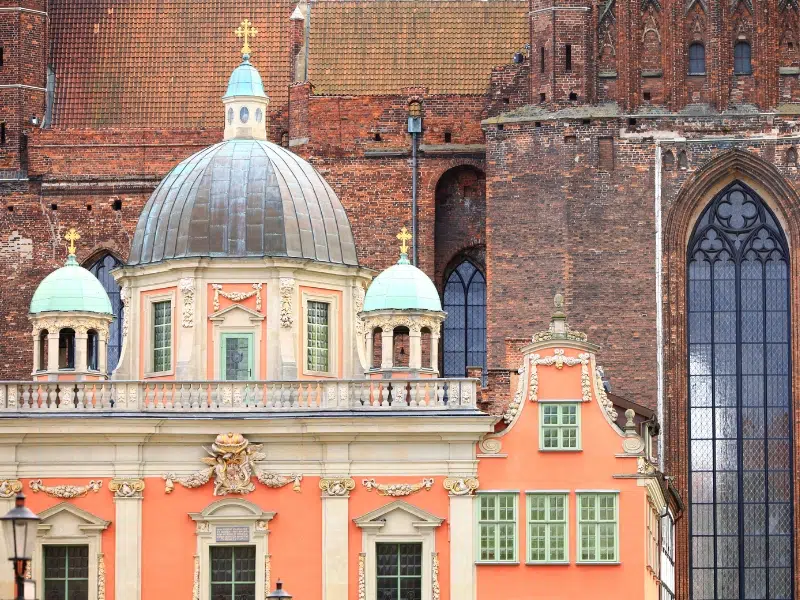
The Royal Chapel is a small Baroque church squeezed between townhouses on Świętego Ducha Street, right beside the huge brick bulk of St Mary's Church in Gdańsk. It was built between 1678 and 1681 with the support of King John III Sobieski, at a time when Gdańsk was a mainly Lutheran city and St Mary's was used for Protestant worship. It is the only Baroque church in the Main Town, and its domes stand out among the Gothic brick of the old centre.
The Royal Chapel at a glance
- Where: ulica Świętego Ducha, on the north side of St Mary's Church in the Main Town (Główne Miasto).
- Built: 1678–1681; consecrated in 1685.
- By: designed by Tylman van Gameren, a Dutch-born architect who worked for the Polish court; building work was supervised by Barthel Ranisch.
- What it is today: a Catholic church belonging to the St Mary's parish, where Mass is held only on certain occasions; the interior is usually closed outside services.
- Time needed: 10 minutes for the façade, which is the main thing to see.
A royal gift to a Protestant city
After the Reformation, Gdańsk became a largely Lutheran city, and the great parish church of St Mary was in Protestant hands. The Catholic community needed a place of worship, and the chapel was paid for largely from the will of the Primate of Poland, Andrzej Olszowski, with King John III Sobieski as its royal patron, which is where its name comes from. The groundbreaking took place in July 1678 and the building was finished in 1681. Its full name is the Church of the Holy Spirit, St Andrew the Apostle and St John the Baptist.
In March 1945, during the fighting for the city, the chapel was badly damaged: the roof collapsed and much of the interior was lost. It was rebuilt after the war, with decoration recreated from photographs and descriptions. In 2025 the city funded a restoration of the façade, cleaning and repairing the plaster and stonework and returning the windows and doors to their historic colour.
What to look for
- The north-facing façade, framed by pilasters and set between two narrow townhouses, which makes the chapel look like part of the street until you notice the domes.
- The central dome and the two smaller domes above the façade, unusual sights in a city of steep Gothic gables.
- The three entrances, with the main portal set apart from the side doors by pilasters.
- The contrast with St Mary's next door: step back and you can fit the Baroque chapel and the Gothic brick wall of the basilica into one view.
Who made the decoration?
The design is credited to Tylman van Gameren, who also built palaces and churches in Warsaw, though some sources treat the attribution with caution. The sculptural decoration is often linked to the young Andreas Schlüter, a Gdańsk-born sculptor who later became one of the great Baroque artists of Berlin. Either way, the chapel brought the courtly Baroque of Warsaw into the middle of a Hanseatic merchant city.
Tips for your visit
- Look for the chapel on Świętego Ducha Street behind St Mary's; many visitors walk past without noticing it because it is squeezed into the street line.
- If you want to see the interior, plan around a service time, as the church is generally not open for sightseeing.
- Combine it with a climb of St Mary's tower next door for a view over the roofs of the Main Town.
Nearby
- St Mary's Church: one of the largest brick churches in the world, with its astronomical clock and tower viewpoint, right next door.
- Mariacka Street: the street of terraces and stone porches leading from St Mary's to the river, a few minutes' walk away.
- Long Market and Neptune's Fountain: the grand square of the Main Town, with Artus Court and the Golden House.
- The Crane (Żuraw): the medieval port crane on the Motława, at the end of Mariacka Street.
See Gdańsk with World City Trail
Our Gdańsk scavenger hunt turns the old town into a game you play on your phone. The route links 10 stops and takes around two hours, with about 24 minutes of walking. It includes places such as the High Gate, the Golden Gate, Artus Court and Neptune's Fountain. You can play in English, German, French, Italian, Spanish, Dutch or Polish.
If you prefer a different format, Gdańsk also has a self-guided walking tour and an outdoor escape game.
Play the Gdańsk scavenger hunt →
Take the self-guided walking tour of Gdańsk →
Play the outdoor escape game in Gdańsk →
Facts checked in October 2026.