
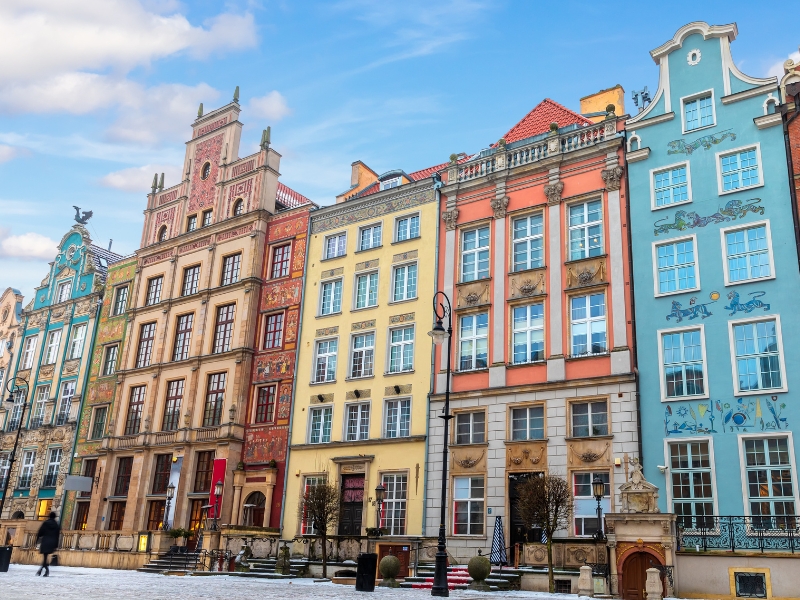
Long Market (Długi Targ) is the wide, square-like street at the end of Gdańsk's Royal Way, running from the Main Town Hall to the Green Gate on the Motława river. For centuries it was the city's main market and its grandest address, lined with merchants' houses, the Artus Court and the Neptune Fountain. Nearly everything you see was rebuilt after 1945, when the Main Town was left in ruins.
Long Market at a glance
- Where: in the Main Town (Główne Miasto).
- Created: as the market of the medieval Main Town; most façades date from the 16th to 18th centuries and were reconstructed after the Second World War.
- What it is today: a pedestrian square and the busiest stretch of the old town, with cafés, the Neptune Fountain, and the Main Town Hall and Artus Court, both branches of the Museum of Gdańsk.
- Time needed: 30 minutes to walk it and study the façades; an hour or two if you go inside the Town Hall or the Artus Court.
From merchants' market to rebuilt showpiece
Long Street and Long Market together form the Royal Way (Droga Królewska), the route Polish kings followed when they made a ceremonial entry into Gdańsk: through the Upland Gate and the Golden Gate, along Long Street and across Long Market to the Green Gate. The Main Town Hall was rebuilt in Renaissance style after a fire in 1556, and in 1561 a gilded figure of King Sigismund II Augustus was placed on top of its tower. In the early 17th century the Flemish-born architect Abraham van den Blocke shaped much of the square: he designed the Neptune Fountain, the façade of the Artus Court and the Golden House.
In March 1945, during the fighting for the city and the fires that followed, the Main Town was burned out and Long Market was reduced largely to shells and rubble. Reconstruction began soon after the war. The Main Town Hall was largely rebuilt by 1952, the Neptune Fountain was running again in 1957, and the Golden House was rebuilt using broken pieces of its original carvings, so much of its sculpted façade is old stone put back in place.
What to look for
- The Neptune Fountain: the bronze sea god in front of the Artus Court, designed by Abraham van den Blocke, cast in 1615 and working as a fountain since 1633. The fence with gilded Polish eagles was added in 1634.
- The Artus Court: the tall façade with huge windows behind Neptune, where the city's merchants met, traded and feasted.
- The Golden House (Złota Kamienica) at no. 41, built in 1609–1618 for the mayor Jan Speymann: gilded reliefs of rulers and battle scenes, statues of the four cardinal virtues along the top and Fortuna on the very summit.
- Two inscriptions on the Golden House that translate as 'Act justly, fear no one' and 'Love virtue and it will make you happy; persecute it and it will destroy you'.
- The Main Town Hall tower at the west end, just over 80 metres tall, with the small gilded figure of Sigismund II Augustus turning in the wind at the top.
- The Green Gate at the east end, built in 1564–1568 to a design by Regnier of Amsterdam as a residence for visiting Polish monarchs. No king ever actually stayed there.
Neptune and the gold in Goldwasser
A popular legend links the fountain with Goldwasser, the herbal liqueur with flakes of gold leaf that has been made in Gdańsk for centuries. People, the story goes, threw so many coins into Neptune's basin that the god lost his temper and struck the water with his trident, shattering the gold into tiny flakes that ended up in the liqueur. It is only a legend.
Tips for your visit
- Come early in the morning or in the evening. At midday in summer the square is packed, and the façades look best in low sunlight.
- For the classic photo, stand by the Green Gate and look west to the Town Hall tower. In summer you can also climb the Town Hall tower for a view down the whole Royal Way.
- Walk the full Royal Way: start at the Upland Gate and the Golden Gate, follow Long Street, cross Long Market and finish at the Green Gate.
- In late July and August the St Dominic's Fair (Jarmark św. Dominika) fills the streets around the square with stalls.
Nearby
- The Motława waterfront: walk through the Green Gate to the riverside promenade and the medieval Crane (Żuraw), the wooden port crane that has become the symbol of Gdańsk.
- St Mary's Church: one of the largest brick churches in the world, a few minutes' walk north, with an astronomical clock from the 15th century.
- Mariacka Street: the street of stone terraces and amber shops that runs from St Mary's Church down to the river.
- Long Street and the Golden Gate: the western half of the Royal Way, ending at the Golden Gate, finished in 1614.
See Gdańsk with World City Trail
Our Gdańsk scavenger hunt turns the old town into a game you play on your phone. The route links 10 stops and takes around 2 hours, with about 24 minutes of walking. It includes the Artus Court and the Neptune Fountain on Long Market, as well as the High Gate and the Golden Gate on the Royal Way. You can play in English, German, French, Italian, Spanish, Dutch or Polish.
If you prefer a different format, there is also a self-guided walking tour and an outdoor escape game in Gdańsk.
Play the Gdańsk scavenger hunt →
Take the self-guided walking tour of Gdańsk →
Play the outdoor escape game in Gdańsk →
Facts checked in October 2026.