
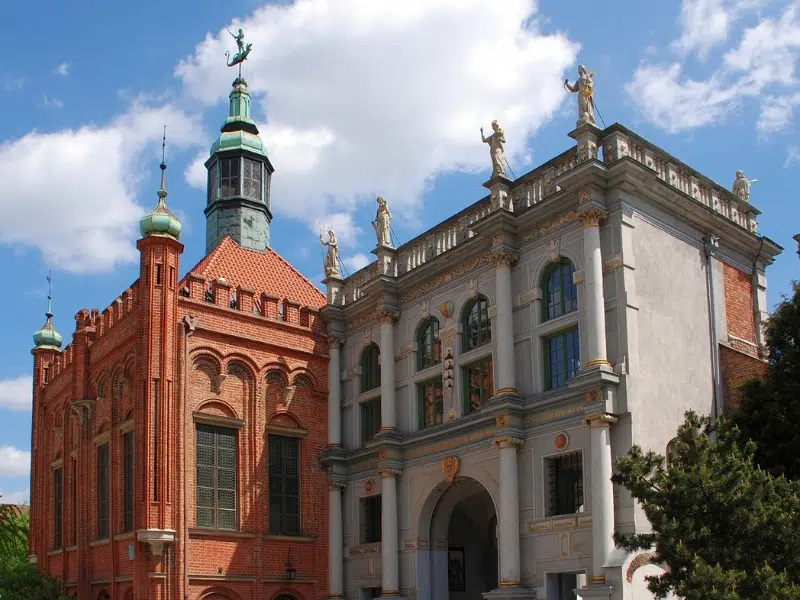
The Golden Gate (Złota Brama) is the stone triumphal arch at the western end of Długa, the Long Street of Gdańsk's Main Town. It was built in 1612–1614 where a Gothic gate had stood, and along its roofline stand eight statues of the virtues a good citizen of Gdańsk was supposed to have. Polish kings visiting the city passed through it on their way to the Long Market.
The Golden Gate at a glance
- Where: the western end of Długa (Long Street), between the Prison Tower and the street itself, on the Royal Route through the Main Town.
- Built: 1612–1614, in place of the medieval Long Street Gate.
- By: designed by Abraham van den Blocke and built by Jan Strakowski; the statues were carved by Piotr Ringering in 1648 to designs by Jeremias Falck.
- What it is today: a pedestrian gateway into the Main Town; the building belongs to the Gdańsk branch of SARP, the Association of Polish Architects.
- Time needed: 10–15 minutes to look at both sides.
From city gate to triumphal arch
The first gate here was the brick Long Street Gate (Brama Długouliczna), built around 1346 as part of the town walls. By the early 17th century Gdańsk had grown rich on the Baltic grain trade and its defences had moved further out, so the old gate was pulled down around 1611 and replaced with something more prestigious: a two-storey arch in the Dutch Mannerist style, designed by Abraham van den Blocke. Royal entries came in through the Highland Gate, passed under the Golden Gate and continued along Długa to the Long Market, a route now called the Royal Route.
The statues on the attic were added in 1648. Weather wore the originals down, and the figures you see are copies made in 1878. In the 19th century the building housed an art school. During the Second World War Soviet shelling damaged the gate, but it was not destroyed, and it was repaired in 1957. A staged restoration began in the 2020s; in 2025 workers uncovered the brick foundations of the old Gothic gate under the passage. Parts of the facade may be under scaffolding while the work continues, so check before you go if you want a clean photo.
What to look for
- The four statues on the west side, facing the Prison Tower: Peace, Freedom, Wealth and Fame.
- The four statues on the Long Street side: Concord, Justice, Piety and Prudence.
- The columns: Ionic columns on high pedestals on the ground floor, Corinthian columns on the upper storey, as in a classical textbook.
- The coat of arms of Gdańsk, two crosses under a crown held by lions, above the main passage on both sides.
- The late-Gothic house of the Brotherhood of St George right next to the gate, topped by a figure of St George fighting the dragon.
Two inscriptions, two languages
The gate speaks to passers-by in Latin and in German, the two written languages of old Gdańsk. The Latin line, borrowed from the Roman historian Sallust, reads 'Concordia res publicae parvae crescunt, discordia magnae concidunt': through concord small states grow, through discord great ones fall. It was a pointed message in a city that prized its own self-government. The German inscription is taken from Psalm 122, a prayer for peace within the city walls and prosperity for those who love the city; it was restored in the 1990s.
Tips for your visit
- Come in the morning for sunlight on the Long Street side and in the afternoon for the west side.
- For the full facade, stand back on the square by the Prison Tower; from Długa, walk a few steps east and turn round.
- Walk on along the Royal Route: Długa leads straight to the Long Market, Neptune's Fountain and the Green Gate.
Nearby
- Highland Gate: the outer Renaissance gate where the Royal Route begins, a couple of minutes' walk west.
- Prison Tower and Torture House: the medieval fortifications between the Highland Gate and the Golden Gate.
- Uphagen House: an 18th-century merchant's house on Długa, now a museum of burgher interiors, a short walk along the street.
- Long Market: the city's grand square with Neptune's Fountain, Artus Court and the Main Town Hall, a few minutes' walk east.
See Gdańsk with World City Trail
Our Gdańsk scavenger hunt turns the old town into a game you play on your phone. The route links 10 stops and takes around 2 hours, with about 24 minutes of walking. The Golden Gate is one of the stops, along with the High Gate, Artus Court and Neptune's Fountain. You can play in English, German, French, Italian, Spanish, Dutch or Polish.
If you prefer a different format, there is also a self-guided walking tour and an outdoor escape game in Gdańsk.
Play the Gdańsk scavenger hunt →
Take the self-guided walking tour of Gdańsk →
Play the outdoor escape game in Gdańsk →
Facts checked in October 2026.