
The best things to see in Graz cluster around the Old Town: the Mariensäule, Opera Graz, the Stadtpark, the Mausoleum of Ferdinand II, Graz Cathedral, the Glockenspiel, the Landhaus, the City Hall, Sporgasse and the Uhrturm on the Schlossberg. Together they trace Graz's story from medieval Styria through Habsburg power to the UNESCO-listed old town of today.
What is the Mariensäule in Graz?
If you want a quick lesson in things to see in Graz, start at the Mariensäule, the gilded column standing Am Eisernen Tor at one end of Herrengasse. It was unveiled in 1670 on the Karmeliterplatz, designed by the master builder Domenico Sciassia. The column was raised as a vow: Emperor Leopold I had it built in gratitude for the city’s protection from plague and Turkish invasions.
It hasn’t always stood where you find it today. In 1796 it was moved to the newly created Jakominiplatz to give the growing suburb founded by Andreas von Jakomini a landmark of its own. Only in 1928 did it finally arrive at its current spot Am Eisernen Tor. Look closely at the top: a gilded Virgin Mary stands on a globe, her foot on a serpent, a classic baroque way of showing good triumphing over evil. It’s a public monument with no fixed hours or fee, so you can swing by any time.
Why is Opera Graz worth stopping at?
Walk on to the Opernring and the building in front of you is the second largest opera house in the country. Designed by Ferdinand Fellner and Herman Helmer in neo-baroque style, the Graz Opera was inaugurated in 1899 with a performance of Schiller’s play William Tell, followed a few days later by Wagner’s Lohengrin. It’s built as a stepped theater and remains, after the Vienna State Opera, the second largest opera house in Austria.
The building has seen rough times too. It suffered damage during World War II bombings but was repaired, and between 1983 and 1985 it underwent a fifteen million dollar renovation that installed modern equipment without significantly changing the original exterior and interior. One detail worth a look: the painted iron safety curtain inside was made by the artist Alexander Rothaug. Tickets vary by performance and are sold through the Oper Graz box office; if you just want the facade, it’s free to admire from the ring road any time.
What's in Graz's Stadtpark?
The Stadtpark is the green lung right beside the Opera, laid out in the second half of the 19th century as Graz grew beyond its medieval walls and the old fortifications were dismantled. It’s landscaped in the English style, with winding paths, ponds and mature trees, and dotted with monuments and busts of Styrian figures rather than one single attraction. Look for the Musikpavillon bandstand, still used for concerts in summer, and the old spa building, the Kurhaus, tucked into the greenery. Entry is free and it’s open around the clock, making it an easy spot to slow down between the busier stops on your walk.
What is the Mausoleum of Ferdinand II in Graz?
Next to the Cathedral rises one of the more unusual buildings on any list of things to see in Graz: the Mausoleum of Emperor Ferdinand II. Construction began in 1614 under the patronage of Archduke Ferdinand II of Habsburg, who later became Holy Roman Emperor, and it was intended to serve as a dynastic burial site and as a symbolic monument tied to the Catholic Counter Reformation in Inner Austria.
The design came from an Italian court painter turned architect. In 1614 Ferdinand commissioned his Italian court painter and architect to erect a mausoleum and an adjacent St. Catherine’s Church next to today’s Cathedral, meant to become one of the most important buildings of the early 17th century in Austria. Work stalled once Ferdinand left for Vienna. In 1619 Ferdinand was elected emperor and left Graz for Vienna, construction at the Mausoleum came to a standstill, and in 1637 Ferdinand was laid to rest in a half-finished tomb. The detail to look for inside is the oval dome over the burial chapel: it was the first of its kind built outside Italy. The Mausoleum is open to visitors during normal opening hours and there is no entrance fee.
What's the story behind Graz Cathedral?
Graz Cathedral, the Dom, sits right beside the mausoleum and forms the religious heart of the old town. The Gothic hall church was built in the 15th century for Emperor Frederick III, with the tower and roof dating from the 1460s, and it was later given a baroque makeover inside. Look up above the south portal for a faded but striking fresco from 1485 known as the Landplagenbild, painted after a year of plague, locusts and Turkish raids, one of the oldest surviving depictions of its kind north of the Alps. The cathedral is generally open daily and free to enter, though donations toward its upkeep are welcome.
Where can you hear the Glockenspiel in Graz?
A short walk from the cathedral brings you to the Glockenspielplatz, a small square named for the mechanical clock set into the gable of a building here since the early 20th century. Twice a day, at 11am and 3pm (with an evening show added in the warmer months), two painted wooden figures in traditional Styrian dress emerge and turn slowly to a chime of bells while a little tune plays below. It’s a free, no-fuss stop and one of Graz’s most photographed corners, especially once the surrounding cafe terraces fill up.
What is the Grazer Landhaus?
Head to Herrengasse for one of the city’s architectural landmarks. The Italian fortress builder Domenico dell’Allio erected the Grazer Landhaus in 1531, and it was the first Renaissance building in the city. Step into the courtyard rather than just admiring the street facade: the inner courtyards with their elegant arcades are especially worth seeing.
The building is still working, not just decorative. Today it houses the Landtag, the Styrian regional parliament. The courtyard is generally accessible free of charge during the day, though the parliamentary chambers themselves are only seen on organised tours.
What should you notice at Graz's City Hall?
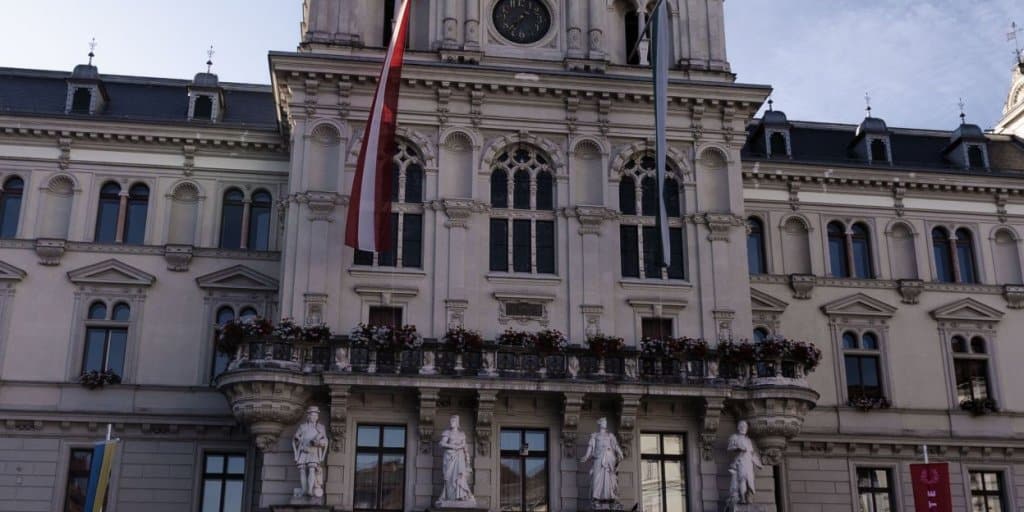
The Rathaus dominates the main square, Hauptplatz, with a facade rebuilt at the end of the 19th century in a heavy neo-baroque style after the older town hall on the site was demolished. It’s still the seat of the mayor and city council today. Look at the roofline for the allegorical statues and the clock, and notice how the building anchors the whole square, with cafes and market stalls spreading out in front of it much as they have for centuries. The exterior and square are open at all hours and cost nothing to wander through.
Why is Sporgasse one of the things to see in Graz?
From the Hauptplatz, Sporgasse climbs gently toward the Schlossberg and is one of the oldest streets in the city, its name recalling the spur makers, the Sporer, who once had their workshops here. Walk it slowly and you’ll spot house after house with medieval and Renaissance details still intact, oriel windows, carved doorways, faded frescoes under the eaves. Keep an eye out for the small Ottoman-style turban sculpture perched above one of the doorways, a quirky souvenir of the city’s long entanglement with the Ottoman wars. The street itself is free to walk, day or night.
What is the Uhrturm and can you go inside?
The Uhrturm, the clock tower on top of the Schlossberg, is the single most recognisable symbol of Graz. Its stone base is medieval, but the current tower dates largely from the 16th century, part of the fortifications that once ringed the hill. The oversized clock hands, deliberately made so the hour hand is shorter than the minute hand, so from a distance you’d once have misread the time, are the detail everyone points out. You can reach the tower on foot up the Schlossbergsteig steps, by the Schlossbergbahn funnicular, or by lift through the tunnels inside the hill; the lift and funicular both charge a small one way fare, while walking up costs nothing but a bit of puff. The tower itself is a viewing point rather than a museum, and it’s accessible during daylight hours year round.
| Where | Graz Old Town, Styria, Austria |
| Best season | Spring to autumn, April to October, for outdoor stops and the Stadtpark |
| Cost | Most stops are free; Uhrturm funicular and lift cost a small one way fare |
| How long | About 2 to 3 hours to walk the whole route at a relaxed pace |
Questions people ask about Graz
Is Graz Cathedral free to visit?
Yes, the cathedral is generally open daily and free to enter, though visitors are asked to be respectful during services and donations toward upkeep are welcome.
How do you get up to the Uhrturm?
You can walk up the Schlossbergsteig steps for free, or take the Schlossbergbahn funicular or the lift through the tunnels inside the hill for a small fee.
Is the Mausoleum of Ferdinand II open to the public?
Yes, it’s open during normal visiting hours next to Graz Cathedral and there’s no entrance fee.
Where does the Glockenspiel perform?
On the Glockenspielplatz, a small square just off Sporgasse, usually at 11am and 3pm with figures appearing to bells and music.
What is inside the Grazer Landhaus today?
It houses the Landtag, the Styrian regional parliament, though the Renaissance courtyard with its arcades is open for visitors to walk through.