
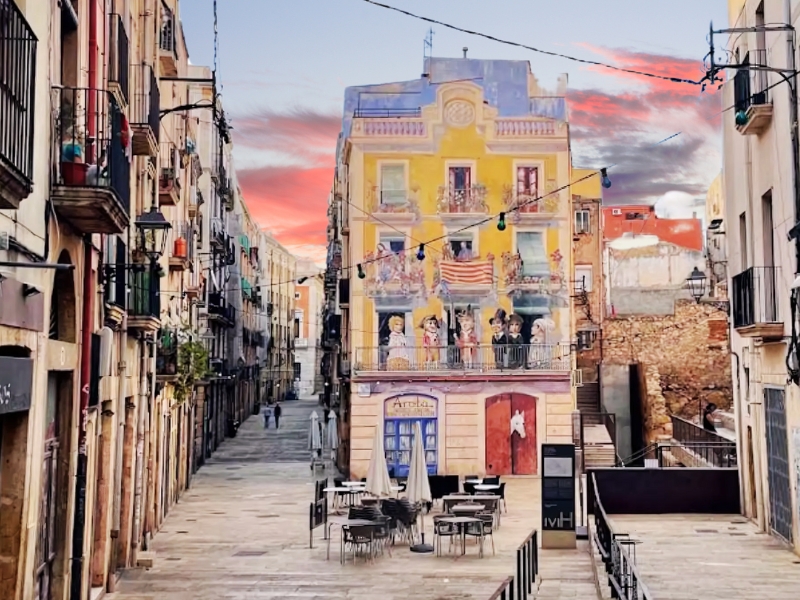
This guide covers six places in Tarragona that tell the story of the city beyond its Roman ruins: the Central Market, the Balcó del Mediterrani, the City Hall on Plaça de la Font, the old town known as the Part Alta, the painted Plaça dels Sedassos and the decorated bollards of Carrer del Comte. They run from the 19th-century city along the Rambla Nova up into the medieval streets, so you can see them all on one walk.
Central Market (Mercat Central)
Tarragona's covered market stands on Plaça Corsini, just off the Rambla Nova. It was built between 1911 and 1915 to a design by Josep Maria Pujol de Barberà, the architect who shaped much of Modernista Tarragona, with a cast-iron frame and a high vaulted roof. After a long renovation it reopened in 2017, and its stalls of fish, meat, fruit, cheese and charcuterie are again where many locals do their shopping. It is a stop on our scavenger hunt.
- The cast-iron columns, the tall windows that light the hall and the decorated gables on the outside.
Balcó del Mediterrani
At the sea end of the Rambla Nova, the city's main boulevard, the street stops at a viewpoint on top of the cliff. From the Balcó del Mediterrani you look down over the railway and the beach of El Miracle, along the coast and across to the port, with the Roman amphitheatre just below. Locals have a habit of walking up to the end of the Rambla to 'tocar ferro', touch the iron railing, a daily ritual that often turns into a chat with friends. Touching iron is the Catalan way of knocking on wood, so do it yourself for luck. The balcony is a scavenger hunt stop.
- The iron railing itself, polished by countless hands.
City Hall and Plaça de la Font
Tarragona's City Hall stands on Plaça de la Font, a long, narrow square whose shape follows the arena of the Roman circus, where chariot races once took place. The present building, with its neoclassical front and Ionic columns, dates from the 19th century and replaced a convent that stood on the site. Inside is a mausoleum of King James I of Aragon, the 13th-century conqueror of Mallorca and Valencia, though his remains now lie at Poblet Monastery. The City Hall is one of the scavenger hunt stops.
- The long, slightly curving shape of the square, which traces the circus track hidden under the houses.
- The café terraces along the square, one of the liveliest places in the old town in the evening.
The Part Alta, Tarragona's old town
The Part Alta is the upper town, on the hill where the Romans built the provincial capital of Tarraco. Its medieval streets were laid out over the Roman forum, temple and circus, and Roman stones appear in house walls, cellars and shop floors. The remains of Tarraco, from the walls to the amphitheatre, have been on UNESCO's World Heritage list since 2000. At the top stands the cathedral, built on the site of the Roman temple. Today the Part Alta is a district of narrow lanes, small squares, bars and craft shops, and it fills up in September for the Santa Tecla festival, when human towers rise in Plaça de la Font.
- The Roman walls along the Passeig Arqueològic, whose lowest blocks are among the oldest Roman structures in Spain.
- Arches and vaults of the Roman circus that still show in the buildings around Plaça de la Font and the lanes behind it.
Plaça dels Sedassos
This small square in the Part Alta looks at first like a row of old houses with people leaning from their balconies. In fact the whole façade is a trompe-l'oeil mural, painted in 1995 by the Barcelona artist Carles Arola. It shows Tarragona houses of the late 19th century and a crowd of figures: nobles, a doctor, a harlequin, a captain holding a staff with coloured ribbons and local festival figures. The artist painted himself at work on a balcony and his wife watering the plants. The square is a scavenger hunt stop.
- The open birdcage, a symbol of freedom, and the horse at the bottom of the mural.
- The painted windows on the neighbouring walls, with a grandmother and a child looking out.
Carrer del Comte and its painted bollards
On Carrer del Comte in the Part Alta, the short bollards that keep cars off the pavement are painted. They are the work of the International Pilons Parade, a neighbourhood event during the street's own festival of Sant Agapit Bis, in which residents, local groups, students and visitors each decorate one bollard and the best ones win a prize. The 2025 edition was the 17th, with 47 bollards painted. The designs change with each edition, so there is always something new to find.
How to see them in one walk
Start at the Central Market and walk down the Rambla Nova to the Balcó del Mediterrani to touch the iron. Follow the cliff edge past the Roman amphitheatre, then climb into the old town to Plaça de la Font and the City Hall. From there wander up through the Part Alta to Carrer del Comte and Plaça dels Sedassos, and finish at the cathedral at the top of the hill.
See Tarragona with World City Trail
Our Tarragona scavenger hunt turns the city into a game you play on your phone. The route links 10 stops, from the Monument als Castellers on the Rambla Nova to the cathedral, and four places in this guide are among them: the Central Market, the Balcó del Mediterrani, the City Hall and Plaça dels Sedassos. The route also takes in the Roman amphitheatre and circus. At each stop you solve a puzzle and hear a short story, at your own pace.
If you prefer a different format, there is also a self-guided walking tour and an outdoor escape game in Tarragona.
Play the Tarragona scavenger hunt →
Take the self-guided walking tour of Tarragona →
Play the outdoor escape game in Tarragona →
Facts checked in October 2026.