
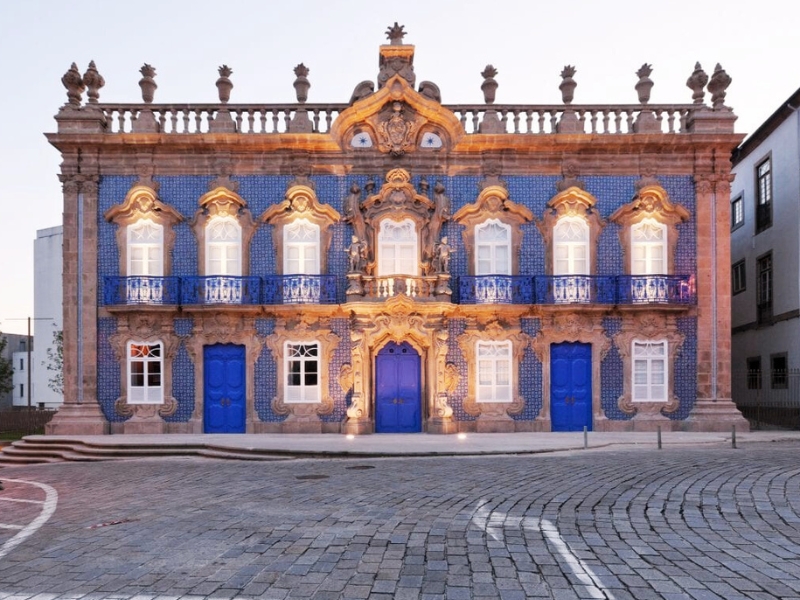
This guide covers five places in the centre of Braga: the fountain on Praça da República, the medieval castle tower, the City Hall, the Biscainhos Museum and the Palácio do Raio. Braga was ruled for centuries by powerful archbishops, and in the 18th century they and the city's rich families rebuilt it in an exuberant Baroque style. These five places, all within a short walk of each other, show that story from a medieval keep to tiled palace fronts.
Praça da República and its fountain
Praça da República is Braga's main square, the meeting point between the old town and the newer avenues. Locals call it the Arcada, after the arcaded buildings along one side, which date from the 18th century. The square took its present name after the proclamation of the Portuguese Republic in 1910. In the middle, a large fountain sends up jets of water in front of the long garden of Avenida Central, and on warm evenings its rim is a favourite place to sit. From the square, Rua do Souto, the old town's main shopping street, leads towards the cathedral. The fountain is the first stop of our scavenger hunt.
- Café Vianna under the arcades, open since 1858 and one of the oldest cafés in the city.
- The Lapa church, an 18th-century chapel set into the middle of the arcaded front.
Braga Tower (Torre de Menagem)
Just behind the arcades, hemmed in by shops and houses, rises the keep of Braga's medieval castle. It was built during the reign of King Dinis (1279–1325), when the city was given new walls, and it is about 30 metres tall, with three floors inside. The rest of the castle was pulled down in 1905, and only this square Gothic tower was spared; it was made a national monument in 1910. Pieces of the medieval walls survive here and there in the old town, but this tower is the clearest reminder that Braga was once a fortified city. It is one of the scavenger hunt stops.
- King Dinis's coats of arms on the walls, the double window near the top and the corner lookouts under the crown of battlements.
Braga City Hall
The City Hall on Praça do Município is one of the finest Baroque buildings in Braga. The archbishop D. José de Bragança, a brother of King João V, commissioned it, and work began in 1753 to a design by André Soares, the local architect who shaped much of Baroque Braga. Building dragged on for more than a century and was only completed in 1865, on a site where a bullring once stood. Soares worked in a lively late Baroque style, with curving lines and deep carving in the local granite. It is one of the scavenger hunt stops.
- The granite front with its richly carved central doorway, balcony and window frames.
- The Pelican Fountain in the square in front, a pelican feeding its young.
Biscainhos Museum
The Biscainhos is a noble townhouse whose building was begun in the late 17th century by Constantino Ribeiro do Lago and completed by his son in 1699; it was extended in the 18th century. The name probably comes from Basque craftsmen from Biscay who were working in Braga at the time. The house stayed in the hands of the same family line for centuries and opened as a museum in 1978. Its rooms are furnished as an 18th-century noble home, with painted ceilings, tiles, furniture, porcelain, glass and clocks, so it is one of the best places in Braga to see how the families behind these grand fronts actually lived. It is a scavenger hunt stop.
- The main hall lined with azulejos and topped by a painted ceiling.
- The garden behind the house, about a hectare on three terraces, with stone basins and old tulip trees.
- The small domed pavilion on the garden wall.
Palácio do Raio
Few façades in Portugal are as eye-catching as this one. André Soares designed the palace in 1754–55 for a wealthy merchant, João Duarte de Faria. It takes its name from Miguel José Raio, Viscount of São Lázaro, who bought it in 1853 after making his fortune in Brazil; locals also call it the Casa do Mexicano. The bright blue tiles that cover the front were added in the late 19th century. Today it belongs to the Santa Casa da Misericórdia, Braga's historic charity, and since 2015 it has housed a small museum on its history. It is the last stop of the scavenger hunt.
- The blue tile front framed by curving granite window surrounds, a typical Braga mix of stone and tile.
- The carved granite doorway and the balcony above it.
How to see them in one walk
Start at the fountain on Praça da República and walk into the arcades, then turn behind them to find the castle tower. From there head to the Santa Barbara Garden beside the old archbishops' palace and on to the City Hall on Praça do Município. The Biscainhos Museum is a few streets west. Then go through the Arco da Porta Nova, past the cathedral, and finish at the Palácio do Raio near the Santa Cruz church. Leave time for the Biscainhos, the only one of the five places where you can spend a long time indoors, and for the cathedral, one of the oldest in Portugal.
See Braga with World City Trail
Our Braga scavenger hunt turns the old town into a game you play on your phone. The route links 10 stops, from the fountain on Praça da República to the Palácio do Raio, and all five places in this guide are among them, together with A Brasileira café, the Santa Barbara Garden, the Arco da Porta Nova, the cathedral and the Santa Cruz church. At each stop you solve a puzzle and hear a short story, at your own pace.
If you prefer a different format, there is also a self-guided walking tour and an outdoor escape game in Braga.
Play the Braga scavenger hunt →
Take the self-guided walking tour of Braga →
Play the outdoor escape game in Braga →
Facts checked in October 2026.