
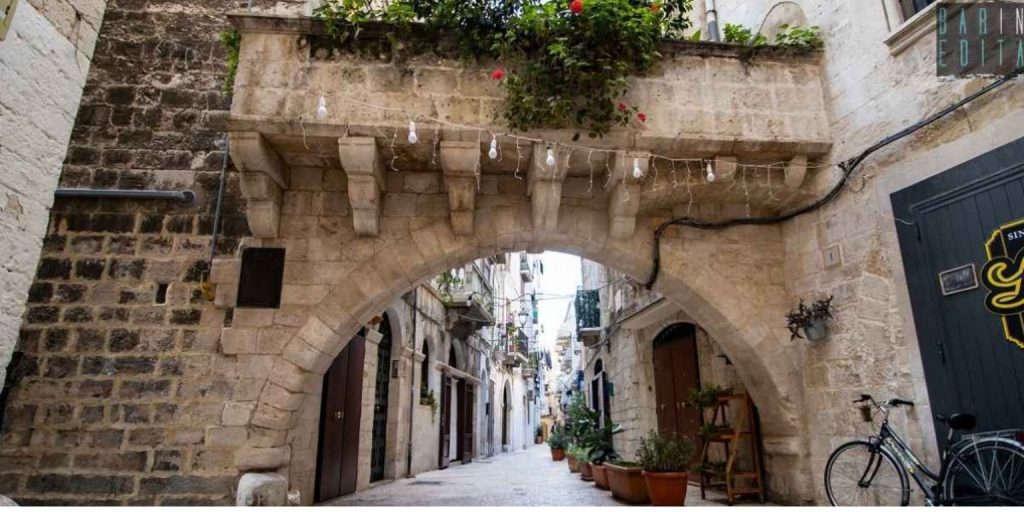
This guide follows six places along the edge of Bari Vecchia, the old town on its peninsula: two theatres in the 19th-century Murat quarter, Piazza del Ferrarese, the Fortino di Sant'Antonio on the sea wall, Piazza Mercantile and the Norman-Swabian Castle. Together they show how Bari grew from a walled medieval port into a modern city, and all six are stops on our scavenger hunt.
Teatro Petruzzelli
The Teatro Petruzzelli was paid for entirely by two Bari merchants and shipowners, the brothers Onofrio and Antonio Petruzzelli, who signed an agreement with the city in 1896. It was designed by the engineer Angelo Cicciomessere, later known as Messeni, who was married to their sister Maria. Work began in 1898, and the theatre opened on 14 February 1903 with Meyerbeer's Les Huguenots. With more than 2,000 seats it was the largest theatre in Bari and the fourth largest in Italy.
On the night of 26 to 27 October 1991 an arson fire gutted the building; the last opera staged before it was Bellini's Norma. The theatre was rebuilt and reopened in October 2009 with Beethoven's Ninth Symphony, and its first opera season after the fire began that December with Puccini's Turandot. Its ownership was argued in the courts for years, and the courts have returned it to the founders' heirs.
- The rebuilt auditorium under its dome, which you can see if you go to a performance or join a guided visit.
Teatro Margherita
The Teatro Margherita stands on piles driven into the sea, in a bend of the old harbour. The reason is a deal: the city had promised the Petruzzelli family that no other theatre would be built on municipal land, so the new theatre went over the water instead. Francesco De Giglio designed it in Liberty style, and it was the first reinforced-concrete building in Bari. It opened as the Kursaal Margherita on 22 August 1914, replacing a wooden variety theatre that had burned down in 1911.
Over the years it was a museum, a variety hall, a cinema and, during the Second World War, a garrison theatre for Allied troops. It closed in 1980, and after a long restoration designed by David Chipperfield it reopened on 6 December 2018 as a space for contemporary art and exhibitions.
- Walk around the outside to see how the building stands on its piles above the water.
Piazza del Ferrarese
Piazza del Ferrarese is the south-east entrance to Bari Vecchia, where the modern city meets the old one. With Piazza Mercantile next door it was the centre of city life and the place for markets. When the square was repaved, the foundations of Porta Nuova, a city gate built in 1612, and the walls beside it were uncovered, and their outline is now marked in the paving.
- The two rows of dark paving stones that trace the base of Porta Nuova and its walls.
Fortino di Sant'Antonio and the Muraglia
The Fortino di Sant'Antonio Abate is one of the towers that strengthened the old walls on the sea side. It was first built for defence by Giovanni Antonio Orsini Del Balzo, Prince of Taranto, pulled down by the people of Bari in 1463 and rebuilt in the 16th century. A ramp leads up to it from Piazza del Ferrarese, and from there the walk along the Muraglia, the fortified sea wall, runs around the old town towards the Santa Scolastica complex and the port.
- The view along the seafront from the top of the fort.
- The Muraglia itself: before the seafront road was built in the early 20th century, these walls rose almost straight out of the sea.
Piazza Mercantile
Piazza Mercantile is the old main square of Bari Vecchia, a large open space where markets were held. On one side stands the Palazzo del Sedile, from the 15th and 16th centuries, which was the seat of the city council. From the square, Strada Palazzo di Città leads into the alleys towards the Basilica of San Nicola.
- The Colonna Infame, the old column of justice in a corner of the square, a monument whose history historians still argue about.
Castello Normanno-Svevo
Bari's castle was probably begun in 1132 under the Norman king Roger II. In 1156 it was destroyed when King William I razed the rebellious city, and from 1233 Emperor Frederick II had it rebuilt and strengthened. Later the Aragonese and the Sforza enlarged it; Isabella of Aragon adapted it for firearms, and her daughter Bona Sforza, Queen of Poland, died here in 1557. In 1696 lightning struck a tower full of gunpowder, and in later centuries the castle served as a prison and barracks.
Today the castle is a museum run by the Italian Ministry of Culture. Inside is a collection of plaster casts of friezes and reliefs from medieval churches all over Apulia, and the rooms were reopened with new finds in 2017.
- The moat on three sides and the angular bastions of the outer walls; the north side, once washed by the sea, has no moat.
- The bridge from the south that leads into the inner courtyard and the Swabian keep.
How to see them in one walk
Start at the Teatro Petruzzelli in the Murat quarter and walk down to the seafront and the Teatro Margherita. Cross into Piazza del Ferrarese, climb the ramp to the Fortino di Sant'Antonio and follow the Muraglia for a stretch with the sea beside you. Come back down to Piazza Mercantile, then wind through the alleys of the old town past the Basilica of San Nicola and the Cathedral of San Sabino to the castle on the western edge of Bari Vecchia. The old town is a maze, so let yourself get a little lost between the stops.
See Bari with World City Trail
Our Bari scavenger hunt turns the old town into a game you play on your phone. The route links 10 stops, from the gardens of Piazza Umberto I to Largo Albicocca, and all six places in this guide are stops, along with the Basilica of San Nicola and the Cathedral of San Sabino. At each stop you solve a puzzle and learn a story, at your own pace.
There is also a self-guided walking tour and an outdoor escape game in Bari, for people who prefer a different format.
Play the Bari scavenger hunt →
Take the self-guided walking tour of Bari →
Play the outdoor escape game in Bari →
Facts checked in October 2026.