
Away from the crowds under the Two Towers, central Bologna hides a string of smaller places that are easy to walk past: the Baroque church of San Salvatore, where Guercino is buried, the terracotta front of the Oratorio dello Spirito Santo, the sculpture groups of Santa Maria della Vita, the garden square of Piazza Minghetti and the carved heads of Palazzo Bolognini Amorini Salina. All five lie a few streets from Piazza Maggiore, and all five are stops on our scavenger hunt.
Santissimo Salvatore
The church of the Santissimo Salvatore stands west of Piazza Maggiore, on a site where a 12th-century church once belonged to the Canons Regular of Santa Maria di Reno. The present Baroque building went up between 1605 and 1623 under the direction of the Barnabite priest Giovanni Ambrogio Mazenta, with the architect Tommaso Martelli. The 16th-century bell tower is the only part of the older church that survives.
Inside are eight side chapels with paintings by Garofalo, Girolamo da Treviso, Innocenzo da Imola and Carlo Bononi, a polyptych of 1353 by Vitale da Bologna, and a high altarpiece of Christ the Saviour in glory by Giovanni Francesco Gessi and Guido Reni. The painter Guercino was buried here in 1666. The church is normally closed except for arranged tours, so check before you go. It is the last stop on our scavenger hunt.
- The copper statues on the facade by Orazio Provaglia and the four evangelists attributed to Giovanni Tedeschi.
- The marble tablet in the nave that marks Guercino's grave.
The Oratorio dello Spirito Santo
This small oratory on Via Val d'Aposa was built between 1481 and 1497 for the Celestine monks of the nearby church of San Giovanni Battista. It was first dedicated to the Madonna, but took its popular name from the lay Confraternity of the Holy Spirit that met here until it was suppressed in 1798. Its front is covered in rich Renaissance terracotta decoration, restored in 1892–1893 under Alfonso Rubbiani. Today it is used by the regional delegation of the Order of Malta, so you will mostly see it from the street. It is a stop on our scavenger hunt.
- The five medallions of saints on the facade, attributed to the medallist Sperandio of Mantua.
- The fine terracotta mouldings and candelabra patterns around the door and pilasters, best seen in low sunlight.
Santa Maria della Vita
Santa Maria della Vita, a few steps from Piazza Maggiore, grew out of a hospital run from 1275 by the Battuti Bianchi, a confraternity of flagellants. The present late-Baroque church was begun in 1687–1690 on an elliptical plan by Giovanni Battista Bergonzoni; the dome by Giuseppe Tubertini was completed in 1787, and the facade was added only in 1905.
Its great treasure is the Lamentation over the Dead Christ by Niccolò dell'Arca, from 1463: a group of mourners gathered around the body of Christ, each showing grief in a different way. In the oratory next door, built in 1604–1617, Alfonso Lombardi's terracotta Death of the Virgin from 1522 has 14 statues. The church is a stop on our scavenger hunt.
- Look at both groups on the same visit and compare Niccolò dell'Arca's mourners of 1463 with Lombardi's figures of 1522, made about sixty years later.
Piazza Minghetti
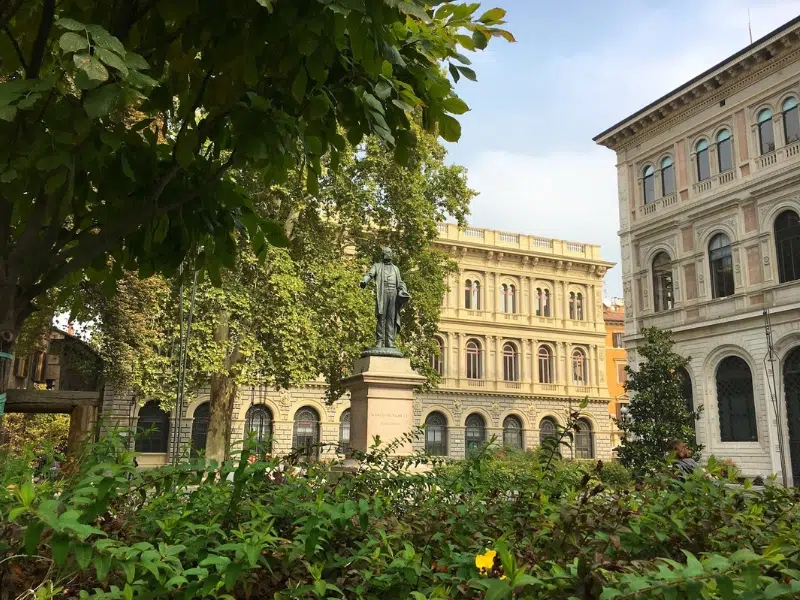
Piazza Minghetti is a garden square laid out between 1893 and 1896 to a design by Ernesto Balbo Bertone di Sambuy, who had just designed the Giardini Margherita. To make room for it, a group of medieval houses near Via de' Toschi was pulled down. The square is surrounded by the Palazzo della Cassa di Risparmio and the Palazzo delle Poste, and it is a stop on our scavenger hunt.
- The statue of Marco Minghetti, Bologna-born prime minister of Italy, by Giulio Monteverde (1896). He is shown lifting his hat and gesturing as he speaks; critics of the time joked that he seemed to be begging for money for the state.
- The trees and benches of the garden in the middle, a good place for a short break between sights.
Palazzo Bolognini Amorini Salina
On Piazza Santo Stefano stands the Renaissance palace of the Bolognini family. Giovanni Bolognini decided to build it in 1493, but rivalry with the Bentivoglio delayed the work for about twenty years. The left wing was finished by 1551, the right wing in 1602, and the building was only fully completed in 1884, when it passed to Giovanni Salina. The design is credited to Andrea da Formigine.
Over the years the palace housed the Casino dei Nobili, a society of nobles whose rooms heard performances of music by Rossini, Haydn and Donizetti, and later the British Council and the provincial tourist board. It is a private building, so you see it from the square, which is the best place for it anyway. It is a stop on our scavenger hunt.
- The two rows of terracotta heads in round frames along the facade, the 16th-century ones probably by Alfonso Lombardi and Niccolò da Volterra.
How to see them in one walk
Start at the church of San Salvatore, west of Piazza Maggiore, and walk a few streets south to the Oratorio dello Spirito Santo on Via Val d'Aposa. Head east across Piazza Maggiore to Santa Maria della Vita on Via Clavature, then continue south-east to the garden of Piazza Minghetti. Finish on Piazza Santo Stefano in front of Palazzo Bolognini Amorini Salina, with the Santo Stefano church complex across the square. The porticoes keep you dry in rain and shaded in summer, so the walk works in any weather.
See Bologna with World City Trail
Our Bologna scavenger hunt turns the old town into a game you play on your phone. The route links 10 stops, from the Two Towers to the church of San Salvatore, and all five places in this guide are stops, along with the Biblioteca Salaborsa, Palazzo d'Accursio, the Basilica of Santi Vitale e Agricola and the Basilica of San Domenico. At each stop you solve a puzzle and learn a story, at your own pace.
There is also a self-guided walking tour and an outdoor escape game in Bologna, for people who prefer a different format.
Play the Bologna scavenger hunt →
Take the self-guided walking tour of Bologna →
Play the outdoor escape game in Bologna →
Facts checked in October 2026.