
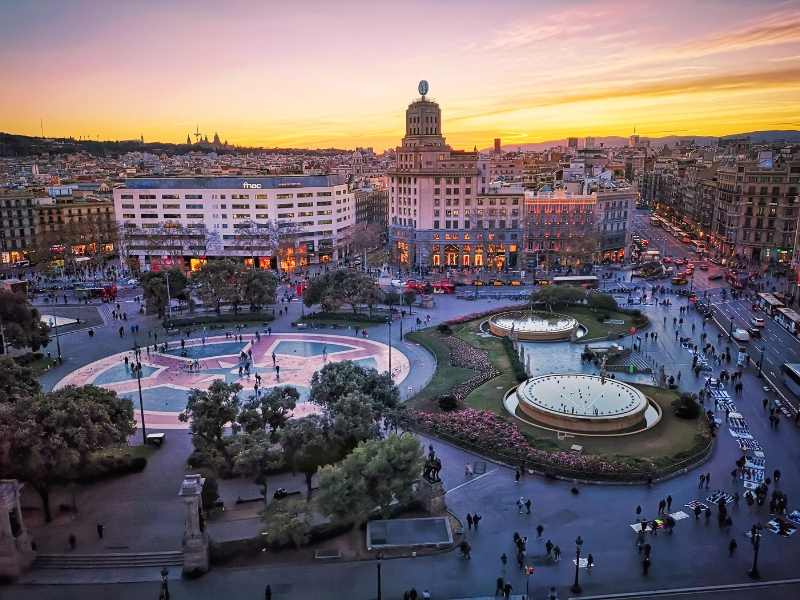
This guide follows five places from the top of the old town down to the sea: Plaça de Catalunya, the Palau de la Música Catalana, the Gran Teatre del Liceu on La Rambla, the Picasso Museum in the Born and the old fishermen's quarter of La Barceloneta. They cover music, art and everyday life in Barcelona from the 18th century to today, and you can link them on foot in a day, with time for the beach at the end.
Plaça de Catalunya
Plaça de Catalunya is the hinge between the medieval old town and the 19th-century grid of the Eixample. It was an empty space outside the city walls until the walls came down in the 1850s, and the square took its present form in the 1920s, with fountains, lawns and sculptures. Today it is Barcelona's main transport hub and the point where La Rambla, Passeig de Gràcia and Portal de l'Àngel begin.
- The monument to Francesc Macià, president of Catalonia in the 1930s, by Josep Maria Subirachs: a staircase standing upside down on the eastern side.
- The sculptures around the fountains, including La Deessa, a reclining woman by Josep Clarà.
Palau de la Música Catalana
This concert hall was built between 1905 and 1908 for the Orfeó Català, a choral society, by the architect Lluís Domènech i Montaner, one of the masters of Catalan modernisme. Inside, the walls of the hall are almost all glass, and the ceiling has a huge stained-glass skylight that hangs down like an upside-down dome. It has been a UNESCO World Heritage Site since 1997.
The stage is framed by sculptures that turn into mosaic: a row of muses, their upper bodies carved in relief and their lower halves set in tiles, playing instruments on the back wall. The hall can be seen on a guided visit or, better still, at a concert.
- The corner of the facade with the sculpted group of the Catalan folk song, by Miquel Blay.
- The mosaic columns and the busts of composers such as Bach, Beethoven and Wagner on the facade.
Gran Teatre del Liceu
Barcelona's opera house opened on La Rambla in 1847. It was paid for by private shareholders rather than a king, and it became the stage of the Catalan bourgeoisie. Its history is dramatic: a fire destroyed the auditorium in 1861, an anarchist threw bombs into the stalls during a performance in 1893, killing about twenty people, and on 31 January 1994 another fire burned the hall down again.
The theatre was rebuilt and reopened in 1999, with the horseshoe-shaped auditorium recreated in red and gold, and it is one of the largest opera houses in Europe. From outside the facade is modest; the size only becomes clear inside. Guided tours show the auditorium and the Hall of Mirrors.
- The Hall of Mirrors (Saló dels Miralls), one of the few rooms to survive the 1994 fire.
Picasso Museum
The Picasso Museum opened in 1963 in the Palau Aguilar, a Gothic palace on Carrer de Montcada, and now fills five linked medieval mansions on the same street. Pablo Picasso moved to Barcelona with his family in 1895 as a teenager and studied art here, and the museum is strongest on these early years, with academic studies, portraits and works from his Blue Period.
In 1968 Picasso gave the museum his series of 58 works based on Velázquez's Las Meninas, painted in 1957, and after his death his family added more. The collection now counts more than 4,000 works, many of them drawings and prints.
- The courtyards and Gothic staircases of the Carrer de Montcada palaces.
- The Las Meninas room, where you can follow how Picasso took apart one painting in dozens of versions.
La Barceloneta
La Barceloneta is a triangle of land between the port and the sea that was built up from 1753 on new ground, to house people who had lost their homes when the Ciutadella fortress was built. Its narrow, regular blocks of small houses, laid out by military engineers, are still easy to recognise on a map. For two centuries it was home to fishermen, sailors and dock workers, and it keeps the feel of a village by the sea.
Today it is best known for its beach and seafood restaurants. The bomba, a fried potato ball with spicy sauce, is said to have been invented in a bar here. The neighbourhood is not on our scavenger hunt route, but it is only a short walk from the waterfront stops.
- L'Estel Ferit (The Wounded Shooting Star), the stack of rusty cubes by Rebecca Horn on the beach, made for the 1992 Olympics.
- The Barceloneta market and the baroque church of Sant Miquel del Port in the middle of the grid.
How to see them in one walk
Start at Plaça de Catalunya and walk east to the Palau de la Música Catalana. From there cross the Gothic Quarter past the cathedral and come out on La Rambla at the Liceu. Walk down La Rambla to the Columbus Monument, follow the waterfront past the Rambla de Mar and El Cap de Barcelona, and turn into the Born for the basilica of Santa Maria del Mar and the Picasso Museum. Finish by walking south to La Barceloneta and the beach. Book tickets for the Palau and the Picasso Museum in advance, as both often sell out.
See Barcelona with World City Trail
Our Barcelona scavenger hunt turns the old town into a game you play on your phone. The route links 10 stops, from Plaça de Catalunya to the Picasso Museum, and Plaça de Catalunya, the Palau de la Música Catalana, the Liceu and the Picasso Museum are all stops, along with the cathedral, Güell Palace, the Columbus Monument, the Rambla de Mar, El Cap de Barcelona and Santa Maria del Mar. At each stop you solve a puzzle and learn a story, at your own pace.
There is also a self-guided walking tour and an outdoor escape game in Barcelona, for people who prefer a different format.
Play the Barcelona scavenger hunt →
Take the self-guided walking tour of Barcelona →
Play the outdoor escape game in Barcelona →
Facts checked in October 2026.