
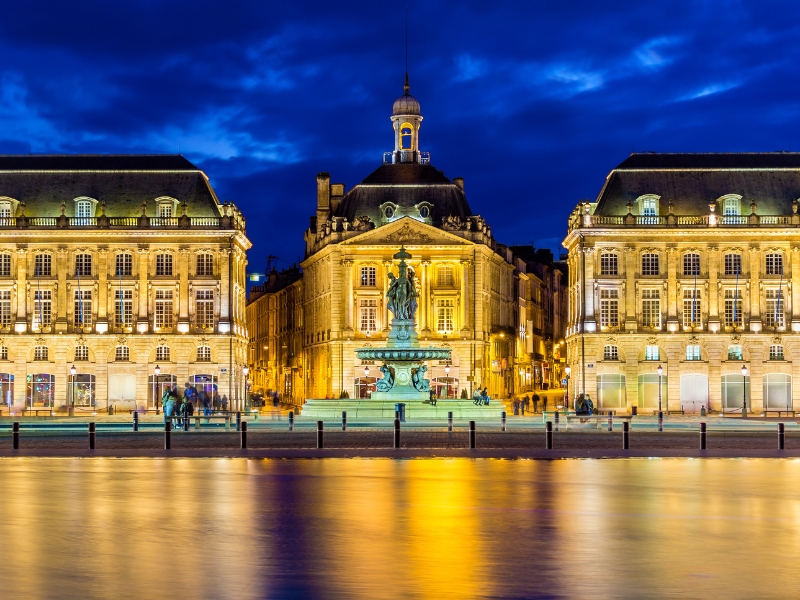
This guide links eight places that show how Bordeaux grew: the ruins of its Roman amphitheatre, two of its old city gates, a Baroque Dominican church, the Grand Théâtre, the vast Place des Quinconces, the royal Place de la Bourse on the river and the Grosse Cloche, the bell tower of the medieval town hall. From Roman Burdigala to the 18th-century port city that UNESCO listed in 2007, they make one walk across the centre.
Palais Gallien
Hidden among houses in the Fondaudège quarter, the Palais Gallien is the only Roman monument still visible in Bordeaux. It was the amphitheatre of Burdigala, built around the early 2nd century, and could hold up to about 22,000 spectators on wooden seats. The name has nothing to do with a palace: it first appears in 1367 and is linked by tradition either to the emperor Gallienus or to Galienne, a legendary queen. The arena was used as a stone quarry in the Middle Ages and sold off in plots during the Revolution; it has been a listed historic monument since 1840.
- The tall north-west gate with its arches, the best-preserved part, seen from Rue du Docteur Albert-Barraud.
- The curve of the old arena, which you can still follow in the line of the surrounding streets.
Porte Dijeaux
The Porte Dijeaux is a classical stone gate on the edge of Place Gambetta. It was built between 1748 and 1753, from plans by André Portier with sculpture by Claude-Clair Francin, when the intendant Tourny was opening up the medieval city; it replaced a 14th-century gate a little further east. The origin of the name is uncertain: one theory reads it as the Gate of the Jews in Gascon, another as a reference to a Roman temple of Jupiter. The gate is one of the stops on our scavenger hunt.
- The carved decoration above the arch and the view through it down Rue de la Porte-Dijeaux towards the old town.
Notre-Dame Church
Notre-Dame was built between 1684 and 1707 as the church of the Dominicans, known in France as Jacobins, and took its present name only in 1802. It was modelled on the Gesù in Rome, and its richly carved Baroque facade faces Place du Chapelet. Inside, a long nave with oval arcades leads to a marble high altar, and the organ by Godefroy Schmidt dates from 1785. After part of the vault collapsed, the church was closed from 1971 to 1981. It is a stop on our scavenger hunt.
- The relief above the door showing the Virgin giving the rosary to St Dominic, which gave Place du Chapelet its name.
- The Cour Mably next door, a former cloister of the convent.
The Grand Théâtre
The Grand Théâtre on Place de la Comédie was designed by Victor Louis and inaugurated in April 1780. It is home to the Opéra National de Bordeaux and the Ballet National de Bordeaux. The ballet La fille mal gardée had its premiere here in 1789. Inside, the grand staircase served as a model for the one in the Paris Opéra Garnier. The theatre is a stop on our scavenger hunt.
- The portico of 12 Corinthian columns, topped by 12 statues of the nine Muses and the goddesses Juno, Venus and Minerva.
- Step inside the hall for a look at the staircase if a guided visit or performance allows.
Place des Quinconces
The Place des Quinconces was laid out between 1810 and 1828 on the site of the Château Trompette, a royal fortress built to control the city. It is the largest square in France and one of the largest in Europe. At its west end stands the Monument aux Girondins (1894–1902), built in memory of the Girondin deputies who died in the Terror; its column carries a bronze Liberty breaking her chains. The square is a stop on our scavenger hunt.
- The bronze fountains of the monument: removed by the German occupiers in the Second World War, found in Angers in 1945 and put back in 1983.
- The two rostral columns of 1829 facing the Garonne, and the marble statues of Montaigne and Montesquieu from 1858.
Place de la Bourse
Place de la Bourse opened the old city up to the Garonne. Jacques Gabriel designed it in the 1730s and his son Ange-Jacques Gabriel, Louis XV's first architect, completed it; work lasted from 1730 to 1775. It was built as a royal square around a statue of Louis XV, which was destroyed in the Revolution. The Palais de la Bourse on the north side now houses the chamber of commerce, and the former Hôtel des Fermes on the south side holds the National Customs Museum. The square is a stop on our scavenger hunt.
- The Fountain of the Three Graces in the centre, installed in 1869.
- The Miroir d'eau across the road, a shallow sheet of water opened in 2006, which reflects the facades and produces mist; it is switched off in winter.
Porte Cailhau
The Porte Cailhau, built between 1493 and 1496, was both a defensive gate and a triumphal arch: it was dedicated to King Charles VIII after his victory at Fornovo in 1495. Its name comes from calhau, the Gascon word for pebble, after the pebble-paved quay it faced. The style mixes late Gothic and early Renaissance, and the gate is about 35 metres high including its roofs. It is a stop on our scavenger hunt and can be visited inside.
- The machicolations and portcullis slot on the river side, and the stone statue of Charles VIII, a copy from 1880 of the marble original destroyed in 1793.
The Grosse Cloche
The Grosse Cloche was a gate of the 13th-century walls, built against the church of Saint-Éloi, and became the belfry of the old town hall. The present building is mostly 15th century, and the bell that gives it its name was cast in 1775 and weighs 7,800 kilograms. The gate is also called Porte Saint-James, as it stood on the pilgrim route to Santiago de Compostela. The Grosse Cloche is the last stop on our scavenger hunt.
- The gilded leopard on the weathervane, a reminder of the time when Bordeaux was the capital of Guyenne, an English province.
- The bell itself, which is rung on a few set days a year, such as 14 July and 11 November.
How to see them in one walk
Start at the Palais Gallien in the north-west of the centre, then walk south to Place Gambetta and the Porte Dijeaux. Continue east through the shopping streets to Notre-Dame on Place du Chapelet and on to the Grand Théâtre. Walk north to the Place des Quinconces and the river, then follow the Garonne south to the Place de la Bourse and the Miroir d'eau. Turn into the old town at the Porte Cailhau and end at the Grosse Cloche on Rue Saint-James. The whole centre is flat, and the trams along the river are a handy way back.
See Bordeaux with World City Trail
Our Bordeaux scavenger hunt turns the old town into a game you play on your phone. The route links 10 stops, from the Cathédrale Saint-André to the Grosse Cloche, and seven of the places in this guide are stops: the Porte Dijeaux, Notre-Dame, the Grand Théâtre, the Place des Quinconces, the Place de la Bourse, the Porte Cailhau and the Grosse Cloche, along with Place Camille Jullian and the Porte de Bourgogne. At each stop you solve a puzzle and learn a story, at your own pace.
There is also a self-guided walking tour and an outdoor escape game in Bordeaux, for people who prefer a different format.
Play the Bordeaux scavenger hunt →
Take the self-guided walking tour of Bordeaux →
Play the outdoor escape game in Bordeaux →
Facts checked in October 2026.