
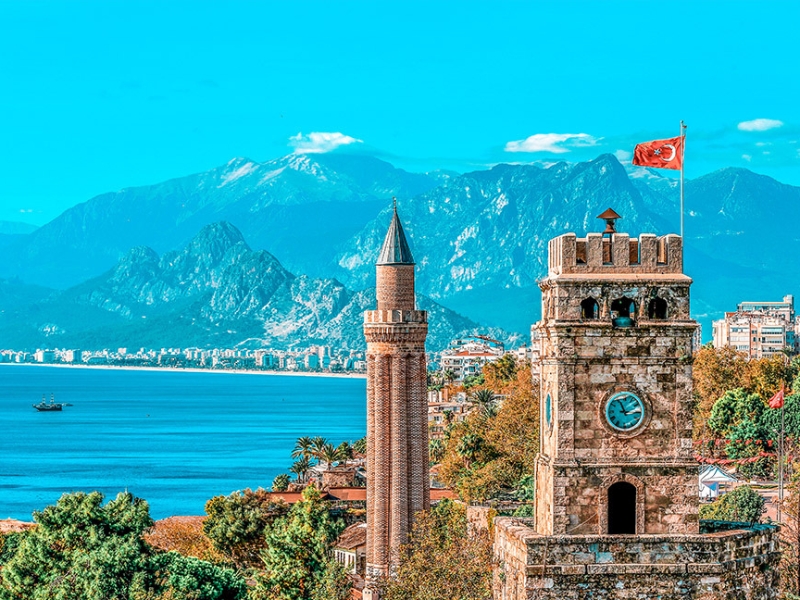
Antalya is more than two thousand years old, and in Kaleiçi, the walled old town, you can still read the layers: a Hellenistic founder, a Roman temple turned church turned mosque, a harbour used since antiquity, the walls that held it all together, and a domed Ottoman mosque at the edge of it all. This guide follows those five places, which all sit within a short walk of each other in and around the old town.
King Attalus II, founder of the city
Attalus II Philadelphus was king of Pergamon from 159 to 138 BC. He was born in 220 BC and was already around sixty when he came to the throne, after his brother Eumenes II; his surname Philadelphus means "the one who loves his brother". In the 2nd century BC he founded a port on this coast and named it after himself: Attaleia, the city that became Antalya. He also gave Athens a famous gift, the Stoa of Attalos on the Agora, rebuilt in the 1950s and now home to the Museum of the Ancient Agora.
After the kingdom of Pergamon came to an end in 133 BC, Attaleia stayed independent for a short time and fell into the hands of pirates. In 77 BC the Roman general Servilius Isauricus brought it into the Roman Republic, and in 67 BC Pompey used it as a naval base in his campaign against the pirates. Today a statue of the king honours him in the centre of Antalya, close to the entrance of the old town. It is one of the stops of our scavenger hunt, which is a good excuse to stop and look at the man the city is named after.
The Kesik Minare (Broken Minaret)
Few buildings tell Antalya's story as well as the Kesik Minare, on Hesapçı Street in the middle of Kaleiçi. It began as a Roman temple in the 2nd century AD. In the Byzantine period it became a church dedicated to the Virgin Mary; it was badly damaged during the Arab raids and repaired in the 9th century. When the Seljuks took Antalya in the early 13th century, they added a minaret and turned the church into a mosque. In 1361 the crusader king of Cyprus captured the city and the building became a church again, until it returned to being a mosque under Prince Korkut, a son of the Ottoman sultan Bayezid II. That is why it is also called the Korkut Mosque.
In 1896 a fire destroyed the main building, and for more than a century only the minaret with its damaged top stood among the ruins; kesik means "cut" in Turkish. Restoration began in 2018, the top of the minaret and a roof were restored in 2019, and on 5 March 2021, the anniversary of the Seljuk conquest of the city, the building reopened as a mosque, with the first prayers held there in nearly 125 years.
- The minaret itself, the part that survived the fire and gave the building its name.
- The mix of building periods in the walls: a Roman temple, a Byzantine church and a Seljuk and Ottoman mosque in one place.
- The quiet lane around it, lined with old Kaleiçi houses, many of them now small hotels.
The old harbour
Antalya was a port from the start, and the harbour at the bottom of Kaleiçi is the reason the city exists. It dates back to Roman times, parts of the ancient breakwater still survive, and it was from here that Pompey ran his naval base in 67 BC. The harbour stayed important through the Byzantine and Seljuk centuries, but after the Ottoman conquest of Rhodes in 1522 it lost much of its role. Today it is a yacht marina and one of the liveliest corners of the old town, with fishing boats, excursion boats and cafés along the quay, and cliffs and walls rising behind it.
- The view up from the quay to the old town and its red-tiled roofs.
- The boats along the harbour wall, from small fishing boats to tour boats heading out along the coast.
The Kaleiçi city walls
Kaleiçi literally means "inside the castle", and the old town is still shaped by its fortifications: a double ring of walls in the shape of a horseshoe, open towards the sea. The city has had walls since Roman times, and in the 8th century they were strengthened again to hold off Arab attacks. Later Seljuk and Ottoman rulers repaired and added to them, so the walls you see today mix Hellenistic, Roman, Byzantine, Seljuk and Ottoman work.
Sections of the walls and towers survive around the edge of the old town, some of them built into later houses. Inside them are about 3,000 traditional houses with red-tiled roofs, and the restoration of the district earned Turkey's Ministry of Culture and Tourism the Golden Apple award of FIJET, the international federation of travel writers, in 1984.
Tekeli Mehmet Pasha Mosque
In the Kalekapısı district, by the main entrance to the old town, stands the Tekeli Mehmet Pasha Mosque, one of the most important Ottoman mosques in Antalya. Its main dome rests on a high drum and is supported by three half-domes on the east, west and south sides, while three smaller domes cover the portico on the north side. It is named after an Ottoman pasha, Tekeli Mehmet Pasha, and is a good contrast with the Seljuk minarets and Roman remains around it.
- The tiled panels with verses from the Koran in taliq script above the windows of the north façade.
- The more tiled inscriptions inside, if you visit outside prayer times and dress modestly.
How to see them in one walk
Start in the centre at the statue of King Attalus II, then walk the few steps to the Tekeli Mehmet Pasha Mosque in the Kalekapısı district. Enter Kaleiçi and follow the lanes downhill to the Kesik Minare on Hesapçı Street. Continue down to the old harbour for a break by the water, then walk back up along the edge of the old town, where you can follow surviving sections of the walls. The lanes are steep in places and the summer heat is strong, so go in the morning or late afternoon, and carry water.
See Antalya with World City Trail
Our Antalya scavenger hunt turns Kaleiçi into a game you play on your phone. The route links 10 stops, from Republic Square to Hıdırlık Tower, and the statue of King Attalus II is one of them, along with the Toy Museum, the Iskele Mosque, the Yivli Minaret, the Clock Tower, Hadrian's Gate, the Yenikapı Greek church and the Atatürk House Museum. At each stop you solve a puzzle and learn a story, at your own pace.
There is also a self-guided walking tour and an outdoor escape game in Antalya, for people who prefer a different format.
Play the Antalya scavenger hunt →
Take the self-guided walking tour of Antalya →
Play the outdoor escape game in Antalya →
Facts checked in October 2026.