
This guide covers four places in the medieval centre of Bruges: the Belfry on the Markt, the Basilica of the Holy Blood on the Burg, the Church of Our Lady and the old hospital of Sint-Jan beside it. Two of them were built for the city's merchants and rulers, two for faith and care of the sick, and together they explain how a rich trading town of the Middle Ages lived. All four lie within a short walk of each other inside the historic centre, a UNESCO World Heritage Site since 2000.
Belfry of Bruges
The Belfry stands on one side of the Markt and was built around 1240, when Bruges was one of the great cloth-trading cities of Europe. It was the town's watchtower, alarm bell and safe: the city's charters, seals and money were kept inside. A fire in 1280 destroyed the upper part and the city archives with it, so most of the brick tower you see is a rebuilding. The octagonal top stage was added between 1483 and 1487.
The tower once ended in a spire. Lightning destroyed it in 1493, and its wooden successor burned in 1741 and was never replaced, which brought the height down to 83 metres. The Belfry also leans: the top is about 87 centimetres out of line, towards the east. Since 1999 it has been a UNESCO World Heritage Site as one of the belfries of Belgium and France, and many visitors know it from the 2008 film In Bruges, in which the tower plays a leading part.
- The climb: 366 narrow, steep steps lead to the top, with a view over the red roofs of the old town.
- The old treasury room on the way up, where the town kept its charters, seals and coffers behind iron grilles.
- The carillon: 47 bells weighing about 27.5 tonnes, played by a large drum with pins or by a carillonneur at a keyboard, both of which you can see near the top.
Basilica of the Holy Blood
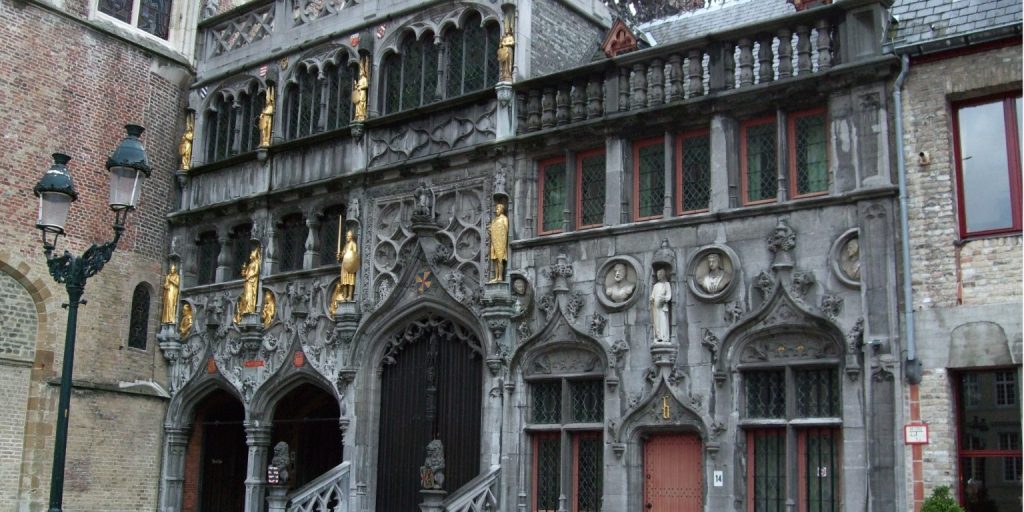
In a corner of the Burg square stands a small church that is really two chapels, one above the other. It was built in the 12th century as the private double chapel of the Counts of Flanders. The lower chapel, dedicated to St Basil, is Romanesque, built between 1134 and 1149,. It is dark, low and plain, with thick columns. The upper chapel was rebuilt in Gothic style and heavily redecorated in the 19th century, so it is bright with colour, painted walls and stained glass.
The upper chapel keeps the relic that gives the church its name: a phial said to contain a cloth with the blood of Christ. Tradition says Thierry of Alsace, Count of Flanders, brought it back from the Holy Land in 1150. Historians have found no trace of it in Bruges before the 1250s, and think it more likely came from Constantinople after the city was sacked in 1204 during the Fourth Crusade. The phial itself is a Byzantine perfume bottle of rock crystal. Every year on Ascension Day it is carried through the streets in the Procession of the Holy Blood, which UNESCO lists as intangible cultural heritage.
- The facade towards the Burg, with gilded statues, including Mary of Burgundy.
- The late Gothic and Renaissance staircase built between 1529 and 1533, which leads from the street to the upper chapel.
- In the upper chapel, the globe-shaped pulpit from 1728; in the small museum, the reliquary of 1617, made of gold and silver and set with more than 100 precious stones.
Church of Our Lady
The brick tower of the Church of Our Lady is the tallest structure in Bruges, at about 115.6 metres, and one of the tallest brick church towers in the world. The church was built mainly between the 13th and 15th centuries. It is best known for a statue that should never have left Italy: Michelangelo's white marble Madonna and Child, made around 1504 and probably meant for Siena Cathedral. Two Bruges merchants, the Mouscron brothers, bought it, and it was given to the church in 1514. It was the only sculpture by Michelangelo to leave Italy in his lifetime. It was taken away twice, by the French in the 1790s and by the Nazis in 1944, and came back both times. The church is one of the scavenger hunt stops.
- The Madonna and Child in its altar: the child seems about to step down from his mother's lap.
- Behind the high altar, the tombs of Mary of Burgundy and her father Charles the Bold, with gilded bronze figures lying on black stone, and the painted medieval graves below them, seen through glass.
Sint-Janshospitaal
Across the street from the Church of Our Lady, the Old St John's Hospital was founded in the mid-12th century to care for sick pilgrims and travellers, and its buildings are among the oldest surviving hospital buildings in Europe. It kept working as a hospital until 1977, when the patients moved to a new hospital outside the centre. In the 1860s the old wards were nearly demolished; supporters of the Gothic Revival saved them.
Today the medieval wards and the hospital church are a museum run by Musea Brugge. Its main treasure is a group of seven works by the 15th-century painter Hans Memling, four of them painted for the hospital itself and kept here since the late 15th century. The best known is the Shrine of St Ursula, a small gilded reliquary shaped like a chapel, with painted panels that tell her story, in the old hospital church. The collection also includes the Diptych of Maarten van Nieuwenhove.
- The Shrine of St Ursula: follow the panels around it, from her arrival in Cologne to her martyrdom.
- The 17th-century hospital pharmacy and its herb garden, where the sisters prepared medicines.
- The attic, with an oak roof structure that is one of the oldest and largest of its kind in Europe.
How to see them in one walk
Start on the Markt and climb the Belfry first, before the queue builds up. From the square, walk along Breidelstraat to the Burg and visit the Basilica of the Holy Blood: the lower chapel first, then the stairs to the upper one. Walk south along the canals past the Rosary Quay, then on to the Church of Our Lady. Finish across the street at Sint-Janshospitaal, and if you still have energy, cross the little Bonifacius Bridge behind the church on your way out.
See Bruges with World City Trail
Our Bruges scavenger hunt turns the old town into a game you play on your phone. The route links 10 stops, from Jan van Eyckplein to the Choco-Story chocolate museum, and the Belfry and the Church of Our Lady are among them. So is the Burg, the square of the Basilica of the Holy Blood, together with the City Theatre, Sint-Salvator's Cathedral, the Bonifacius Bridge, the Nepomucenus Bridge and the Rosary Quay. At each stop you solve a puzzle and learn a story, at your own pace.
There is also a self-guided walking tour and an outdoor escape game in Bruges, for people who prefer a different format.
Play the Bruges scavenger hunt →
Take the self-guided walking tour of Bruges →
Play the outdoor escape game in Bruges →
Facts checked in October 2026.