
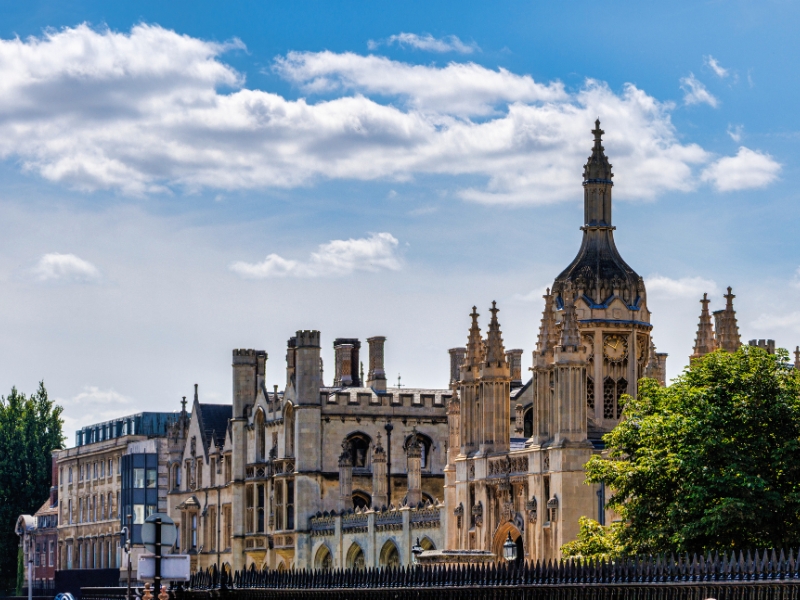
This guide covers five places in central Cambridge that most visitors walk straight past on the way to the colleges: Parker's Piece, a tiny artwork called the Teleport-o-Matic, the University Museum of Zoology, the Polar Museum and the Xu Zhimo garden at King's College. Together they show a side of the city beyond chapels and lawns: football history, street art, science and a Chinese poet who fell in love with the river Cam. All five lie within an easy walk between the green south-east of the centre and King's.
Parker's Piece
Parker's Piece is the large, flat, square green just south-east of the city centre. It takes its name from Edward Parker, a cook at Trinity College, who leased the land from the college from 1587. In 1613 Trinity swapped it with the town for the land by the river where the Wren Library now stands, and it has been public open space ever since. In 1838 a feast for 15,000 guests was held here to celebrate the coronation of Queen Victoria.
The green has a claim to a place in sports history. Students played football here under the Cambridge Rules in the 19th century, and the 1863 version of those rules fed into the first laws of the Football Association, published that December. First-class cricket was played here from 1817 to 1864, and league cricket still is. Parker's Piece is the first stop of our scavenger hunt.
- The lamp post where the two diagonal paths cross, known to everyone in Cambridge as Reality Checkpoint.
- The Cambridge Rules 1848 monument from 2018: four stone pillars carved with early football rules in several languages.
- The blue plaque for the cricketer Jack Hobbs, who grew up in Cambridge, on the wall of the Hobbs Pavilion.
Teleport-o-Matic
Cambridge has a series of Dinky Doors: miniature doors and shopfronts fixed at ankle height to walls around the city, each with its own invented story. The Teleport-o-Matic, or ToM, presents itself as the world's tiniest and most efficient teleportation service, with a little control panel. It sits between a row of telephone boxes in the centre and has been there since at least 2020. Dinky Doors are small and sometimes damaged or moved, so look out for one rather than counting on it. Another Dinky Door, at the base of the Reality Checkpoint lamp post on Parker's Piece, asks you to turn its dials to rate how real reality feels.
University Museum of Zoology
You can't miss the entrance on Downing Street: a 21-metre skeleton of a fin whale hangs in the glass Whale Hall at the front of the David Attenborough Building. The whale washed up dead at Pevensey Bay in Sussex in 1865. The museum reopened in June 2018 after a large redevelopment, and its collections go back to the early 19th century. It belongs to the university and is one of the scavenger hunt stops.
- The fin whale overhead as you walk in: it is the second-largest whale species after the blue whale.
- Specimens collected by Charles Darwin, including fish preserved in spirit from the voyage of HMS Beagle in 1831 to 1836.
- The bones of extinct birds such as the dodo from Mauritius.
The Polar Museum
The Polar Museum belongs to the Scott Polar Research Institute, founded in 1920 by Frank Debenham, who had been on Captain Robert Falcon Scott's last expedition. The institute was set up as the national memorial to Scott and the four men who died with him on the way back from the South Pole in 1912. Its building on Lensfield Road, designed by Sir Herbert Baker, was completed in 1934.
Over the entrance is a Latin inscription, Quaesivit arcana poli videt dei: he sought the secrets of the pole, he sees the hidden face of God. In front stands a bust of Scott made by his widow, the sculptor Kathleen Scott. The museum was renovated and reopened in 2010, and it is another of the scavenger hunt stops.
- The domed ceilings in the entrance halls, painted by MacDonald Gill with maps of the world seen from the North and South Poles.
- Captain Scott's last letters, written in his tent as the expedition was dying.
- Objects from the 19th-century search for the Northwest Passage, the sea route north of Canada.
Xu Zhimo garden at King's College
Xu Zhimo is one of the best-known Chinese poets of the 20th century. He spent time at King's College as a literature researcher in 1921 and 1922, and wrote a famous poem about the river Cam, usually known in English as Second Farewell to Cambridge, in November 1928, after a return visit. He died in a plane crash in 1931. Generations of Chinese schoolchildren have learned the poem, and many Chinese visitors come to King's because of it.
In 2008 a stone carved with the poem's first and last lines was placed near the river behind the King's bridge. In August 2018 a small Chinese garden was opened around it, the first garden of its kind inside a Cambridge college. King's College is a stop on our scavenger hunt; to reach the garden you need to enter the college grounds, which usually requires a ticket for visitors.
- The marble memorial stone with the opening lines, very quietly I take my leave, as quietly as I came here, in Chinese characters.
- The willows along the bank, which the poem describes as a golden bride in the setting sun.
How to see them in one walk
Start on Parker's Piece and walk to the lamp post in the middle, then head south down Regent Street to Lensfield Road for the Polar Museum. From there walk west to Trumpington Street, go north and turn right along Pembroke Street into Downing Street for the Museum of Zoology. Continue north to King's Parade and enter King's College, then follow the path down to the river and the Xu Zhimo stone. Keep your eyes low along the way: the Dinky Doors are easy to miss. Both museums are university museums, so check their days before you go.
See Cambridge with World City Trail
Our Cambridge scavenger hunt turns the city centre into a game you play on your phone. The route links 10 stops, starting on Parker's Piece and finishing at St John's College, and the Polar Museum, the Museum of Zoology and King's College are all on it. The other stops are the Fitzwilliam Museum, the Mathematical Bridge, the Corpus Clock, Great St Mary's and Trinity College. At each stop you solve a puzzle and learn a story, at your own pace.
There is also a self-guided walking tour and an outdoor escape game in Cambridge, for people who prefer a different format.
Play the Cambridge scavenger hunt →
Take the self-guided walking tour of Cambridge →
Play the outdoor escape game in Cambridge →
Facts checked in October 2026.