
Český Krumlov is small enough to cross on foot in a morning, yet it packs a castle second in size only to Prague Castle, a Baroque garden, a Gothic church and a square ringed by Renaissance houses into one loop of the Vltava. This guide covers eight places that sit along that loop: the castle and its tower, the Cloak Bridge, the Castle Garden, Svornosti Square with its plague column, the Church of St Vitus, the Wax Museum, the Egon Schiele Art Centrum and Lazebnický Bridge. The whole historic centre has been a UNESCO World Heritage Site since 1992, and every one of these places is a stop on our scavenger hunt.
Český Krumlov Castle and the Castle Tower
The castle is first mentioned in 1253, when it belonged to the Vítkovci family. From 1302 it passed to the Rosenbergs, who turned it into a Renaissance residence, then to the Eggenbergs and, in the 18th century, to the Schwarzenbergs; these last two families gave it much of its Baroque look. The result is a long chain of courtyards, palaces and bridges running along a rock above the river, and the second largest castle complex in the country after Prague Castle.
- The Castle Tower, the oldest part of the complex: its 13th-century core was rebuilt in the Renaissance and painted in 1580, with pastel colours, a balustraded gallery and illusionistic decoration. You can climb it for the classic view over the red roofs.
- The Bear Moat at the entrance to the castle, crossed by a bridge on the way into the courtyards; bears are still kept here today.
The Cloak Bridge
The Cloak Bridge (Plášťový most) was built in 1764 across a deep ravine that separates the upper castle from the theatre and the garden. It is not a simple bridge but a covered corridor carried on several levels of arches, five storeys high in all, so from below it looks more like an aqueduct than a passage. The castle's Baroque theatre, one of the best-preserved Baroque theatres in the world, sits right next to it.
- Stand on the path below the bridge, on the way to the garden, and look up: from there you can see all the levels of arches at once.
The Castle Garden
The Castle Garden (Zámecká zahrada) stretches west of the castle along the top of the hill. It was laid out in the Baroque style and still keeps its formal layout of parterres, avenues and clipped hedges, with a wilder landscape section at the far end. It is one of the quietest places in town, even on busy days, because most visitors stop at the castle courtyards.
Two features stand out. The Cascade Fountain, from the mid-18th century, drops water over a series of stone steps decorated with sculpture. The Bellarie summer house, a Rococo pavilion, reopened in 2024 after a four-year restoration: inside are frescoes, a Baroque kitchen and a lift table that once carried food up to the dining room. Since 1959 the garden has also had a revolving open-air auditorium, which turns the audience around to face different parts of the garden used as scenery during summer performances.
- The cascade fountain in the middle of the formal garden, with its stone basins and statues.
- The Bellarie, a grey and white Rococo pavilion with green shutters.
Svornosti Square, the Fountain and the Plague Column
Náměstí Svornosti is the main square of the old town, with the town hall on one side and Renaissance and Baroque houses all around. In the middle stands the Marian plague column, put up between 1714 and 1716 in memory of the plague of 1680 to 1682. The Prague sculptor Matěj Václav Jäckel made the main statues: the Virgin Mary on top, and two rows of saints below, including St Wenceslas, St Vitus, St Sebastian and St Roch, the saints most often called on against the plague.
- The six-sided stone fountain around the column. The first fountain here dates from the late 16th century; the present one was rebuilt in the 1840s by the stonemason Josef Hauber.
- The arcades of the town hall, which runs along one side of the square.
The Church of St Vitus
The church tower you see from almost everywhere in town belongs to St Vitus, the main parish church. The present building went up between 1407 and 1438 on the foundations of an older church and was consecrated in 1439. It is a Gothic hall church with three aisles of equal height and a net vault over the choir. The tower is newer: its Baroque onion dome was replaced by the present Neo-Gothic spire in 1893 and 1894.
- The Chapel of St John of Nepomuk, built in 1725 and 1726 for the Schwarzenbergs, where the hearts of Prince Adam Franz and his wife Eleonora Amalia lie side by side under a black marble plate.
- The Gothic and Renaissance wall paintings and old tombstones along the aisles.
The Wax Museum
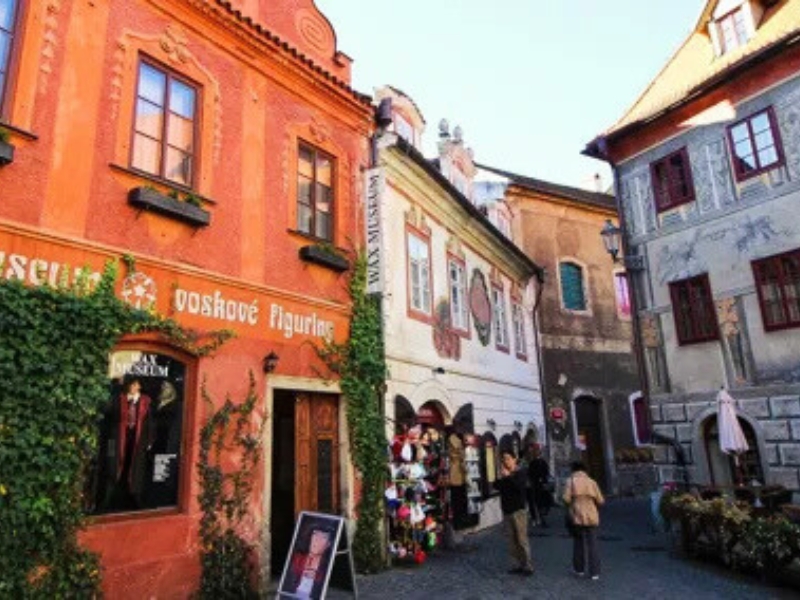
The Wax Museum on Kájovská Street is a family-friendly stop that brings South Bohemian history to life with wax figures. It shows Bohemian kings and emperors, among them Charles IV, Rudolf II and Franz Joseph, along with scenes from everyday life in the past.
- The cellars, set up as a medieval craftsmen's quarter, an alchemist's kitchen and an old tavern.
The Egon Schiele Art Centrum
The painter Egon Schiele had a strong bond with Český Krumlov, which he knew by its German name, Krumau: it was his mother's home town. In May 1911 he moved here with his partner Wally Neuzil and painted views of the town, but locals were shocked that the couple lived together unmarried and by the young models he used, and he left in August of the same year.
Since 1993 the Egon Schiele Art Centrum has filled the former town brewery on Široká Street, a Renaissance building from 1606 to 1608 with sgraffito facades and vaulted halls on central columns. It runs a permanent exhibition on Schiele's life and work along with changing shows of 20th-century and contemporary art.
Lazebnický Bridge
Lazebnický most links the Latrán quarter below the castle with the island of the old town. Its name comes from the old bathhouse (lázeň) next to it, not from barbers, although it is often translated as Barber's Bridge. The present bridge dates from the 1830s and rests on stone piers, with a wooden covering; in the middle stand a statue of St John of Nepomuk and a crucifix.
The bridge is linked with a dark episode from the castle's history: Don Julius, the illegitimate son of Emperor Rudolf II, lived at the castle from 1605 and in 1608 murdered Markéta Pichlerová, the daughter of a local barber. He was locked up and died in 1609. The story is true; the idea that it is tied to this bridge belongs to local storytelling.
How to see them in one walk
Start at the castle entrance and walk up through the courtyards past the Bear Moat and the Castle Tower, cross the Cloak Bridge and finish this part in the Castle Garden. Walk back down through the courtyards into Latrán, cross Lazebnický Bridge to the island and continue up Radniční Street to Svornosti Square and the plague column. From there it is a short walk to the Church of St Vitus, the Wax Museum on Kájovská Street and the Egon Schiele Art Centrum on Široká Street, all within a few minutes of each other.
See Český Krumlov with World City Trail
Our Český Krumlov scavenger hunt turns the old town into a game you play on your phone. The route links 10 stops, from the old monasteries to the castle, and all eight places in this guide are stops: the Castle Tower, Lazebnický Bridge, the Church of St Vitus, the fountain and plague column, the Wax Museum, the Egon Schiele Art Centrum, the Cloak Bridge and the Castle Garden, with the castle itself at the finish. At each stop you solve a puzzle and learn a story, at your own pace.
There is also a self-guided walking tour and an outdoor escape game in Český Krumlov, for people who prefer a different format.
Play the Český Krumlov scavenger hunt →
Take the self-guided walking tour of Český Krumlov →
Play the outdoor escape game in Český Krumlov →
Facts checked in October 2026.