What is the Cambridge outdoor escape game?
The Cambridge outdoor escape game is an escape room that leaves the building and moves into the streets: you play on your smartphone, and at each of the 10 stops a puzzle is waiting that you solve by studying the surroundings and reasoning it through. Roughly 2 hours is enough time for the 2.5 km route, with 43 minutes of that spent walking.
The puzzles sit at colleges, museums and bridges along the River Cam, from the Fitzwilliam Museum to the Corpus Clock. Each one stands on its own, so you never need a storyline to move on, and up to three levels of hints are there when a clue refuses to click. Central Cambridge suits this format because its colleges and museums lie close together and the ground is flat.
- Durationabout 2 hours
- Walkingabout 43 min · 2.5 km
- Stops10
- LanguagesEnglish, German, French, Italian, Spanish, Dutch
What you do during the escape game
Solve
Work out the puzzle at each stop from what you can see and from logic alone. You need no prior knowledge of the city.
Spot the clue
Clues hide in the details of each building, bridge or lawn, from carvings to the layout of the paths.
Stroll
Follow Google Maps from one stop to the next, roughly 43 minutes of walking across about 2.5 km.
Set your pace
There is no countdown. Ask for a hint if you need one, stop for tea and carry on later or on another day.
See the route and attractions →
How it works
- Book online Choose the number of players. Your booking reference arrives by email straight away.
- Get the app Download the World City Trail app from the App Store or Google Play and enter your booking reference.
- Play when you like Start whenever you are ready, walk at your own pace and pause any time. No guide, no fixed schedule.
Who it is for
Groups of friends
Every stop gives the group a puzzle to argue over, and nobody has to know Cambridge in advance.
Couples
A shared challenge that keeps you talking as you walk from one college to the next, with no clock ticking.
Team building
Teams of up to 5 each play on their own phone, so colleagues can split the thinking as they go.
Good to know
- Bring a charged smartphone with mobile data; a power bank helps.
- Best started in daylight, so you can see the details the puzzles ask about.
- No entry tickets needed: everything happens outside the buildings. Going inside is optional and paid separately.
- Family friendly; children must be accompanied by an adult.
- Not suitable for wheelchair users and difficult with strollers.
- Teams of up to 5 work best; bigger groups split into several teams, one ticket per player.
- Every purchase helps support stray cats and dogs in Greece.
The puzzle trail: from Parker's Piece to St John's College
10 stops · about 43 min walking · start: Parker's Piece · finish: St John's College
The first puzzle waits on Parker's Piece and the last at St John's College. In between come the Polar Museum, the Fitzwilliam Museum, the Mathematical Bridge, the Museum of Zoology, the Corpus Clock, King's College, Great St Mary's and Trinity College. Start in daylight if you can, since the puzzles are solved outdoors and rain slows everything down. Google Maps guides you between stops, you can reorder them in the app, and no entry tickets are needed.
Open the route map ↗
1Parker's PieceStart
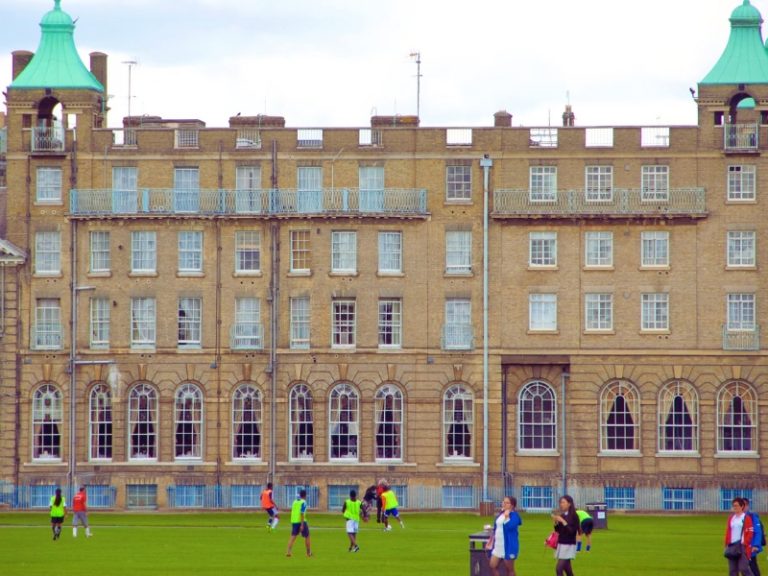
This large open green takes its name from Edward Parker, a college cook who leased the land in the early 17th century. Games played here under the Cambridge Rules, first drawn up in 1848, influenced the rules of the Football Association founded in 1863. The lamp post where the paths cross is known locally as Reality Checkpoint.
2Scott Polar Research Institute (Polar Museum)
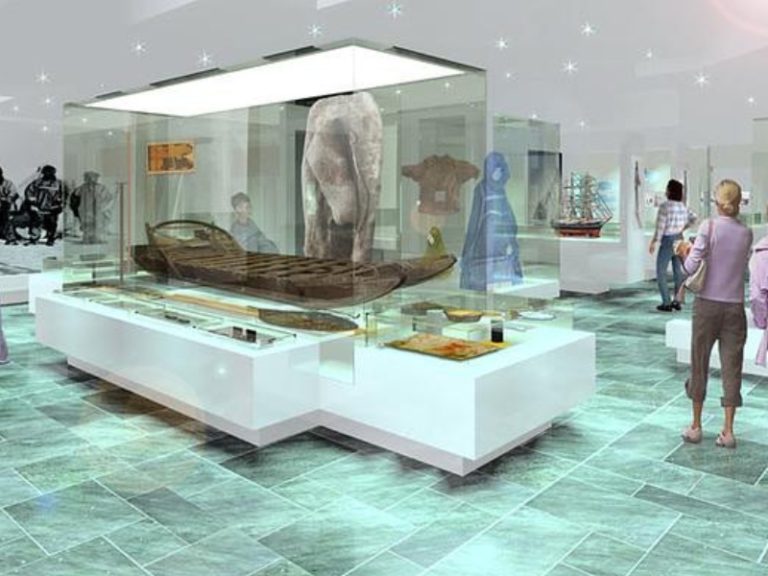
The institute was founded in 1920 as a memorial to Captain Robert Falcon Scott and the men who died with him on their return from the South Pole in 1912. Its building on Lensfield Road houses the Polar Museum, and a Latin inscription above the entrance honours Scott's search for the secrets of the Pole.
3The Fitzwilliam Museum
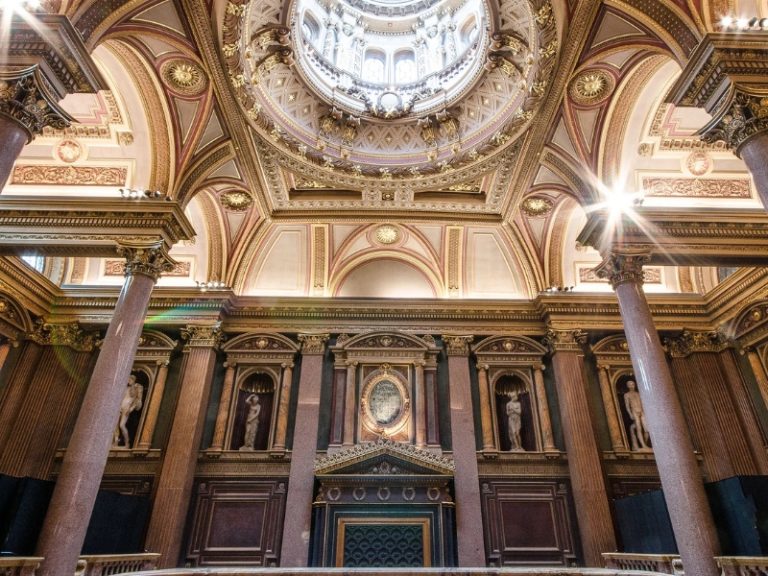
The University's museum of art and antiquities was founded in 1816 with the bequest of Richard, 7th Viscount Fitzwilliam. Its grand classical building with a columned portico was designed by George Basevi and begun in 1837. A student legend says the stone lions at the entrance come down to drink when the clock strikes midnight.
4Mathematical Bridge
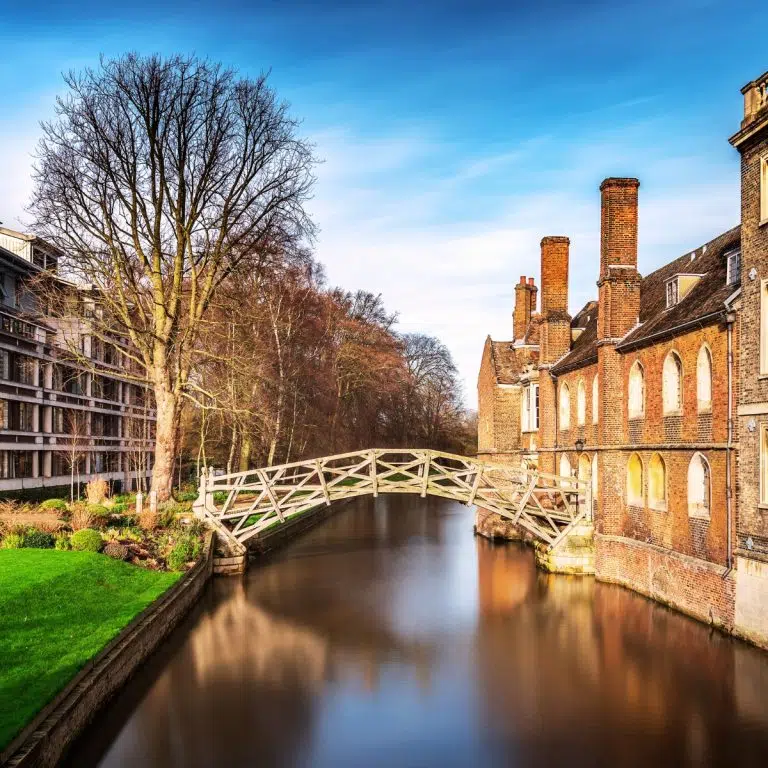
This wooden footbridge across the Cam belongs to Queens' College and was designed by William Etheridge and built by James Essex in 1749. Its straight timbers form an arch, which inspired the popular myth that Isaac Newton built it without nuts or bolts. Newton had died in 1727, and the bridge has since been rebuilt twice.
Read the full story →
5University Museum of Zoology
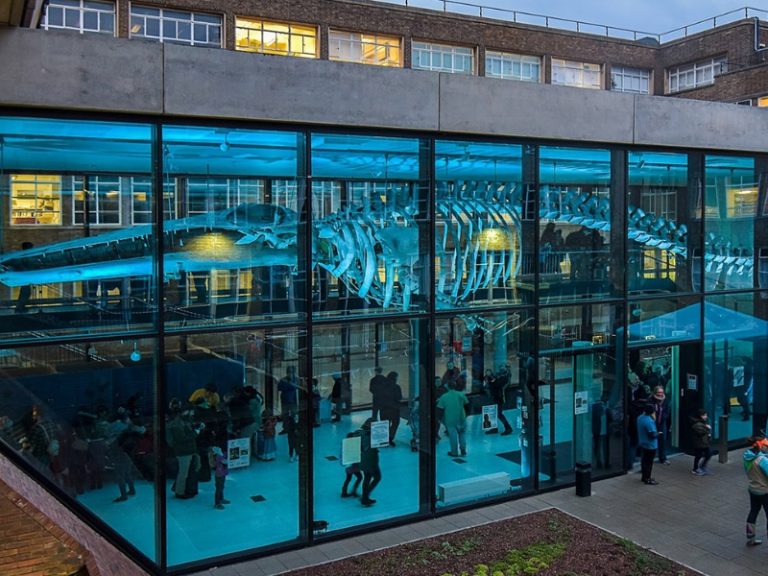
The Museum of Zoology on the University's Downing Site holds animal specimens from all over the world, including some collected by Charles Darwin. The skeleton of a fin whale more than 20 metres long hangs in its glass entrance hall and can be seen from outside.
6Corpus Clock
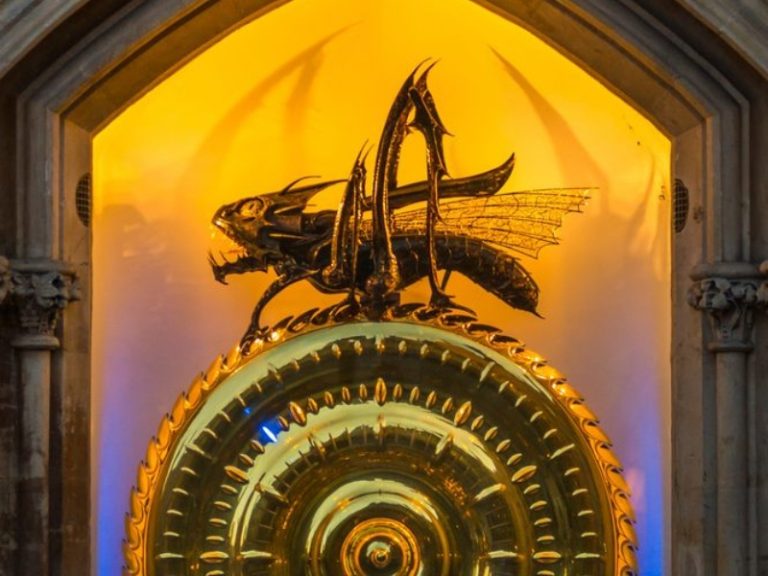
Unveiled by Stephen Hawking in 2008, this clock on the corner of Corpus Christi College's Taylor Library was conceived by the inventor John Taylor. A creature called the Chronophage, or time-eater, crawls over its gold-coloured disc and seems to devour each passing minute. The clock is deliberately erratic and is exactly right only once every five minutes.
Read the full story →
7King's College
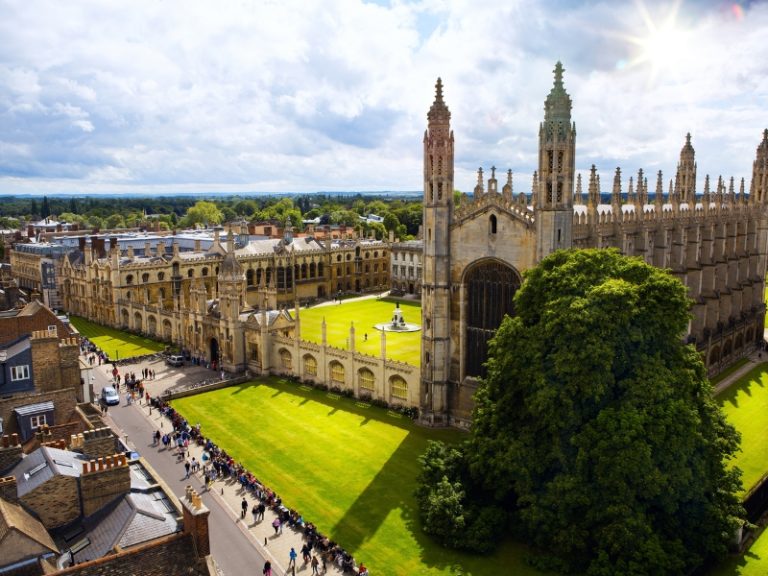
King Henry VI founded King's College in 1441, and its chapel, built in stages between 1446 and 1515, has the largest fan vault in the world. The choir's Festival of Nine Lessons and Carols is broadcast around the world every Christmas Eve. From King's Parade you see the chapel rising behind the 19th-century gatehouse.
Read the full story →
8Great St Mary's
Great St Mary's is the University Church and traditionally the centre of Cambridge: university distances are measured from it, and students once had to live within three miles of it. The chime of its bells, written for the church in 1793, was later copied for Big Ben in London and became known as the Westminster Quarters.
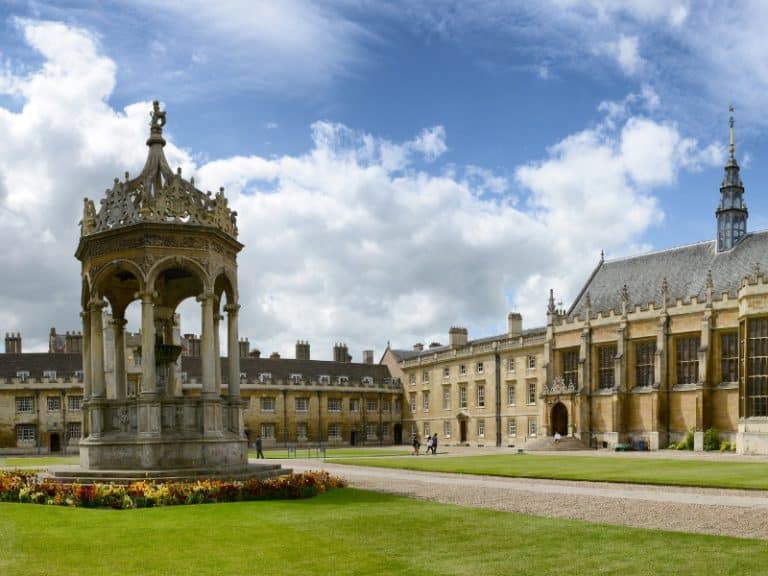
9Trinity College
Henry VIII founded Trinity College in 1546, and his statue above the Great Gate holds a chair leg instead of a sceptre, the result of a student prank. Isaac Newton studied and worked here, and an apple tree outside the gate is said to descend from the tree in his garden. Behind the gate lies the vast Great Court.
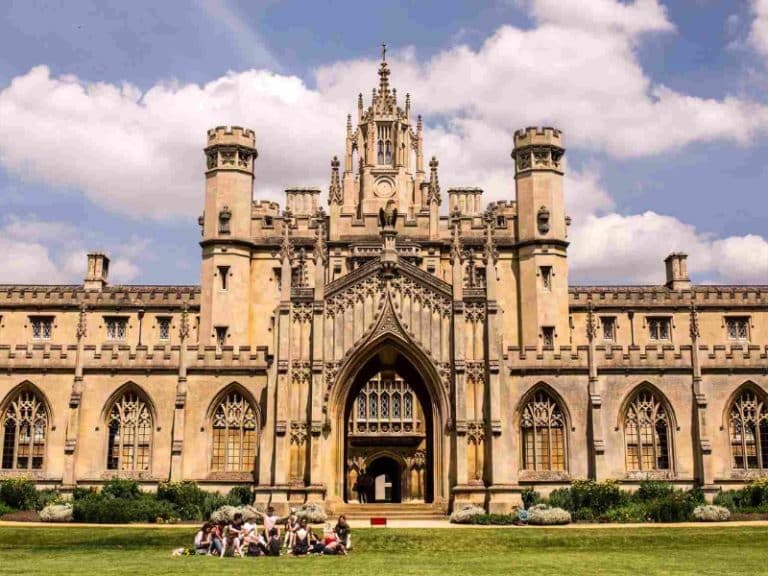
10St John's CollegeFinish
St John's College was founded in 1511 under the will of Lady Margaret Beaufort, mother of King Henry VII. Her coat of arms, held by mythical beasts called yales, decorates the gatehouse. Further inside, the covered Bridge of Sighs, built in 1831, crosses the Cam.
Only logged in customers who have purchased this product may leave a review.




Reviews
There are no reviews yet.