
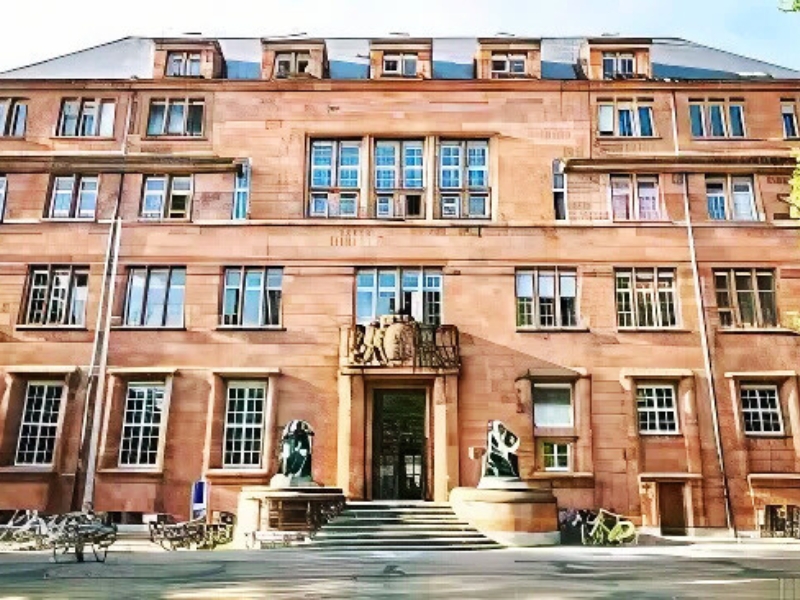
This guide covers four places in the western half of Freiburg's old town: the University of Freiburg and the square in front of it, the Martinstor city gate, the Haus zum Walfisch, where Erasmus of Rotterdam once lived, and the coats of arms of Freiburg's twin towns. They sit within a short walk of each other and show three sides of the city: the medieval walled town, the university town, and the city that rebuilt itself after the Second World War and turned to its neighbours.
University of Freiburg
The Albert-Ludwigs-Universität was founded in 1457, when Freiburg belonged to the Habsburgs; its real founder was Archduke Albert VI of Austria, who gave it land, income and its own jurisdiction. It took its present name in 1820, after Grand Duke Ludwig I of Baden granted it an annual contribution that kept it going. The philosophers Edmund Husserl and Martin Heidegger taught here, Hannah Arendt and Friedrich Hayek studied here, and the university counts more than twenty Nobel laureates among its alumni, teachers and researchers.
The building most visitors see is the Kollegiengebäude I, a large Art Nouveau lecture building by Hermann Billing that opened in 1911. To its north lies the Platz der Alten Synagoge, named after the synagogue that stood here from 1870 until 9 to 10 November 1938, when SS and SA men set it on fire during the November pogroms and blew up the ruins the same day. The square was redesigned and reopened in 2017, with a shallow water basin that traces the outline of the old synagogue. It is a memorial as well as a city square, so treat the basin with respect.
- The Art Nouveau facade of the Kollegiengebäude I, the university's main lecture building.
- The water basin on the Platz der Alten Synagoge, which follows the footprint of the destroyed synagogue.
- The city theatre on the west side of the square, opened in 1910.
Martinstor
The Martinstor is the older of Freiburg's two surviving medieval gate towers. Tree-ring dating of its roof timbers points to 1202, and it first appears in a document in 1238 as the Porta Sancti Martini. For most of its life it was much lower than today: in 1901, following a proposal by the architect Carl Schäfer, the tower was raised to about three times its old height so what looks medieval is partly a piece of 1900s romanticism.
At times the gate was also used as a prison; locals joked that inmates had been given Saint Martin's cloak. A side wing added in 1901 now houses a fast-food restaurant, but the city council made sure its red-and-yellow logo was kept off the gate. On the old-town side, a picture of Saint Martin decorated the tower from the 17th century until it was removed in 1968 and 1969. After a long debate over what should replace it, the city decided in 2015 to leave the space empty.
- The plaque beside the arch on the old-town side remembering the victims of Freiburg's witch trials, including three women executed in 1599.
- The empty frame above the plaque to the citizens' militia, where the image of Saint Martin used to be.
- The western side wing, added in 1901 when the tower was raised.
Haus zum Walfisch
The House of the Whale on Franziskanerstraße was built between 1514 and 1516 for Jakob Villinger von Schönenberg, treasurer-general to Emperor Maximilian I. Its best feature is the late Gothic oriel above the doorway, considered one of the finest portal oriels of the late Gothic period north of the Alps. The building was not yet finished when its most famous resident arrived: the humanist Erasmus of Rotterdam moved in at Christmas 1529, after leaving Basel, and lived here until 1531, when he moved to another house in Schiffstraße.
In the British air raid of 27 November 1944, the house burned out completely and its interior was lost, but the facade survived and the oriel was saved by emergency shoring. It was rebuilt in 1947 and 1948. Since the 1910s it has been used by the local savings bank, which has its banking hall on the ground floor, so you can admire the outside and step into the hall during business hours.
- The carved stone oriel over the entrance, with its rich late Gothic tracery.
- The plaque on the facade naming Jakob Villinger as the builder.
Coats of arms of the twin towns
Freiburg has a long list of partner cities, and it shows them off with a mosaic of their coats of arms. The partnerships began in 1959 with Besançon in France, followed by Innsbruck in 1963, Padua in 1967 and Guildford in 1979. Madison in the United States, Matsuyama in Japan, Lviv in Ukraine, Granada in Spain and Isfahan in Iran joined between 1987 and 2000, and Suwon, Tel Aviv and Wiwilí de Jinotega in Nicaragua followed in 2015.
The mosaic fits a city that is known for decorating its streets: the old town is famous for its cobblestone mosaics, small pictures laid in pebbles in the pavement, so keep looking down as you walk. Spotting all the partner cities and their emblems makes a good small challenge, and it is the final stop of our scavenger hunt route, after the New Town Hall.
- Try to find the arms of Besançon, the first partner city, and of the three cities that joined in 2015.
How to see them in one walk
Start at the Platz der Alten Synagoge and the Kollegiengebäude I of the university. Walk along Bertoldstraße to Kaiser-Joseph-Straße and turn right to reach the Martinstor. From the gate, head into the old town towards the cathedral square with the Historisches Kaufhaus, the late Gothic merchants' hall, and the Münster, then come back past the Bertoldsbrunnen fountain and turn into Franziskanerstraße for the Haus zum Walfisch. The Rathausplatz with the old and new town halls is just round the corner, and the twin-town coats of arms complete the circuit. If you have energy left, the Schwabentor, the other surviving gate, is on the far side of the old town.
See Freiburg with World City Trail
Our Freiburg scavenger hunt turns the old town into a game you play on your phone. The route links 10 stops, from the Platz der Alten Synagoge to the coats of arms of the twin towns, and the University of Freiburg, the Martinstor and the twin-town coats of arms are all stops, along with the Schwabentor, the Historisches Kaufhaus, the Münster, the Markthalle, the Bertoldsbrunnen and the New Town Hall. The Haus zum Walfisch is not a stop, but it is only a short detour from the route.
There is also a self-guided walking tour and an outdoor escape game in Freiburg, for people who prefer a different format.
Play the Freiburg scavenger hunt →
Take the self-guided walking tour of Freiburg →
Play the outdoor escape game in Freiburg →
Facts checked in October 2026.