
This guide covers five places on the slope between Porto's upper town and the river: São Bento railway station, the Clérigos Church and Tower, the Livraria Lello bookshop, the Igreja da Misericórdia on Rua das Flores and the Alminhas da Ponte, a small bronze memorial down by the Douro. Two of them were designed by the same Italian architect, all five sit on one downhill walk, and together they tell Porto's story from the 16th century to the railway age.
São Bento railway station
São Bento stands where a Benedictine convent, São Bento da Avé Maria, was founded on the orders of King Manuel I in 1518. The convent was demolished in 1892, and the station that replaced it was designed by the Porto architect José Marques da Silva, who had trained in the French Beaux-Arts tradition. Building work began in 1904 and the station opened in 1916, so from the outside it looks more like a Parisian public building than a railway terminus.
The real reason to step inside is the entrance hall. Between 1905 and 1916 the painter Jorge Colaço covered its walls with around 20,000 blue-and-white azulejo tiles, made at the Sacavém factory, over some 551 square metres. The large panels show moments of Portuguese history, while a frieze higher up shows everyday life in the countryside. Trains still run from here, so you can visit simply by walking in.
- King John I and Philippa of Lancaster riding into Porto for their wedding in 1387, and the conquest of Ceuta in 1415.
- The scenes of vineyards, the grape harvest and wine being shipped down the Douro, a reminder of what made Porto rich.
Clérigos Church and Tower
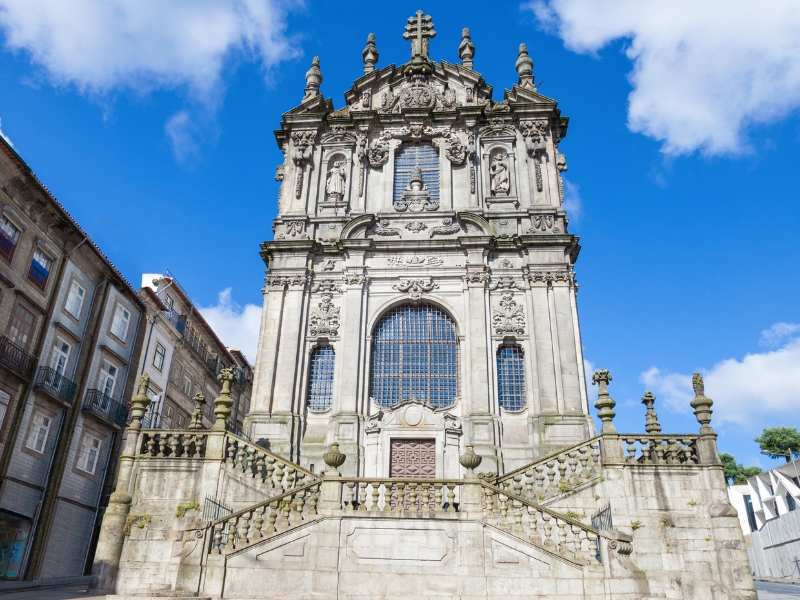
The Clérigos Church was built between 1732 and 1750 for a brotherhood of clergy, to a design by Nicolau Nasoni, an Italian architect and painter who spent most of his working life in Porto. It was one of the first Baroque churches in Portugal with an elliptical floor plan, and its richly carved facade faces down the hill towards the river. Nasoni asked to be buried in the church's crypt, and he was, although the exact spot is not known.
The bell tower behind the church was added between 1754 and 1763 and is about 75 metres tall. Its design takes ideas from the bell towers of Tuscany, with Roman Baroque decoration on top, and it can be seen from many parts of the city, which is why it has long served as a landmark for finding your way. A climb of 240 steps leads up through six levels to a viewing platform over the rooftops, the river and Vila Nova de Gaia on the far bank.
- The double staircase in front of the church, finished together with the tower in 1763.
- The oval nave inside, a shape that was still new in Portugal when the church went up.
Livraria Lello
Livraria Lello goes back to the Livraria Chardron, a bookshop founded in 1869, and to the bookselling firm José Lello set up with his brother-in-law in 1881. The present building on Rua das Carmelitas was designed by the engineer Francisco Xavier Esteves and opened in 1906. Its narrow facade mixes neo-Gothic and Art Nouveau forms, and behind it a red wooden staircase forks in two as it rises to a gallery on the first floor.
For years the staircase was said locally to have inspired the bookshop in the second Harry Potter book, because J.K. Rowling once lived in Porto. In 2020 she denied it and said she had never been inside. The shop is so popular that it has charged an entry fee since 2015, deducted if you buy a book; expect a queue and come early in the day.
- The stained-glass skylight above the staircase, with the motto Decus in Labore (dignity in work) and the owners' monogram.
- The carved wooden balustrades of the gallery and the bookshelves that reach up to the ceiling.
Igreja da Misericórdia
The church of the Misericórdia, the charitable brotherhood of Porto, stands on Rua das Flores, one of the city's most attractive streets. Work began in 1555 and the church was blessed in 1559, but lightning destroyed its facade in 1621, and the church you see today was rebuilt in the 18th century to a project by Nicolau Nasoni, the architect of the Clérigos. Since 2015 it has been part of the Museu da Misericórdia do Porto, which fills the building next door where the brotherhood had its seat from the 16th century until 2013, with paintings, sculpture and sacred art.
- The facade with its three arches and dense Baroque and Rococo carving, squeezed into a narrow street front.
- The blue-and-white tiles of 1866 inside the church, and the choir attributed to Nasoni.
Alminhas da Ponte
Alminhas are small roadside shrines to the souls in purgatory, found all over northern Portugal. This one, on the Ribeira waterfront, remembers the worst day in Porto's modern history. On 29 March 1809, as French troops under Marshal Soult attacked the city, crowds fled across the Ponte das Barcas, a bridge of boats over the Douro. The bridge gave way under their weight and in the panic hundreds of people drowned.
The bronze relief of the disaster was made in 1897 by the sculptor Teixeira Lopes, the father of the better-known António Teixeira Lopes. People still leave lit candles and flowers in front of it. A local legend tells of a clerk who carried old people and children across the bridge sixteen times and fell into the river on the seventeenth; some say his cry can be heard when the Douro floods.
- The candles and flowers left below the relief, a sign that the memorial is still used and not just looked at.
How to see them in one walk
Start at São Bento and take a few minutes with the tiles in the hall. Walk up to the Clérigos Church and climb the tower while you still have energy, then continue a few minutes further to Livraria Lello, past the Jardim da Cordoaria. From there head back down towards Rua das Flores for the Misericórdia church and museum, and follow the street downhill towards the Bolsa Palace and the church of São Francisco. End at the Ribeira waterfront, where the Alminhas da Ponte stand by the river, with the Luís I Bridge in view.
See Porto with World City Trail
Our Porto scavenger hunt turns the old town into a game you play on your phone. The route links 10 stops, from São Bento station to the Luís I Bridge, and all five places in this guide are stops: São Bento, the Clérigos Church and Tower, Livraria Lello, the Igreja da Misericórdia and the Alminhas da Ponte. Along the way you also pass the Jardim da Cordoaria, the Bolsa Palace, the church of São Francisco and Ribeira Square, solving a puzzle at each stop at your own pace.
There is also a self-guided walking tour and an outdoor escape game in Porto, for people who prefer a different format.
Play the Porto scavenger hunt →
Take the self-guided walking tour of Porto →
Play the outdoor escape game in Porto →
Facts checked in October 2026.