
This guide covers six places in the centre of Metz that sit on one line from the old southern gate to the cathedral: the Porte Serpenoise, Place de la République, the Esplanade and its fountains, the Temple Neuf, Place d'Armes and the church of Notre-Dame. They span three very different chapters of the city's history: the French garrison town of the 18th century, the German city of the years after 1871, and the pedestrian centre of today.
Porte Serpenoise
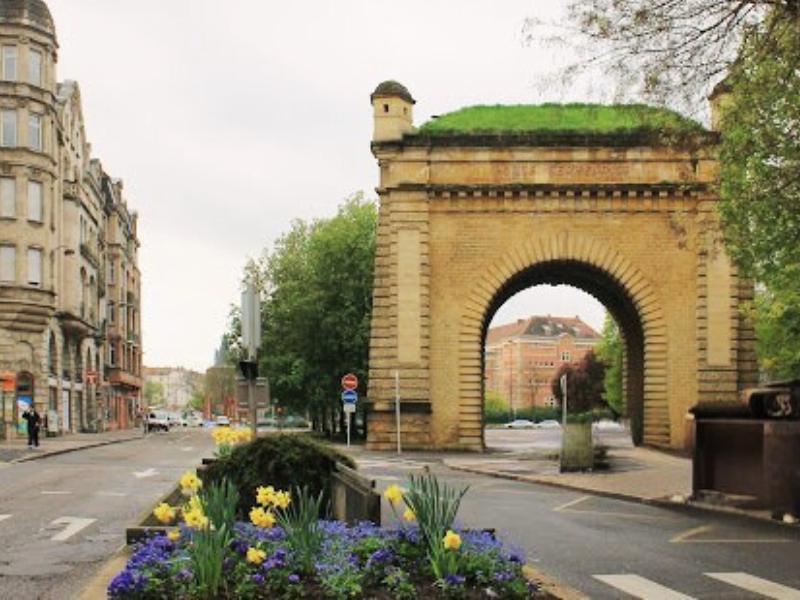
The Porte Serpenoise takes its name from the Roman road that left Metz here for Scarpone, a town upstream on the Moselle: the Latin Via Scarponensis was worn down over time to Serpenoise. A medieval gate stood in the 13th-century walls, but it was badly damaged in the siege of 1552 and pulled down in 1561 to make room for the new citadel. The gate you see today was rebuilt in 1852, widened in 1892 and remodelled in 1902 and 1903, when the ramparts around it were cleared away.
- Its shape today, close to a triumphal arch with four turrets and a grassy bank on top, standing free on a tree-lined avenue rather than in a wall.
- Its German past: while Metz was part of the German Empire it was called the Prinz-Friedrich-Karl-Tor, and Prussian troops entered the city through it in 1870.
Place de la République
Just inside the gate opens Place de la République, the largest square in central Metz. It was laid out in 1802 as the Place Royale, next to the old citadel at the edge of the city, and with the Esplanade it hosted a world's fair, the Exposition universelle of 1861. From 1964 a raised car park covered much of it; the car park was removed, and the square was redesigned as a tree-lined space for pedestrians and reopened in November 2010.
- The buildings around it, including the Banque de France on avenue Robert-Schuman and the long barracks of the Caserne Ney, and the open side facing the Esplanade gardens.
The Esplanade and its fountains
The Esplanade was laid out on the filled-in moats of the citadel, which had been demolished; the ditches were filled by 1816. Today it is a garden of about 9,200 square metres, framed by rows of lime and chestnut trees around flower beds and a round basin with a jet of water. On its long sides stand the Palais de Justice and the Arsenal concert hall, and at its far end the ground drops away to the Moselle valley, with a view across to Mont Saint-Quentin.
- The statue of Marshal Ney, one of Napoleon's marshals, by Charles Pêtre, put up in 1860.
- La Naïade, also known as La Source, a nymph figure by the same sculptor, and the bronze horse by Christophe Fratin from 1850.
- The bust of the poet Paul Verlaine, and the view from the terrace over the water and the green hills beyond.
Temple Neuf
From the Esplanade you look down on the Temple Neuf, the Protestant church on the Île du Petit-Saulcy, an island in the Moselle. It was built between 1901 and 1905, when Metz was part of the German Empire, by the city's chief architect Conrad Wahn, in a neo-Romanesque style inspired by the great churches of the Rhineland. The foundation stone was laid on 25 November 1901, and Emperor Wilhelm II inaugurated the church on 14 May 1904.
The church is about 53 metres long and its central tower rises to nearly 55 metres. Its facades and roofs are listed as historic monuments, and it is still a Reformed parish church.
- The Ottonian details of the design, a deliberate echo of the imperial churches of the early Middle Ages.
- The view of the church and its reflection from the banks and bridges around the island.
Place d'Armes
Place d'Armes is the classical square next to the cathedral, designed by the architect Jacques-François Blondel and commissioned by Marshal de Belle-Isle. Work began in 1754; old buildings, among them the medieval Palais des Treize, were cleared away, and the new town hall was finished in 1788. Blondel planned the square as a set: the town hall faces the cathedral facade, and on a smaller side stands the former guardhouse.
The square has changed its name several times with the regimes: Place de la Loi in 1792, Place Napoléon in 1806, Paradeplatz during the German annexation, and today Place d'Armes, though many people in Metz simply call it the Place de l'Hôtel-de-Ville.
- The bronze statue of Marshal Abraham de Fabert, with an inscription on the pedestal about defending a place entrusted to him by the king.
- The former guardhouse, the corps de garde, which now houses the tourist office.
Église Notre-Dame
On rue de la Chèvre, a few streets south of the cathedral, stands Notre-Dame-de-l'Assomption, a church built for the Jesuits. The first stone was laid in the 1660s, but building stopped and started several times, and it was only completed in 1739. Its two-storey facade with paired Doric columns follows the model of the Jesuit novitiate in Paris. It has been listed as a historic monument since 1968.
- The organ case of 1729, which holds an organ by the Mutin-Cavaillé-Coll workshop inaugurated by the composer Charles-Marie Widor.
- The 21 stained-glass windows by Laurent-Charles Maréchal, made between 1841 and 1860, and the 18th-century confessionals.
How to see them in one walk
Start at the railway station, walk to the Porte Serpenoise, and go through it onto Place de la République. Cross to the Esplanade and its fountains, then go down towards the river for the Temple Neuf on its island. From there walk up to the cathedral and Place d'Armes beside it, continue to the church of Notre-Dame on rue de la Chèvre, and finish via Place Saint-Louis at the Porte des Allemands, the old fortified gate on the east side of the centre.
See Metz with World City Trail
Our Metz scavenger hunt turns the city centre into a game you play on your phone. The route links 10 stops, from the station to the Porte des Allemands, and the Porte Serpenoise, Place de la République, the Esplanade fountains, the Temple Neuf, Place d'Armes and the church of Notre-Dame are all stops, along with the station, the cathedral and Place Saint-Louis. At each stop you solve a puzzle and learn a story, at your own pace.
There is also a self-guided walking tour and an outdoor escape game in Metz, for people who prefer a different format.
Play the Metz scavenger hunt →
Take the self-guided walking tour of Metz →
Play the outdoor escape game in Metz →
Facts checked in October 2026.