
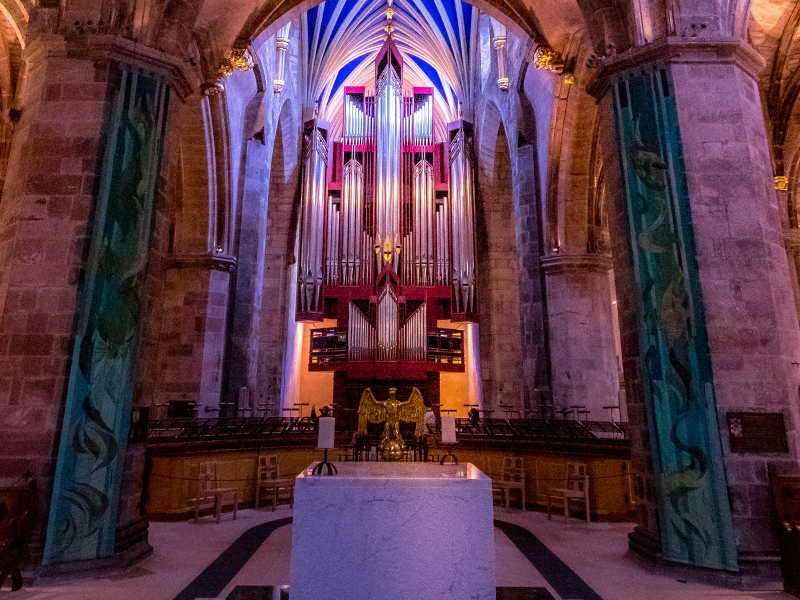
This guide links five places that run from the Old Town across to the New Town and up onto Calton Hill: The Hub, St Giles' Cathedral, the Royal Scottish Academy, the Burns Monument and Calton Hill itself. Most of them were built or rebuilt in the early 19th century, when Edinburgh was nicknamed the Athens of the North, and you can see that ambition in their Gothic spires and Greek columns.
The Hub
The dark Gothic church at the top of the Royal Mile, just below the castle esplanade, was built in the 1840s as the Victoria Hall, a meeting hall for the General Assembly of the Church of Scotland. It was designed by James Gillespie Graham with Augustus Pugin, who was working on the Houses of Parliament in London at the same time. Its spire is 71.7 metres high, the highest point in central Edinburgh. The building later served as a parish church, and in 1999 it was converted by the architect Benjamin Tindall, who left the outside largely unchanged, and opened by the Queen as The Hub, the home of the Edinburgh International Festival.
- The spire, which you can see from much of the city and which makes a useful landmark when you are lost in the Old Town closes.
- The festival box office and information centre inside, the first stop if you want tickets for the International Festival in August.
St Giles' Cathedral
The High Kirk of Edinburgh on the Royal Mile was probably founded in the 12th century, traditionally in 1124 under King David I. Its best-known feature, the crown steeple, has been dated by tree-ring analysis to the 1460s. In 1559 the reformer John Knox preached here and was elected its minister, and St Giles' became a centre of the Scottish Reformation. Strictly speaking it is only a cathedral by name: it had bishops only from 1633 to 1638 and from 1661 to 1689, and the Church of Scotland has had none since, but the title stuck.
The interior you see today is largely the result of a restoration from 1872 to 1883, backed by William Chambers, who hoped to make it a Westminster Abbey for Scotland; he died three days before it reopened. A famous story is attached to the church too: tradition holds that on 23 July 1637 a woman called Jenny Geddes threw her stool at the dean when he began reading from the new Prayer Book, starting a riot.
- The crown steeple, whose open stone arches form the shape of a crown above the Royal Mile.
- The Thistle Chapel, designed by Robert Lorimer and added between 1909 and 1911 as the chapel of the Order of the Thistle.
The Royal Scottish Academy
At the foot of the Mound, where it meets Princes Street, stands a Greek temple of a building designed by William Henry Playfair and built in 1822 to 1826 as the Royal Institution, then extended in the 1830s. It has been the home of the Royal Scottish Academy since the early 20th century, and it is used today as an exhibition space, shared with the National Galleries. In a refurbishment known as the Playfair Project it was linked underground to the Scottish National Gallery next door, with an entrance from Princes Street Gardens.
- The statue of Queen Victoria, dressed as Britannia, on top of the north portico, by John Steell.
- The fluted Doric columns all around the building, and the pairs of sphinxes, also by Steell, at its four corners.
Burns Monument
Below Calton Hill on Regent Road, a small round temple honours the poet Robert Burns. It was designed by Thomas Hamilton, who won the commission in 1831, and it largely repeats the design of the Burns monument he had already built in Alloway, Burns's birthplace, which was based on the ancient Monument of Lysicrates in Athens. It was built to hold a full-size marble statue of Burns by John Flaxman, but the statue was moved in 1889 and is now in the Scottish National Portrait Gallery.
- The view from the monument across the valley to the Old Town, with the Canongate and the edge of Holyrood below.
Calton Hill
Calton Hill rises at the east end of Princes Street and is part of Edinburgh's World Heritage Site. Its top is crowded with monuments, the most striking being the National Monument, a copy of the Parthenon meant to honour the Scottish soldiers who died in the Napoleonic Wars. Work began in 1826 and stopped in 1829 when the money ran out, and the row of columns that stands today is all that was built, which earned it the nickname Edinburgh's Disgrace.
Next to it stands the Nelson Monument, built in 1807 to 1816 in the shape of an upturned telescope to mark the victory at Trafalgar. On the south-western slope, the Old Calton Burial Ground holds the tomb of the philosopher David Hume and a monument to five political reformers who were sent to Botany Bay in Australia in 1793. Every year on 30 April the hill hosts the Beltane Fire Festival.
- The time ball on top of the Nelson Monument, dropped at one o'clock as a time signal for ships at Leith, in step with the One O'Clock Gun fired from the castle.
- The Dugald Stewart Monument, a round temple by Playfair completed in 1831 in memory of a philosopher of the Scottish Enlightenment, and one of the classic viewpoints over the city.
- David Hume's tomb in the Old Calton Burial Ground, engraved only with his name and the years 1711 and 1776.
How to see them in one walk
Start at The Hub at the top of the Royal Mile and walk down to St Giles' Cathedral. From there go down the Mound to the Royal Scottish Academy on Princes Street, then walk east along Princes Street, past the Scott Monument, to Waterloo Place. Follow Regent Road a little further to the Burns Monument, and finish by climbing onto Calton Hill for the view back over everything you have seen. If you want to add more of the Old Town, take a detour from St Giles' down to the Grassmarket and Greyfriars Kirkyard before heading for the Mound.
See Edinburgh with World City Trail
Our Edinburgh scavenger hunt turns the city into a game you play on your phone. The route links 10 stops, from the Scott Monument to Calton Hill, and the Royal Scottish Academy, The Hub, St Giles' Cathedral, the Burns Monument and Calton Hill are all stops, along with the castle Esplanade, the Grassmarket, Greyfriars Kirkyard and the Canongate. At each stop you solve a puzzle and learn a story, at your own pace.
There is also a self-guided walking tour and an outdoor escape game in Edinburgh, for people who prefer a different format.
Play the Edinburgh scavenger hunt →
Take the self-guided walking tour of Edinburgh →
Play the outdoor escape game in Edinburgh →
Facts checked in October 2026.