
This guide follows the old coronation route of the Polish kings, the Royal Road, from its starting point in Kleparz to Wawel Hill, and then makes a short detour to Kazimierz. On the way it covers six places: the Town Hall Tower, the Barbican, St Florian's Church, the Church of Saints Peter and Paul, Wawel Cathedral and the Isaac Synagogue. Between them they show Kraków's defences, its first Baroque church, the cathedral where kings were crowned and one of the finest synagogues of the old Jewish town.
Town Hall Tower
The tall brick and stone tower on the Main Market Square is all that is left of Kraków's medieval town hall. It was built at the end of the 14th century; the rest of the town hall was pulled down in 1820 to open up the square, and only the tower was kept. It is about 70 metres high and leans by about 55 centimetres, the result of a storm in 1703. Since 1967 it has belonged to the Historical Museum of Kraków, and its top floor can be climbed for a view over the square.
- The two stone lions at the entrance, carved in the early 19th century and brought here from a palace outside the city during the renovation of the 1960s.
- The cellars, which once held the city prison and a torture chamber and are now used as a theatre stage.
The Barbican
At the northern edge of the old town stands the Barbican, a round brick outwork built around 1498, when Kraków feared an Ottoman attack. It is one of only three fortified outposts of this kind that survive in Europe, and the best preserved of them. A covered passage once linked it to the city walls through St Florian's Gate. Today it belongs to the Historical Museum of Kraków and shows the story of the city's fortifications.
- The seven turrets on top of the wall, and the walls themselves, which narrow from about 3 metres thick at the base to about half a metre at the top.
- The plaque on the east wall to Marcin Oracewicz, a burgher who defended the city against Russian troops during the Bar Confederation and, according to legend, shot their colonel with a button from his coat instead of a bullet.
St Florian's Church
North of the Barbican, across Matejko Square in the old district of Kleparz, stands the church of St Florian, the patron saint of firefighters in Poland. Legend says that in 1184 the oxen carrying the saint's relics refused to go any further at this spot, so a church was built here; it went up between 1185 and 1216, and its present Baroque look dates from a rebuilding after the wars with Sweden. This is where the Royal Road began: new kings were welcomed here on their way to be crowned at Wawel, and royal funeral processions to the cathedral set out from here too.
- A link to a later pope: the young priest Karol Wojtyła, the future Pope John Paul II, served here as vicar from 1949 to 1951; as pope he made the church a minor basilica in 1999.
- The view south from the church steps across Matejko Square to the Barbican and St Florian's Gate, the line the coronation processions followed into the city.
Church of Saints Peter and Paul
On Grodzka Street, the last stretch of the Royal Road before Wawel, stands a church built between 1597 and 1619 for the Jesuits, funded by King Sigismund III Vasa. It is described as the first building in Kraków designed entirely in the Baroque style, and perhaps the first in present-day Poland. Several architects worked on it; Giovanni Battista Trevano finished the facade, the dome and the interior.
Below the church is a crypt where the Jesuit preacher Piotr Skarga is buried, and since 2012 a National Pantheon for distinguished Poles has been created here, with the composer Krzysztof Penderecki, the writer Sławomir Mrożek and the codebreakers Marian Rejewski, Jerzy Różycki and Henryk Zygalski among those laid to rest.
- The twelve apostles on pillars in front of the church: the originals, completed in 1722, were damaged by acid rain and replaced by copies in the same limestone.
- The Foucault pendulum inside, said to be the longest in Poland at 46.5 metres, which is set swinging at demonstrations on Thursdays.
Wawel Cathedral
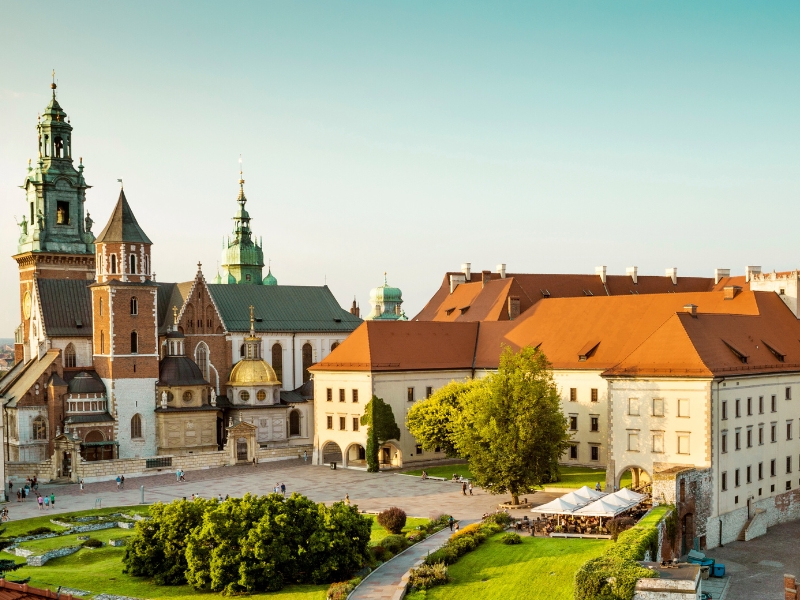
The Royal Road ends at Wawel Cathedral on the castle hill. The present Gothic church was consecrated in the 14th century, and from 1320 to 1764 it was the place where Polish kings were crowned, in front of the high altar. Inside is the shrine of St Stanislaus, a medieval bishop of Kraków, with a silver coffin made in 1669 to 1671 under a black marble canopy.
The most famous of the side chapels is the Sigismund Chapel, built between 1517 and 1533 by the Florentine architect Bartolomeo Berrecci for King Sigismund I the Old. In the crypts lie not only kings but also national heroes and poets: the poet Adam Mickiewicz was laid to rest here in 1890, Juliusz Słowacki in 1927, and Marshal Józef Piłsudski is buried here too. Karol Wojtyła said his first Mass as a priest in the crypt on 2 November 1946.
- The gilded dome of the Sigismund Chapel on the south side, easy to spot from the courtyard.
- The Sigismund Bell in its tower, installed in 1521 and weighing almost 13 tonnes; it rings only on great religious feasts and occasions of national importance.
Isaac Synagogue
In Kazimierz, south-east of Wawel, the Isaac Synagogue on Kupa Street is often called the most architecturally important of Kraków's old synagogues. It was built between 1638 and 1644 in Baroque style and is named after its founder, Izaak Jakubowicz, known as Isaac the Rich, a banker to King Władysław IV. A Hasidic story, told by Rebbe Simcha Bunim of Peshischa, says that Isaac dreamed of a treasure under a bridge in Prague, travelled there, and was told by a soldier of his own dream of a treasure under a poor Jew's stove in Kazimierz; Isaac went home and found it under his own stove.
In December 1939 the Gestapo ordered Maksymilian Redlich to burn the synagogue's Torah scrolls; he refused and was shot. The Nazis wrecked the interior, and a fire in 1981 caused more damage. The building was returned to the Jewish community in 1989 and is again an active Orthodox synagogue.
- The painted Hebrew prayers on the walls, uncovered when conservators removed later layers of paint, and the Baroque stucco wreaths and garlands on the vaulted ceiling.
How to see them in one walk
Start at St Florian's Church on Matejko Square and walk south past the Barbican and through St Florian's Gate into Floriańska Street, which brings you to the Main Market Square and the Town Hall Tower. Continue down Grodzka Street to the Church of Saints Peter and Paul and on to Wawel Hill and its cathedral. From the foot of Wawel it is a short walk south-east to Kazimierz and the Isaac Synagogue on Kupa Street.
See Kraków with World City Trail
Our Kraków scavenger hunt turns the old town into a game you play on your phone. The route links 10 stops, from the Town Hall Tower to the Avenue of Stars, and the Town Hall Tower, the Barbican, the Church of Saints Peter and Paul and Wawel Cathedral are all stops, along with the Cloth Hall, St Mary's Basilica, St Florian's Gate, Plac Szczepański and the Copernicus statue. St Florian's Church and the Isaac Synagogue are not on the route. At each stop you solve a puzzle and learn a story, at your own pace.
There is also a self-guided walking tour and an outdoor escape game in Kraków, for people who prefer a different format.
Play the Kraków scavenger hunt →
Take the self-guided walking tour of Kraków →
Play the outdoor escape game in Kraków →
Facts checked in October 2026.