
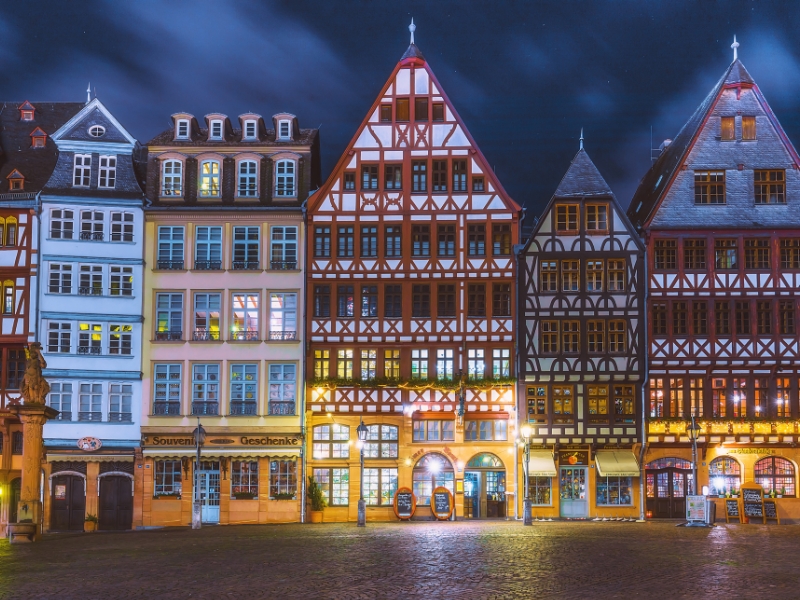
Frankfurt is known for its bank towers, but its centre is full of older stories, and this guide links seven of them: the Alte Oper, the Goethe monument, the Goethe House, the Römerberg, the Stadthaus am Markt, the Historisches Museum and, a little further out, the old Bonames airfield. Most of them were badly damaged in the Second World War and brought back by the city and its citizens, so together they also tell the story of how Frankfurt rebuilt its memory.
Alte Oper
Frankfurt's old opera house was designed by the Berlin architect Richard Lucae. Building began in 1873, and it opened on 20 October 1880. Bombs gutted it in 1944, but many of its outer walls survived, and for decades it stood as a ruin. A politician, Rudi Arndt, called it Germany's most beautiful ruin and suggested blowing it up, which earned him the nickname Dynamite Rudi. Citizens thought otherwise: from 1953 an initiative raised 15 million Deutschmarks for its reconstruction, and it reopened as a concert hall on 28 August 1981, Goethe's birthday.
- The inscription on the frieze, Dem Wahren, Schönen, Guten: to the true, the beautiful, the good.
- The Opernplatz in front, which still carries the name of the opera house the building once was, although since 1981 it has been a concert hall.
Goethe monument
The bronze Goethe on the Goetheplatz was designed by Ludwig Schwanthaler and unveiled on 22 October 1844. Its casting in Munich has a sad story: the head of the royal foundry, Johann Baptist Stiglmaier, was dying, his nephew Ferdinand von Miller supervised the work, and Stiglmaier died a few hours after hearing that the cast had succeeded. In September 1944 a bomb blast threw the statue off its base and broke off its head and arms. Citizens buried the pieces to save them from metal thieves; after restoration it stood for decades in the Gallusanlage park and came back to the Goetheplatz in 2007, now facing north instead of south.
- The reliefs on the pedestal, which show figures from Goethe's works, among them Faust with Mephisto, Iphigenia and Orestes, and the Erlking.
- Minerva on the front of the pedestal, leaning on a column with symbols of Goethe's scientific interests, from botany to his theory of colours.
Goethe House
Johann Wolfgang von Goethe was born in this house on the Großer Hirschgraben on 28 August 1749, and it was here that he wrote Götz von Berlichingen, The Sorrows of Young Werther and the first drafts of Faust. The Freies Deutsches Hochstift, a learned society, bought the house in 1863 and opened it to the public. On 22 March 1944 it was destroyed in an air raid. It was rebuilt from 1947 and reopened in 1951 by Theodor Heuss, then President of West Germany.
- The staircase railing, which is original: it was dug out of the rubble and restored.
- The Deutsches Romantik-Museum next door, opened in 2021, which can be visited on the same ticket as the house.
Römerberg
The Römerberg is the main square of the old town and has been the political centre of Frankfurt since the Middle Ages. On its west side stands the Römer, the town hall: on 11 March 1405 the city council bought two houses, the Römer and the Goldener Schwan, and made them its seat, and the city government has stayed here ever since. When emperors were crowned in the cathedral, the celebrations moved to the Römer and the square below. Less proudly, the square was also the scene of a Nazi book burning in 1933.
The air raid of 22 March 1944 burned out the Römer and most of the old town. The facade was largely restored by 1952 and the town hall reopened in 1955. Upstairs, the Kaisersaal is lined with 52 portraits of emperors, painted between 1838 and 1853. In winter the square holds the Frankfurt Christmas Market.
- The three stepped gables of the Römer front, and the balcony added in a neo-Gothic redesign at the end of the 19th century.
- The Fountain of Justice in the middle of the square: Justitia here wears no blindfold, unlike most figures of justice. A fountain has stood on this spot since 1543; the bronze figure dates from 1887, paid for by a wine merchant, Gustav Manskopf.
Stadthaus am Markt
Between the Römerberg and the cathedral stands the Stadthaus am Markt, a new building that opened in 2016 as part of the project that rebuilt the old town between the two. It is used for exhibitions and events, but its real purpose is underneath: it shelters the remains of the Kaiserpfalz, the royal palace that Louis the Pious, son of Charlemagne, had built here around 815 to 822. The building stands on the site of the palace's great hall, and the excavated walls, shown in an archaeological garden since the 1970s, are now protected from the weather.
- The exhibition Kaiserpfalz Franconofurd, opened in 2018, where you can walk among the foundations of the Carolingian palace.
Historisches Museum
Frankfurt's city history museum was founded in 1878 and moved in 1955 to the Saalhof, a group of old buildings on the Main riverbank close to the Römerberg. It reopened after a long renovation of its old buildings in 2012 and added a new building, opened on 7 October 2017. It is the place to understand what the old town was like before the bombs and how it changed afterwards.
- The large model of the old town by the Treuner brothers, which shows Frankfurt's centre as it looked before the destruction of the Second World War.
- The museum's position by the river, a short walk from the Eiserner Steg footbridge and the old bridge over the Main.
Bonames airfield
The Alter Flugplatz in Bonames, by the river Nidda on the northern edge of the city, is not in the old town but tells a different Frankfurt story. In 1951 and 1952 the US Army set up a helicopter base here on a former airfield, and it was used until it closed on 18 August 1992. The city bought the site, and in 2003 and 2004 it was turned into a nature and leisure area that won the German Landscape Architecture Prize in 2005: much of the concrete was broken up, while the runway and the control tower were kept.
- The old control tower, now home to a café, and the bridge over the Nidda named after the writer Robert Gernhardt, with a bronze of the Grüngürteltier, the comic animal he invented for Frankfurt's green belt.
How to see them in one walk
Start at the Alte Oper and walk south-east to the Goethe monument on the Goetheplatz, then on to the Goethe House on the Großer Hirschgraben. From there continue past St Paul's Church to the Römerberg, walk through the rebuilt old town to the Stadthaus am Markt and the cathedral, then go down to the river for the Historisches Museum and finish on the Eiserner Steg or the old bridge over the Main. Keep the Bonames airfield for another day: it lies on the northern edge of the city and is best reached by public transport or bike.
See Frankfurt with World City Trail
Our Frankfurt scavenger hunt turns the old town into a game you play on your phone. The route links 10 stops, from the Alte Oper to the old bridge over the Main, and the Alte Oper, the Goethe monument, the Goethe House, the Römerberg, the Stadthaus am Markt and the Historisches Museum are all stops, along with St Paul's Church, the cathedral and the Eiserner Steg. The Bonames airfield is not on the route. At each stop you solve a puzzle and learn a story, at your own pace.
There is also a self-guided walking tour and an outdoor escape game in Frankfurt, for people who prefer a different format.
Play the Frankfurt scavenger hunt →
Take the self-guided walking tour of Frankfurt →
Play the outdoor escape game in Frankfurt →
Facts checked in October 2026.