
Innsbruck was a Habsburg residence for centuries, and this guide follows what the dynasty and the Tyroleans left behind: the Hofburg palace and the Court Church with Emperor Maximilian's tomb, the Leopold Fountain opposite, St Anne's Column on Maria-Theresien-Straße, the Ferdinandeum state museum, Ambras Castle in the hills above town and Frau Hitt, the rock on the Nordkette that comes with a legend. Five of them sit within a short walk of each other on the edge of the old town.
Hofburg Innsbruck
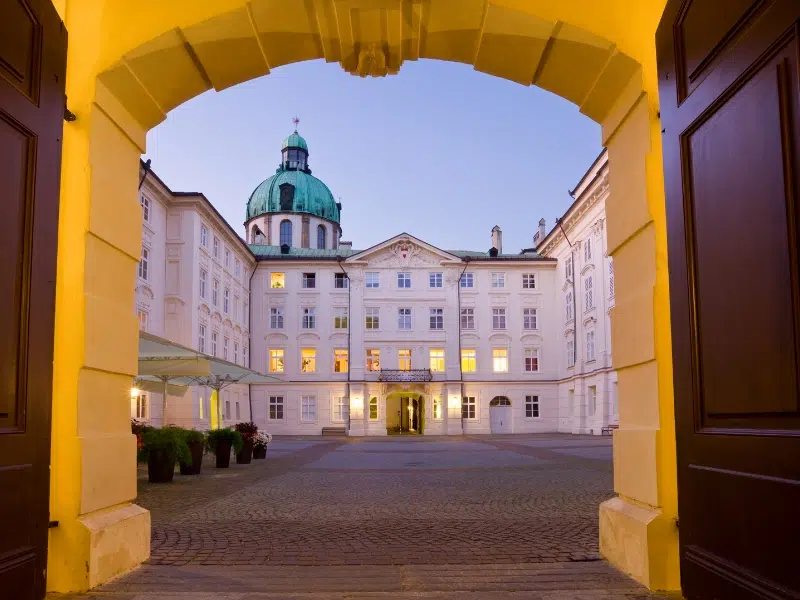
The palace began under Archduke Sigismund in the mid-15th century, and Emperor Maximilian I enlarged it in late Gothic style; in 1499 his court painter Jörg Kölderer turned an old city gate into the Heraldic Tower. What you see today is mostly the work of Empress Maria Theresa, who had the Hofburg rebuilt in Baroque style between 1754 and 1776, with the long main façade on the Rennweg. Her husband, Emperor Francis I, died here suddenly in August 1765 during the wedding celebrations of their son Leopold, and the empress turned the room where he died into a chapel. Today the palace is a museum with Maria Theresa's rooms, the apartment of Empress Elisabeth, a furniture museum and portrait galleries.
- The Giants' Hall, with a ceiling fresco painted by Franz Anton Maulbertsch in 1775–1776; the name comes from earlier paintings of Hercules in the room.
- The cobbled inner courtyard and the white-and-gold Rococo memorial chapel for Francis I.
Court Church (Hofkirche)
Emperor Ferdinand I completed the Hofkirche in 1553 as a memorial to his grandfather Maximilian I. The centrepiece is Maximilian's black marble cenotaph, which took more than 80 years to finish, guarded by 28 larger-than-life bronze statues of ancestors, relatives and heroes. The emperor himself is not here: his will asked for burial in Wiener Neustadt, where his tomb remains, so the monument in Innsbruck is empty. The church is also the grave of Andreas Hofer, the leader of the Tyrolean uprising of 1809.
- The bronze King Arthur, designed by Albrecht Dürer and dated 1513, in full armour among the Habsburg relatives.
- The Silver Chapel, consecrated in 1578, with a silver altar of the Virgin and the tombs of Archduke Ferdinand II and his wife Philippine Welser.
St Anne's Column (Annasäule)
The column in the middle of Maria-Theresien-Straße recalls 26 July 1703, St Anne's Day, when the last Bavarian troops who had invaded Tyrol during the War of the Spanish Succession were driven out. The Tyrolean estates vowed a monument the following year, and it was blessed on 26 July 1706. The sculptor Cristoforo Benedetti from Trentino carved it from red Kramsach marble. On top stands the Virgin on a crescent moon; on the pedestal are St Anne, St George with the dragon, and St Cassian and St Vigilius, patrons of the dioceses of Brixen and Trent. The figures you see are copies: the Virgin was replaced in 1958 and the saints in 2009.
- Stand at the column and look south down the street: on a clear day the mountains close the view, and north the Nordkette rises behind the old town.
Leopold Fountain (Leopoldsbrunnen)
Opposite the Hofburg on the Rennweg, Archduke Leopold V, ruler of Tyrol from 1623, rides a rearing horse. The bronzes were cast from 1622 and are usually credited to Caspar Gras, who achieved something new here: the horse is balanced freestanding on its hind legs, without its tail as a third support, helped by a lead weight inside the tail. Around it are allegorical figures of goddesses and sea gods. The statues were put together as a fountain in 1893; the fountain was taken down in 2015 for the building of the Haus der Musik and set up again a few metres away, with the rider unveiled in 2019.
Tiroler Landesmuseum Ferdinandeum
The Ferdinandeum on Museumstraße is Tyrol's main museum of art and history, founded in 1823 as an association and housed since 1845 in a Neo-Renaissance building. Its collections run from prehistoric and Roman finds to Gothic art, works by Lucas Cranach the Elder and Rembrandt, a Dutch collection, modern painting by Albin Egger-Lienz and Klimt, and violins by Jakob Stainer. Note that the museum is closed from July 2024 until 2027 for restoration and expansion, so check before you go. The historic façade, with two sphinxes at the entrance and a statue of Tyrolia on the roof, is part of the restoration.
Frau Hitt
Look up from the city to the Nordkette and you will see a rock pinnacle of 2,270 metres that, from some angles, looks like a woman on horseback. This is Frau Hitt. According to legend, she was a giant queen known for her greed and vanity; when a beggar asked her for food, she offered him only a stone, and he cursed her so that she and her horse were turned to stone. It is a landmark you see rather than visit, unless you are a climber.
Ambras Castle
In the hills above the city, Archduke Ferdinand II rebuilt a medieval fortress as a Renaissance castle for his wife Philippine Welser, whom he had married in secret, and the family lived there from 1567 to 1595. Ferdinand was a passionate collector, and his Chamber of Art and Curiosities is the only Renaissance collection of its kind still shown in its original place, which makes Ambras one of the oldest museums in the world. Since 1950 it has been run by the Kunsthistorisches Museum in Vienna.
- The Spanish Hall, built in 1569–1572, with 27 full-length portraits of the rulers of Tyrol, and the armouries with suits of armour from Maximilian I onwards.
How to see them in one walk
Start at St Anne's Column on Maria-Theresien-Straße and take a short detour to the Ferdinandeum on Museumstraße. Then walk north into the old town and round to the Rennweg, where the Hofburg, the Court Church and the Leopold Fountain stand side by side. Keep your eyes on the Nordkette for Frau Hitt along the way, and plan Ambras Castle as a separate trip by bus or bike.
See Innsbruck with World City Trail
Our Innsbruck scavenger hunt turns the old town into a game you play on your phone. The route links 10 stops, from the Triumphal Arch to St James' Cathedral, and St Anne's Column, the Ferdinandeum, the Hofburg, the Court Church and the Leopold Fountain are all stops, along with Eduard-Wallnöfer-Platz, the City Tower and the Golden Roof. At each stop you solve a puzzle and learn a story, at your own pace.
There is also a self-guided walking tour and an outdoor escape game in Innsbruck, for people who prefer a different format.
Play the Innsbruck scavenger hunt →
Take the self-guided walking tour of Innsbruck →
Play the outdoor escape game in Innsbruck →
Facts checked in October 2026.