
This guide covers six more places in the old centre of Bruges, from the merchants' square of Jan van Eyckplein in the north to St Salvator's Cathedral in the south: the Markt, the City Hall on the Burg, the Rosary Quay, the Bonifacius Bridge and the cathedral. They are the squares, quays and bridges that tell the story of Bruges as a medieval trading city and as a town that later rebuilt and restored itself. They line up neatly along one walk through the historic centre.
The Markt
The Markt has been the main square of Bruges since the Middle Ages and covers about one hectare. Fairs, jousts, tournaments and executions all took place here, and the first international annual fair was held around 1200. On its south side stands the Belfry, the tower that still dominates the square. In 1995 and 1996 the square was fully renovated, the parking spaces were removed, and it has been mostly free of traffic since.
In the middle stands a statue of Jan Breydel and Pieter de Coninck, unveiled in 1887. In May 1302 the two men led the uprising of Bruges against the French garrison, and in July of the same year the Flemish militias defeated the French knights at the Battle of the Golden Spurs. On the east side, the building with the pinnacles is the Provinciaal Hof, the seat of the provincial government. It stands where the Waterhalle once was, a covered hall over a canal where boats unloaded goods in the middle of the city; the present neo-Gothic building went up after a fire in 1878.
- The house at number 16 on the corner, now a café, where the young Archduke Maximilian of Austria was held prisoner by the citizens of Bruges in 1488.
- The rows of gabled houses on the north and west sides, many of them now restaurants with terraces.
City Hall
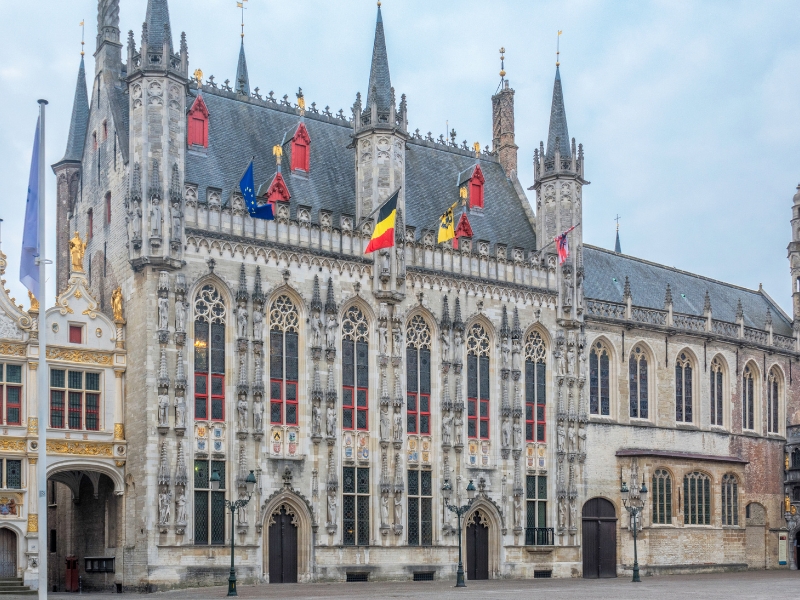
A short walk east, on the Burg square, stands the City Hall of Bruges. Count Louis laid the first stone in 1376 and the building was finished in 1421, which makes it one of the oldest city halls in the Low Countries. It was among the first great late Gothic town halls in Flanders, and others, such as those of Brussels and Leuven, came later. Its sandstone facade is covered with niches for statues of the counts and countesses of Flanders. All the original statues were destroyed during the French Revolution; the ones you see today are later replacements.
Inside, a wide staircase leads to the Gothic Hall on the first floor, where the city council still meets and couples get married. Its timber vault keeps its painted 14th-century consoles. The murals of scenes from the history of Bruges, by the painter Albrecht De Vriendt, were added during the restoration of 1895 to 1905. The Burg itself is one of the scavenger hunt stops. The square takes its name from the castle of the Counts of Flanders, and until the end of the 18th century St Donatian's Cathedral stood here too, until it was demolished after the French Revolution.
- The facade statues and coats of arms, between the tall Gothic windows.
- In the Gothic Hall, the timber vault and its painted consoles, and the murals telling the story of the city.
- On the ground floor, the life-size portraits of former rulers, from mayors to kings and emperors, including Napoleon.
Jan van Eyckplein
In the Middle Ages this square at the end of the Spiegelrei canal was where goods arrived by water and merchants did business, and the buildings around it still show it. The statue in the middle is of the painter Jan van Eyck, who worked in Bruges and died here in 1441. It was made in 1878 by the sculptor Hendrik Pickery. Until the First World War a weekly potato market was held here, and the square was known as the Petattenmarkt. Jan van Eyckplein is the first stop of our scavenger hunt.
- The Tolhuis, the former customs house from 1477, where duties were charged on goods arriving by canal.
- The Poortersloge, the slim tower-like building built in the late 14th and early 15th centuries, where the richest citizens met and received their trading partners.
- On the corner of the Poortersloge at Academiestraat, the little bear statue the people of Bruges call the beertje van de loge, a reminder of the Society of the White Bear that met here.
Rosary Quay
The Rozenhoedkaai, or Rosary Quay, is a corner of the canal where it turns sharply, and from the waterside you get one of the best-known views of Bruges: old houses rising out of the water and the Belfry behind them. In the Middle Ages this was the city's salt harbour, at a time when salt was a valuable commodity. Come early in the morning for the calmest water and the best reflections. The quay is one of the stops of our scavenger hunt.
Bonifacius Bridge
This small stone bridge over the canal behind the Church of Our Lady looks like it has been here for centuries, but it was built in 1910, designed to blend into the medieval setting. It is one of the most photographed corners of the city, with old brick houses on both sides of the water. By tradition, couples kiss on it, and a romantic legend says the first person you meet after crossing is the one you will marry. The bridge is one of the scavenger hunt stops.
- Next to the bridge, a bust of Juan Luis Vives, the Spanish humanist who spent much of his life in Bruges and married here; behind it, the walls of the Gruuthuse palace.
St Salvator's Cathedral
Sint-Salvator was a parish church from the 10th century, and the present building was begun around 1250. It only became a cathedral in 1834, after Belgium's independence, because the old cathedral of Bruges, St Donatian's on the Burg, had been demolished. After a fire in 1839 the English architect Robert Chantrell gave the brick west tower its present top in a Romanesque style; the tower is about 99 metres tall. The cathedral is one of the stops of our scavenger hunt.
- In the choir and nave, the tapestries woven in Brussels by Jasper van der Borcht in 1731, which were ordered for St Donatian's and moved here, together with the paintings they were based on.
- The organ, begun by Jacobus Van Eynde in 1717 to 1719 and rebuilt several times since.
How to see them in one walk
Start at Jan van Eyckplein and follow the canal past the Poortersloge and the Tolhuis, then walk south to the Markt. From the square, take Breidelstraat to the Burg and the City Hall. Leave the Burg through the little passage of the Blinde Ezelstraat towards the canal and the Rosary Quay, then follow the water along the Dijver to the Bonifacius Bridge. Finish at St Salvator's Cathedral, a short walk west. On the way you also pass the sights covered in our first Bruges guide: the Belfry, the Basilica of the Holy Blood, the Church of Our Lady and Sint-Janshospitaal.
See Bruges with World City Trail
Our Bruges scavenger hunt turns the old town into a game you play on your phone. The route links 10 stops, starting at Jan van Eyckplein, and the Burg with the City Hall, the Rosary Quay, the Bonifacius Bridge and St Salvator's Cathedral are all on it, along with the City Theatre, the Belfry, the Church of Our Lady, the Nepomucenus Bridge and the Choco-Story chocolate museum. At each stop you solve a puzzle and learn a story, at your own pace.
There is also a self-guided walking tour and an outdoor escape game in Bruges, for people who prefer a different format.
Play the Bruges scavenger hunt →
Take the self-guided walking tour of Bruges →
Play the outdoor escape game in Bruges →
Facts checked in October 2026.