
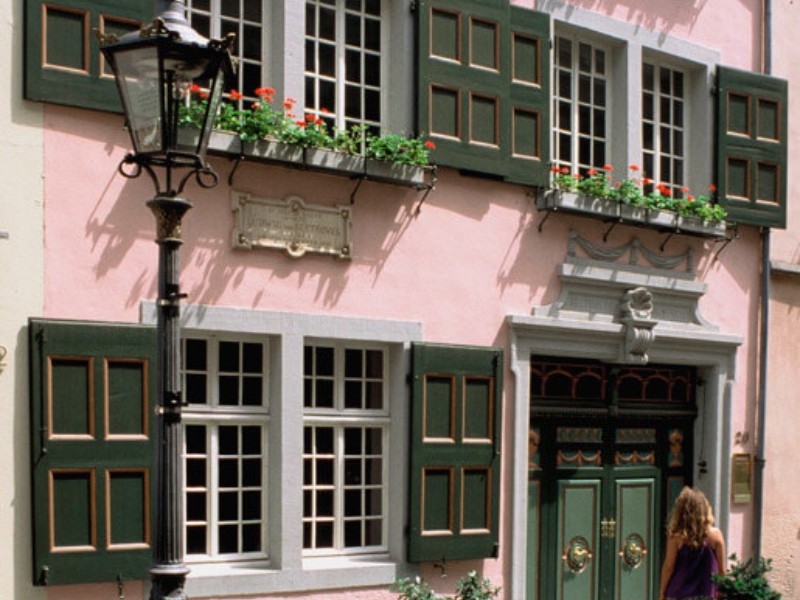
Ludwig van Beethoven was born in Bonn in 1770 and lived here until he left for Vienna at 21. This guide follows his traces through the old town, from the main station to the house where he was born: the Old Cemetery where his mother lies, the Minster, the St Martin's fountain, the Beethoven monument, the Old Town Hall and the church that keeps his baptismal font.
Bonn Hauptbahnhof (main station)
Bonn's main station is the start of our scavenger hunt. The first railway, to Cologne, reached Bonn in 1844, with a station further south; the present station building was designed by Carl Schellen, begun in 1883 and opened in April 1885. It is a listed building. When Bonn became the capital of West Germany in 1949, politicians and civil servants commuted through here, and a platform for government use was built that year (it was removed in a rebuild in 1991–1992).
The Old Cemetery (Alter Friedhof)
A few minutes from the station lies one of the most remarkable cemeteries in Germany. It was laid out in 1715 by the elector Joseph Clemens, who consecrated it himself, as the first burial ground outside the city walls. Beethoven's mother, Maria Magdalena van Beethoven, is buried here, and so are the composers Robert and Clara Schumann, Schiller's widow Charlotte von Schiller and the writers August Wilhelm Schlegel and Ernst Moritz Arndt. It is not on our scavenger hunt route, but it is a quiet detour at the start.
- The Schumann grave, the cemetery's best-known monument, unveiled in 1880.
- The small Romanesque Georgskapelle, a 13th-century chapel of the Teutonic Order that was taken down in Ramersdorf on the other side of the Rhine and rebuilt here in 1846–1847.
The Minster (Bonner Münster)
The Minster is one of the oldest churches in Germany. Its story starts with a memorial chapel in the 4th century over the graves of Cassius and Florentius, Bonn's patron saints; according to legend they were Roman soldiers of the Theban Legion who were beheaded on this spot for their faith. The present church, with its five towers, was built mostly between the 11th and 13th centuries, in a late Romanesque style with some early Gothic elements, and was made a minor basilica in 1956.
While the electors lived in Bonn, the Minster served as the main church of their residence. Its late Romanesque design was a model for the Kaiser Wilhelm Memorial Church in Berlin. The Minster is one of the stops on our scavenger hunt route.
- The two large stone heads of Cassius and Florentius on Martinsplatz, by the side of the church, set up in 2002.
- The relief of St Martin on horseback at the main entrance, and the outline of the old St Martin's church, demolished in the early 19th century, marked in the paving of Martinsplatz.
The Martinsbrunnen (St Martin's Fountain)
In front of the west front of the Minster stands a bronze fountain from 1902 by the sculptor Heinrich Götschmann. It shows three children catching geese, with an older boy holding a lantern at the top: a reference to the old custom of paying rent with geese around St Martin's Day and to the lantern processions held every 11 November. The original bronzes were melted down in the Second World War and recast in 1958 from the original moulds. Locals also call it the Gänsebrunnen, the goose fountain, and it is one of our scavenger hunt stops.
The Beethoven Monument (Beethoven-Denkmal)
The bronze Beethoven on Münsterplatz was the first public monument to the composer. It was made by Ernst Julius Hähnel and unveiled on 12 August 1845, during the first Beethoven festival, held for his 75th birthday. Franz Liszt gave a large sum of his own money towards the monument. Queen Victoria came to watch from the balcony of the Palais Fürstenberg behind it, and noted in her diary that when the cover came off, the royal party only saw the statue from behind.
Beethoven holds a quill pen in his raised right hand, a sign of musical inspiration. The monument is one of the stops on our scavenger hunt route.
- The four reliefs on the pedestal, which stand for the kinds of music he wrote: fantasy, sacred music, the symphony and dramatic music.
- The former Palais Fürstenberg behind the statue, now the main post office, from whose balcony the queen watched.
The Old Town Hall (Altes Rathaus)
The rococo town hall on the market square was built in 1737–1738 by the court architect Michael Leveilly, the same man who later built the Koblenz Gate. The outside staircase, with its gilded railing added in 1765, became the place where Bonn welcomed famous guests while it was the capital: Charles de Gaulle spoke here in 1962, John F. Kennedy in 1963 and Mikhail Gorbachev in 1989, and visiting heads of state signed the city's Golden Book.
Bombing in October 1944 left only the outer walls, and the building was rebuilt by 1950 without its original stucco. The city administration moved out in 1978, but the mayor still has an office here and the town hall is used for receptions and weddings. It is one of our scavenger hunt stops.
- The outside staircase with its gilded railing, best seen from the middle of the market square.
St Remigius (Minoritenkirche)
This tall Gothic church on Brüdergasse was begun in the 1270s by the Franciscans and finished in the 14th century; like many churches of the mendicant orders, it has no tower, only a small turret on the roof. It took the name St Remigius after the old parish church of that name, where Beethoven was baptised on 17 December 1770, was struck by lightning in 1800 and pulled down. The marble font from that church was brought here in 1806. The young Beethoven also played the organ in this church; that instrument was lost in the Second World War. The church is not on our scavenger hunt route but lies a short walk from the market.
- The baptismal font in which Beethoven was baptised.
The Beethoven House (Beethoven-Haus)
Beethoven was born in the attic of the house at Bonngasse 20 in December 1770; he was baptised on 17 December, and his exact birthday is not known. In 1889 a group of citizens founded the Beethoven-Haus association to buy the house, which was at risk of being torn down, and opened it as a museum. Today the association runs the museum, a research library and archive, and a chamber music hall next door, opened in 1989.
The museum describes its holdings as the largest and most varied Beethoven collection in the world, with original manuscripts such as those of the Moonlight Sonata and the Pastoral Symphony. The Beethoven House is one of the stops on our scavenger hunt route.
- The ear trumpets and the conversation books he used as he lost his hearing.
- His last piano, made by Conrad Graf in Vienna, and the viola he played in the Bonn court orchestra.
How to see them in one walk
Start at the main station and, if you have time, step into the Old Cemetery first. Then walk into the old town to the Minster, with the Martinsbrunnen in front of it and the Beethoven monument on Münsterplatz on its other side. Continue to the market square and the Old Town Hall, turn into Brüdergasse for St Remigius, and finish at the Beethoven House in Bonngasse.
See Bonn with World City Trail
Our Bonn scavenger hunt turns the city centre into a game you play on your phone. The route links 10 stops, from the main station to the Electoral Palace and the Egyptian Museum. The main station, the Minster, the Martinsbrunnen, the Beethoven monument, the Beethoven House and the Old Town Hall are all stops; the Old Cemetery and St Remigius are close to the route.
There is also a self-guided walking tour and an outdoor escape game in Bonn, for people who prefer a different format.
Play the Bonn scavenger hunt →
Take the self-guided walking tour of Bonn →
Play the outdoor escape game in Bonn →
Facts checked in October 2026.